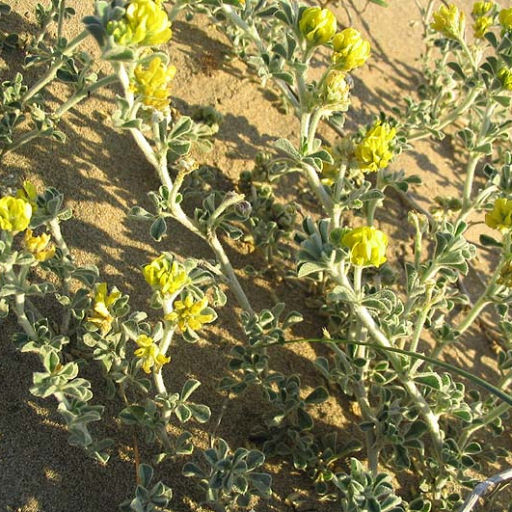
Plant Overview
Known as the Sea Medick, this silver-tongued beauty is a master of the shoreline. Unlike its inland cousins, Medicago marina has evolved to thrive where most plants wither: in the salty, sun-scorched dunes of the Mediterranean and Atlantic coasts. It acts as a natural guardian of the sand, weaving thick, velvet-soft carpets that help stabilize shifting dunes and prevent coastal erosion.
🔍 How to Identify
- 🌿 Silver Foliage: The entire plant is covered in a dense, felt-like layer of tiny white hairs, giving it a distinctive shimmering grey or silvery-green appearance.
- 🌼 Pea-Like Blooms: It produces small, bright yellow flowers clustered together, sporting the classic "keel and wing" shape typical of the legume family.
- 🌀 Spiral Seed Pods: After flowering, it develops fascinating seed pods that are coiled into tight, fuzzy spirals, often resembling tiny, hairy snail shells.
🏡 In Your Garden
- 🏖️ Coastal Specialist: Because it originates from sandy beaches, it requires extremely well-draining soil. If planted in heavy clay, its roots will suffocate; think of it as a "desert plant of the sea."
- 🧬 Self-Sufficient Feeder: Like other members of the pea family, it has a symbiotic relationship with soil bacteria to "fix" nitrogen. This means it can grow in nutrient-poor sand where other plants would starve, actually improving the soil quality as it grows.
- 🌊 Salt Spray Hero: It is one of the few decorative groundcovers that can handle direct salt spray from the ocean, making it an ideal choice for seaside rockeries or "dry" Mediterranean-style gardens.
⚠️ Safety & Toxicity
- ✅ General Safety: Medicago marina is considered non-toxic to humans and common household pets.
- 🐾 Pet Friendly: While not intended for consumption, it lacks the high levels of saponins or alkaloids found in more dangerous legumes, making it a safe choice for gardens shared with curious dogs or cats.
✨ Fun Fact
The dense white hairs covering the leaves aren't just for soft texture—they act as a biological "sunscreen." By reflecting intense UV rays away from the leaf and trapping a thin layer of humid air against the surface, the plant can survive heatwaves that would bake other vegetation crisp!

Detailed Care Instructions
To grow Medicago marina plants, also known as strand alfalfa or beach medick, follow these steps:
- Climate and soil requirements: Medicago marina plants prefer coastal or Mediterranean climates with well-draining, sandy or loamy soil. They can tolerate salt spray and are resistant to drought, making them suitable for coastal gardens.
- Seed collection: Collect seeds from existing Medicago marina plants. The seeds are small and produced in pods. Wait until the pods turn brown and begin to crack open before collecting them.
- Seed scarification: Medicago marina seeds have a hard outer coat, which can inhibit germination. To improve germination rates, scarify the seeds by lightly scratching the coat with sandpaper or nicking it with a knife. This process helps water penetrate the seed during germination.
- Pre-soaking: After scarification, soak the seeds in water for 24 hours to further enhance germination rates.
- Site preparation: Clear the planting area of weeds and stones. Ensure the soil drains well and is free from excessive moisture, as Medicago marina plants do not thrive in waterlogged conditions.
- Sowing seeds: Broadcast the pre-soaked and scarified seeds evenly across the prepared area. Lightly press them into the soil, but do not bury them too deep.
- Watering: Gently water the area after sowing the seeds, keeping the soil moist but not waterlogged. Continue watering regularly to support their growth.
- Thin out seedlings: Once the seedlings emerge, thin them out to allow proper spacing for growth. Keep the healthiest and strongest seedlings, spacing them about 6-8 inches apart.
- Maintenance: Control weed growth around the Medicago marina plants by removing any competing plants. If needed, water occasionally during dry periods to maintain soil moisture.
- Harvesting: Medicago marina plants can be cut for forage or left to grow for their ornamental value. If you plan to harvest them, cut the plants above the soil level when they reach about 12-18 inches in height.
Remember to regularly monitor the plants for signs of pest or disease issues and address them promptly.

Place in a bright room that is sun drenched almost all day. Or directly in a south-facing window.

To properly water this plant, you should first assess the soil moisture level. Insert your finger into the soil and check if it is dry or moist. If it is dry up to a depth of about an inch, it is time to water the plant.
When watering, avoid wetting the leaves and focus on watering the root zone directly. Water thoroughly until the soil is moist, but not waterlogged. Allow excess water to drain out of the pot or planting area.
During the growing season, water at least twice a week or more frequently if the plant is in a sandy soil and the weather is particularly hot and dry. Reduce watering during the dormant season.
Remember that overwatering this plant can cause root rot and other fungal diseases, so it is better to err on the side of underwatering rather than overwatering.
Fertilizing instructions for the Medicago Marina plant:
- Prior to fertilizing, ensure that the plant is well-established in its growing location, typically after 4-6 weeks.
- Choose a balanced, water-soluble fertilizer specifically formulated for legume plants or general-purpose fertilizer with an NPK ratio of around 10-10-10.
- Dilute the fertilizer according to the instructions provided on the packaging. Generally, a dilution ratio of 1 teaspoon of fertilizer per gallon of water is suitable.
- Apply the diluted fertilizer around the base of the Medicago Marina plant, avoiding direct contact with the leaves or stems.
- Water the plant thoroughly after fertilizing to help distribute the nutrients into the soil.
- It is recommended to fertilize the Medicago Marina plant regularly during the growing season, which is typically spring and summer. Follow the fertilizer manufacturer’s guidelines for frequency, usually every 2-4 weeks.
- As autumn approaches, gradually reduce the frequency of fertilization and stop entirely during winter dormancy.
- Monitor the plant regularly for any signs of nutrient deficiencies or excessive fertilization, such as yellowing leaves or burnt foliage. Adjust the fertilization schedule as needed.
- In addition to regular fertilization, consider incorporating organic matter or compost into the soil to improve its nutrient content and overall health of the Medicago Marina plant.
- Lastly, always read and follow the specific instructions provided by the fertilizer manufacturer for best results and to ensure the proper application and dosage.
Medicago Marina is a species of plant that requires well-draining soil to grow most effectively. This type of soil should contain a mixture of organic matter and sand in order to provide the necessary nutrients and drainage. The pH level of the soil should also be between six and eight.
The plant prefers soil that is slightly alkaline, and a soil that is too acidic may cause the plant to struggle or die. It's important to ensure that the soil remains moist, but not waterlogged, as this can also damage the plant. Heavy soil, such as clay, should be avoided as it can hold too much water and restrict root growth, but sandy soil may dry out too quickly.
Overall, the most suitable soil for Medicago Marina is one that is loose and light, drains well, and has a pH level within the optimal range. Testing the soil before planting and adjusting it as necessary is a good way to ensure the plant receives the conditions it needs to thrive.
Medicago marina, commonly known as ..., can be propagated through several methods. Here are some details on how to propagate this plant without mentioning its common names:
- Seeds: Collect ripe seeds from mature plants. Remove any dried pods and separate the seeds. Scarify the seeds by gently rubbing them with sandpaper or soaking them in warm water for a few hours. This helps improve germination rates. Sow the scarified seeds in a well-draining potting mix, lightly press them into the surface, and cover them with a thin layer of soil. Keep the soil slightly moist and place the pot in a warm and bright location, preferably with indirect sunlight. The seeds should germinate within a couple of weeks.
- Stem cuttings: Take 4-6 inch long cuttings from healthy and non-flowering stems. Make the cut just below a leaf node with a clean and sharp pair of pruning shears. Remove the leaves from the lower two-thirds of the cutting. Dip the cut end in a rooting hormone powder or gel to encourage root development. Plant the cutting in a pot filled with a well-draining growing medium, such as a mixture of perlite and peat moss. Water the cutting gently and cover it with a clear plastic bag or place it in a propagator to create a humid environment. Keep the pot in a warm location with indirect sunlight. The cutting should root within 4-6 weeks.
- Division: Mature Medicago marina plants can be divided to create new plants. Carefully dig up the plant, trying to minimize root damage. Gently separate the clumps into smaller sections, ensuring that each section has healthy roots and shoots. Replant the divisions in prepared, well-draining soil, ensuring the roots are adequately covered. Water the newly divided plants and place them in a well-lit area with indirect sunlight. Ensure they receive regular moisture and provide some protection from extreme weather conditions while they establish themselves.
- Rhizome division: Medicago marina has rhizomatous growth, which means it produces horizontal underground stems called rhizomes. To propagate using this method, dig up a mature plant and carefully separate the rhizomes. Ensure each divided rhizome has healthy roots and shoots attached. Replant the rhizomes at the desired location, ensuring they are positioned at the appropriate depth. Water the newly planted rhizomes and provide them with consistent moisture. Place them in a well-lit area with indirect sunlight. The rhizome divisions should establish themselves and produce new growth within a few weeks.
Remember to label your propagated plants to keep track of their growth and development. Provide proper care and maintenance to the propagated Medicago marina plants to ensure their successful establishment in the garden or desired location.








