Plant Overview
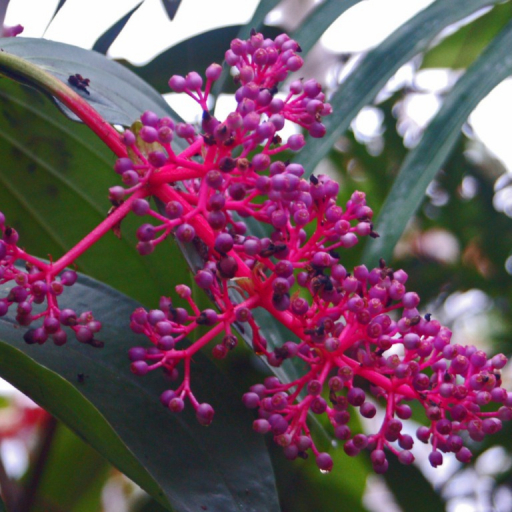
Known as the Showy Pink Lantern or Rose Grape, Medinilla speciosa is a royal-looking evergreen that hails from the misty mountain forests of Indonesia and the Philippines. Unlike your average houseplant, this beauty is an epiphyte, meaning in the wild, it lives tucked into the mossy crooks of high tree branches rather than in the ground. Its elegant, drooping pink flower clusters look like living chandeliers hanging beneath architectural, deep-green foliage.
🔍 How to Identify
- 🍃 Architectural Foliage: The leaves are large, leathery, and deeply ribbed with visible veins, often growing in a symmetrical "opposite" pattern along the stems.
- 🌸 Chandelier Blooms: It produces pendulous, pyramid-shaped clusters of waxy pink flowers that hang gracefully below the leaves.
- 🍇 Jewel-Like Berries: As the flowers fade, they are replaced by small, fleshy berries that transition from pink to a striking metallic purple-black.
🏡 In Your Garden
- ☁️ Humidity is Vital: Because it naturally lives in cloud forests, it craves high humidity. If the air is too dry, the flower buds may drop before they ever have a chance to dazzle you.
- 🌬️ Breezy Roots: It hates "wet feet." To mimic its home on a tree branch, use an airy orchid-bark mix rather than heavy potting soil to ensure the roots can breathe.
- ⛅ The Goldilocks Light: It needs bright, dappled light to trigger blooming. Direct midday sun is too harsh and will scorch the leaves, while deep shade will stop the "lanterns" from forming.
⚠️ Safety & Toxicity
- 🐾 Pet Friendly: Great news for furry friends! Medinilla speciosa is generally considered non-toxic to cats and dogs, making it a safe choice for pet-loving households.
- 👶 Mild Caution: While not poisonous, the sap can occasionally cause minor skin irritation for people with very sensitive skin, and the berries—while beautiful—are not meant for human consumption.
✨ Fun Fact
In its native habitats like Java, the berries are a favorite snack for tropical birds. These birds act as the plant's personal transport system, eating the seeds and depositing them onto high tree branches, allowing the Medinilla to grow far above the forest floor!

Detailed Care Instructions
| Humidity | Normal |
| Lighting | Shade |
| Difficulty | Medium |
| Hibernation | Cold Period |
| Temperature | 21°C - 25°C |
| Hardiness Zones | 10 - 11 |
Here are some steps you can follow to grow Medinilla speciosa, also known as the Philippine orchid.
- Choose a location: Medinilla speciosa prefers bright, indirect light. Find a spot in your home or garden that receives ample light but is protected from direct sunlight, which can scorch the leaves.
- Soil: Use a well-draining potting mix that retains some moisture. You can make your own mixture using equal parts peat moss, perlite, and potting soil.
- Watering: Keep the soil consistently moist but not waterlogged. Water the plant whenever the top inch of soil feels dry. Avoid letting the plant sit in standing water, as this can lead to root rot.
- Humidity: Medinilla speciosa thrives in high humidity conditions. You can increase humidity by misting the leaves regularly or placing a tray of water near the plant. Alternatively, use a humidifier.
- Temperature: This plant prefers warm temperatures between 70-80°F (21-27°C) during the day and slightly cooler temperatures at night.
- Fertilizer: Feed your Medinilla speciosa with a balanced houseplant fertilizer every 2-4 weeks during the growing season (spring and summer). Reduce or cease fertilization during the winter months.
- Pruning: If necessary, prune your plant to maintain its desired shape or to remove any dead or yellowing leaves.
- Support: Medinilla speciosa produces large, heavy flower clusters that may require support. Use stakes or trellises to provide stability for the plant.
- Repotting: As the plant grows, you may need to repot it every 2-3 years. Choose a new pot that is slightly larger than the current one and transfer the plant to fresh potting mix.
- Propagation: Medinilla speciosa can be propagated by stem cuttings. Take a 4-6 inch cutting with at least two nodes and remove the lower leaves. Plant the cutting in a well-draining potting mix and keep it warm and consistently moist until roots develop.
Remember to research and understand the specific care requirements of Medinilla speciosa, as individual plants may have varying needs.

Place in a window with dappled sun or a spot in the middle of a room. Or directly in a window facing west or east.
The ideal way to water this plant is to make sure the soil is thoroughly moistened but not waterlogged. It is recommended to use room temperature water as cold water can shock the roots. Water should be applied evenly around the plant and care should be taken not to wet the leaves, as this may lead to rot or infections. It is important to avoid under or overwatering, as both can cause harm to this plant. The frequency of watering depends on the humidity of the area, the size of the pot, and the temperature. Therefore, one should check the soil regularly by inserting a finger up to the first joint to ensure that the soil is neither too dry nor too wet. This will give a better indication of when it's time to water the plant.
To fertilize this plant, use a balanced fertilizer that is specifically designed for houseplants. Dilute the fertilizer with water according to the package instructions, and apply it to the soil around the plant. Be sure to avoid getting fertilizer on the leaves or stems of the plant, as this can cause damage. Fertilize the plant every two weeks during the growing season (spring and summer), and reduce the frequency to once a month during the dormant season (fall and winter).
The ideal soil for the Medinilla Speciosa plant is a lightweight, well-aerated mixture that allows for good drainage. It should contain a mix of organic matter, such as peat moss or compost, and coarse materials such as perlite or sand. The goal is to create a soil that is both moisture-retentive and allows for air flow to the roots. Adding some lime to the soil mix can help maintain the plant's preferred pH level. It is also important to ensure that the soil is not overly compacted, as this can prevent water from draining and cause root rot. The Medinilla Speciosa plant prefers a slightly acidic soil with a pH of around 5.5-6.5.
To propagate this specific plant, you will need to take stem cuttings. Select a healthy stem that is at least 4-5 inches long and has a few leaves on it. Cut the stem just below a node or where a leaf meets the stem.
Make sure to remove any leaves from the lower half of the stem, leaving only a few at the top. Dip the end of the stem in rooting hormone if you have it, although this is not necessary.
Next, fill a pot with soil that is well-draining and slightly moist. Make a hole in the soil with your finger or a pencil, and gently insert the cutting. Firmly press the soil around the base of the stem to keep it in place.
Water the cutting well, but make sure to not overwater it or let the soil become saturated. Keep the pot in a warm, humid environment with bright, indirect light. You can cover the pot with a plastic bag or put it in a closed terrarium to increase humidity.
The cutting should begin to develop roots within a few weeks, and after a few months, you can transplant it to a larger pot and treat it like a mature plant.








