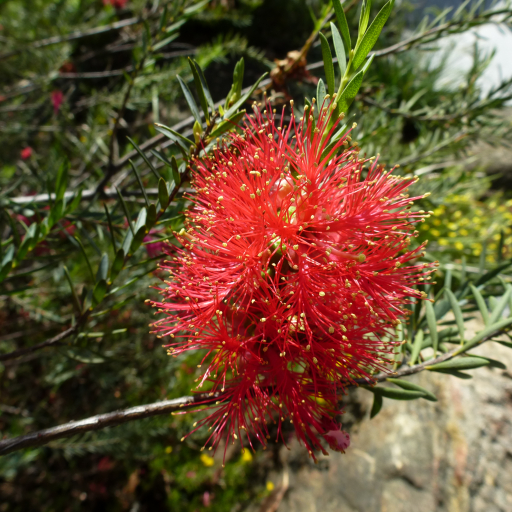
Plant Overview
Often called the Scarlet Honey Myrtle, this Australian native is a show-stopper that looks like it belongs in a vibrant coral reef rather than a dry landscape. Its fiery, brush-like blooms are famous for turning a quiet garden into a bustling hub for nectar-seeking birds and bees. Originating from the rugged sandy plains of Western Australia, it brings a wild, architectural beauty to any sun-drenched space.
🔍 How to Identify
- 🌸 Brilliant Blooms: The flowers are the star—intense scarlet or deep pink "bottlebrushes" tipped with golden-yellow pollen, appearing in showy clusters along the older wood of the stems.
- 🍃 Slender Foliage: The leaves are narrow, grey-green, and slightly thickened, often arranged in neat, opposite pairs that give the branches a refined, geometric texture.
- 🌿 Graceful Form: It typically grows as a hardy, woody shrub with an elegant, arching habit, reaching between 1 to 3 meters in height depending on the specific subspecies.
🏡 In Your Garden
- ☀️ The Sun Factor: To get those iconic "shining" flowers, this plant needs full sun. In shaded spots, the growth becomes "leggy" and the flower production will be sparse.
- 🏜️ Drainage is Vital: Coming from sandy regions, it is highly susceptible to root rot in heavy clay. If your soil doesn't drain well, it’s best to plant it in a raised mound or a large pot with a gritty mix.
- ✂️ Post-Bloom Haircut: Unlike some shrubs that thrive on neglect, the Scarlet Honey Myrtle stays beautiful with a light pruning right after the flowers fade. This prevents the center of the plant from becoming bare and "woody."
⚠️ Safety & Toxicity
- ✅ Generally Safe: This plant is not known to be toxic to humans, dogs, or cats, making it an excellent choice for a family-friendly backyard.
- 👃 Aromatic Oils: Like its cousin, the Tea Tree, its leaves contain aromatic oils. While pleasant to smell, sensitive individuals should avoid rubbing the crushed leaves directly on their skin to prevent minor irritation.
✨ Fun Fact
The name Fulgens is Latin for "shining" or "glowing," a nod to how the bright red stamens seem to catch the sunlight and glow against the muted grey-green foliage!

Detailed Care Instructions
To grow Melaleuca fulgens, also known as Scarlet Honey Myrtle, you can follow these steps:
- Climate: Melaleuca fulgens is suitable for warm climates, so ensure you live in USDA hardiness zones 9-11 or a similar region with mild winters and hot summers.
- Soil: Choose a well-draining soil that is slightly acidic to neutral. Sandy loam soil is ideal. You can amend the soil with organic matter like compost to improve its quality.
- Planting: Select a sunny location as Melaleuca fulgens thrives in full sun. Dig a hole wider and deeper than the plant's root ball. Gently loosen the roots, place the plant in the hole, and backfill it, ensuring the crown is level with the ground.
- Watering: Water the plant deeply until the root zone is thoroughly moistened during the initial planting. After that, water deeply but infrequently, allowing the top inch of soil to dry out before watering again. Avoid constant wetness or waterlogging.
- Mulching: Apply a layer of organic mulch, such as wood chips or compost, around the base of the plant to retain soil moisture and suppress weed growth. Keep the mulch a few inches away from the stem to prevent stem rot.
- Fertilizing: Melaleuca fulgens generally does not require much fertilization. However, you can apply a balanced slow-release fertilizer once a year in the spring to support healthy growth. Follow the manufacturer's instructions for application rates.
- Pruning: Regular pruning can help maintain a desired shape and encourage bushier growth. Prune after flowering by cutting back the spent flower heads to promote new growth.
- Pest and disease control: Melaleuca fulgens is relatively resistant to pests and diseases. However, keep an eye out for common issues like aphids or scale insects. If necessary, treat with organic or chemical controls according to the specific pest or disease.
- Propagation: Melaleuca fulgens can be propagated from seeds or hardwood cuttings. Seeds should be planted in a well-draining starting mix, and cuttings should be taken from young stems and rooted in a mix of perlite and peat moss.
With proper care, Melaleuca fulgens should grow and thrive, providing vibrant scarlet flowers and attracting pollinators to your garden.

Place in a bright room that is sun drenched almost all day. Or directly in a south-facing window.

Melaleuca Fulgens plant needs to be watered regularly, especially during its active growing season. Monitor the soil moisture carefully, and only water when the top inch of soil has become dry. Overwatering can cause root rot and lead to the plant's decline. The plant prefers well-draining soil, so make sure the pot has good drainage holes to prevent water from accumulating at the bottom. Use lukewarm water and water the base of the plant, avoiding the leaves. During the winter months, water sparingly as the plant is dormant and does not require as much moisture. Overall, it is essential to strike a balance between providing enough water to support the plant's growth and avoiding excessive water that can harm the plant.
To properly fertilize the Melaleuca Fulgens plant, follow these instructions:
- Choose a balanced, slow-release fertilizer specifically formulated for native or Australian plants.
- Dilute the fertilizer according to the package instructions. Usually, a general guideline is to mix 1 tablespoon of fertilizer in 1 gallon of water.
- Water the plant thoroughly before applying the fertilizer to ensure the soil is adequately moist.
- Pour the diluted fertilizer around the base of the plant, avoiding direct contact with the leaves or stems.
- Use enough fertilizer to evenly soak the soil in the plant's root zone, which is typically within the drip line of the plant (the outer circumference of its foliage).
- Avoid over-fertilizing, as it can lead to nutrient buildup or burn the roots. Follow the recommended dosage on the fertilizer packaging to prevent any harm to the plant.
- After applying the fertilizer, water the plant again to help the nutrients penetrate the soil and reach the roots.
- Repeat the fertilizer application according to the specific product's instructions. Typically, fertilizing every 6 to 8 weeks during the growing season (spring and summer) is sufficient.
Remember, it is essential to monitor the plant's response to the fertilizer. If you notice any signs of fertilizer burn (such as leaf discoloration or wilting), reduce the amount or frequency of fertilizer application. Additionally, always refer to the fertilizer manufacturer's instructions for the specific product you are using for further guidance.
The soil recommended for growing this plant should be well-draining and slightly acidic, with a pH range between 5.5 to 6.5. It should also be rich in organic matter and have good fertility levels. Additionally, the soil should be able to hold moisture well, but not become waterlogged, as this can cause root rot. This plant can also thrive in sandy soils with good drainage, as long as it is supplemented with regular fertilization. Overall, a soil that is well-draining, slightly acidic, rich in organic matter, and able to hold moisture without becoming waterlogged, is best suited for this plant.
To propagate Melaleuca Fulgens, you can follow these general steps:
- Choose a healthy parent plant: Select a mature and healthy Melaleuca Fulgens plant that has desirable characteristics.
- Gather necessary materials: Collect sharp pruning shears or a clean, sterilized knife, rooting hormone (optional), a suitable growing medium, small pots or containers, and a clear plastic bag or plastic wrap.
- Prepare the parent plant: Prune a stem of the parent plant that is about 4-6 inches long. Make a clean cut just below a node (where leaves or branches emerge). Remove any leaves towards the lower half of the cutting.
- Apply rooting hormone (optional): If preferred, dip the cut end of the stem in rooting hormone powder or gel to encourage root development. This step can enhance the chances of successful propagation.
- Prepare the growing medium: Fill small pots or containers with a well-draining growing medium. A mix of perlite, vermiculite, and peat moss or a commercial potting mix can work well.
- Plant the cutting: Make a hole in the growing medium using your finger or a pencil. Gently insert the cut end of the stem into the hole, ensuring at least half of the stem is placed below the surface. Firmly press the medium around the stem to secure it.
- Create a suitable environment: Mist the cutting with water to provide moisture. Cover the potted cutting with a clear plastic bag or plastic wrap to create a humid environment. This helps prevent excessive moisture loss and promotes rooting.
- Provide appropriate conditions: Place the potted cutting in a warm location with bright, indirect light. Avoid direct sunlight, as it can be too intense and harm the cutting. Maintain the humidity inside the bag or wrap by occasionally misting the cutting.
- Monitor and care for the cutting: Check the cutting regularly to ensure the growing medium remains slightly moist but not overly wet. Keep an eye out for signs of root development, such as new growth or resistance when gently tugging on the stem. It may take several weeks for roots to develop.
- Gradually acclimate the cutting: Once roots have formed, gradually expose the cutting to more light and airflow. Remove the plastic covering for longer periods each day, allowing the plant to adjust to ambient conditions over a week or two.
- Transplant the rooted cutting: Once the cutting has established a healthy root system, carefully transplant it into a slightly larger pot or directly into the desired garden spot. Ensure the plant is adequately watered and protected from extreme weather conditions during this transition.
By following these steps, you can successfully propagate Melaleuca Fulgens and create new plants to enjoy or share with others.








