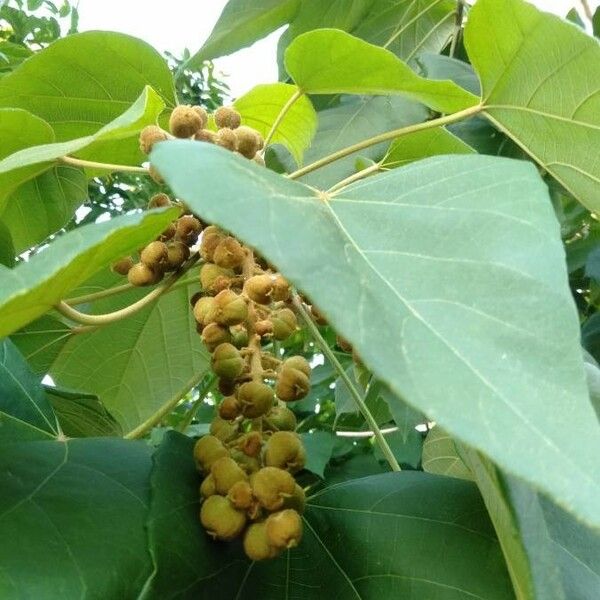
Plant Overview
Known commonly as the Alim tree in the Philippines or the Molucca Mallotus, Melanolepis multiglandulosa is a resilient pioneer species that quickly claims space in disturbed forests and coastal areas. It is a "shapeshifter" of sorts, with leaves that change appearance as the plant matures—starting lobed like a maple and smoothing out into hearts as it grows. In many Pacific cultures, it is respected for its deep roots in traditional medicine and its ability to heal the land.
🔍 How to Identify
- 🍃 Leaf Base Glands: Look closely at the base of the leaf blade where it meets the stem; you will find two distinct, dark, "multiglandular" spots that give the plant its scientific name.
- ✨ Stellate Hairs: The younger branches and the undersides of the leaves are covered in fine, star-shaped hairs that give the plant a dusty, felt-like texture.
- 🌾 Spiky Inflorescence: It produces long, upright spikes (racemes) of tiny, greenish-yellow flowers that lack petals, giving the tree a fuzzy, architectural look during its blooming season.
🏡 In Your Garden
- 🚀 The Pioneer Spirit: This isn't a "fussy" ornamental; it thrives in full sun and is often used for reforestation because it grows rapidly even in poor or disturbed soil.
- 🌳 Space Requirements: In a garden setting, it needs room to spread. It grows as a large shrub or a small tree, making it an excellent "filler" or privacy screen for areas where you want quick, dense green coverage.
⚠️ Safety & Toxicity
- 🧤 Mild Irritant: As a member of the Euphorbiaceae (Spurge) family, the sap can be mildly irritating to sensitive skin. It is best to wear gloves when pruning or clearing branches.
- 🐾 Pet Safety: While various parts are used in traditional human medicine, the raw leaves and sap should not be ingested by pets, as they can cause digestive upset or localized allergic reactions.
✨ Fun Fact
In various Southeast Asian folk traditions, the leaves of the Alim tree are heated over a fire and applied directly to the forehead to treat stubborn headaches, acting as a natural, living "fever patch."

Detailed Care Instructions
To grow Melanolepis Multiglandulosa, you can follow these steps:
- Obtain seeds or a mature plant:
- You can collect seeds from mature plants or purchase them from a reputable source.
- If you have access to a mature plant, you can also propagate it through stem cuttings.
- You can collect seeds from mature plants or purchase them from a reputable source.
- Planting:
- Choose a well-draining pot with enough space for the plant's roots to grow.
- Fill the pot with a suitable potting mix that provides good aeration and drainage.
- Sow the seeds or place the stem cuttings into the potting mix, making sure they are properly covered but not buried too deep.
- Choose a well-draining pot with enough space for the plant's roots to grow.
- Light and temperature:
- Melanolepis Multiglandulosa prefer bright indirect light, so place them near a window with filtered sunlight.
- Ensure the temperature is around 65-80°F (18-27°C) as this plant thrives in warm conditions.
- Melanolepis Multiglandulosa prefer bright indirect light, so place them near a window with filtered sunlight.
- Watering:
- Water the plant when the top inch of soil feels dry. Avoid overwatering, which can lead to root rot.
- Never let the plant sit in standing water as it can harm the roots.
- Water the plant when the top inch of soil feels dry. Avoid overwatering, which can lead to root rot.
- Humidity:
- This plant prefers higher humidity, so misting the leaves regularly or using a humidifier nearby can be beneficial.
- This plant prefers higher humidity, so misting the leaves regularly or using a humidifier nearby can be beneficial.
- Fertilizing:
- Feed the Melanolepis Multiglandulosa plant with a balanced liquid fertilizer every 2-4 weeks during the growing season (spring to summer).
- Reduce or stop fertilization during the dormant period (fall to winter).
- Feed the Melanolepis Multiglandulosa plant with a balanced liquid fertilizer every 2-4 weeks during the growing season (spring to summer).
- Pruning and maintenance:
- Remove any dead or yellowing leaves regularly to maintain the appearance of the plant and prevent diseases.
- Trim the plant if it becomes too leggy or elongated.
- Remove any dead or yellowing leaves regularly to maintain the appearance of the plant and prevent diseases.
- Repotting:
- As the plant grows, you may need to repot it to a larger container to provide more space for the roots.
- Repotting is typically done every 1-2 years, preferably in spring.
- As the plant grows, you may need to repot it to a larger container to provide more space for the roots.
- Potential pests and diseases:
- Keep an eye out for common houseplant pests like spider mites, mealybugs, and aphids. Treat them promptly if you notice any infestation.
- Excessive watering or poor drainage can cause root rot, so ensure adequate drainage and avoid overwatering.
By following these guidelines, you should be able to successfully grow and care for Melanolepis Multiglandulosa. Remember to observe the plant closely and make adjustments if needed to ensure optimal growth.
- Keep an eye out for common houseplant pests like spider mites, mealybugs, and aphids. Treat them promptly if you notice any infestation.

Place in a bright room that is sun drenched almost all day. Or directly in a south-facing window.

In order to successfully water this plant, it is important to keep in mind its specific water requirements. This includes providing it with well-draining soil and avoiding overwatering, as this can lead to root rot. It is recommended that you water this plant only when the top layer of soil feels dry to the touch, and to do so slowly and evenly until water starts to drain out of the bottom of the pot. Additionally, it is important to avoid getting water on the leaves or stems, as this can lead to fungal growth. Instead, aim to water the soil directly at the base of the plant, and avoid getting the foliage wet. Overall, a careful balance of hydration is key to keeping this plant healthy and happy.
To fertilize Melanolepis Multiglandulosa, apply a balanced fertilizer at a rate of 1 tablespoon per gallon of water every 2 weeks during the growing season. Dilute the fertilizer in water and apply directly to the soil around the base of the plant, avoiding contact with the foliage. Water thoroughly after application. During the dormant season, reduce or eliminate fertilization.
The ideal soil for this plant would be a well-draining mixture that is rich in organic matter and nutrients. It should have a pH range of 5.5 to 6.5 and a texture that is loose and light. The soil should be able to retain moisture well without becoming waterlogged, as this can cause root rot. This plant prefers slightly acidic soils and will thrive in soils that are slightly on the acidic side. The soil should also be aerated to facilitate root growth and prevent soil compaction. The use of perlite or vermiculite in the soil mix can be helpful in improving drainage and reducing soil compaction.
Melanolepis Multiglandulosa plants can be propagated through stem cuttings. First, cut a healthy stem from the main plant, making sure it is at least four inches long and has several leaves. Remove the bottom leaves, leaving only two or three at the top.
Next, dip the cut end in rooting hormone powder and tap off the excess. Place the cutting in a pot of well-draining soil, with the remaining leaves above the soil. Water the soil until it is moist, but not waterlogged.
Cover the pot with a plastic bag or clear plastic wrap, creating a greenhouse effect. This will help the cutting retain moisture and encourage root growth. Place the pot in a warm, bright spot, but out of direct sunlight.
Check the cutting regularly to make sure the soil is moist and the plastic covering is not causing excess moisture. After a few weeks, gently tug on the cutting to see if it has rooted. If it resists, it has likely taken root and can be gradually acclimated to more light and less moisture.
Once the cutting has established roots and new growth, it can be transplanted into its own container or planted outside in a suitable location.








