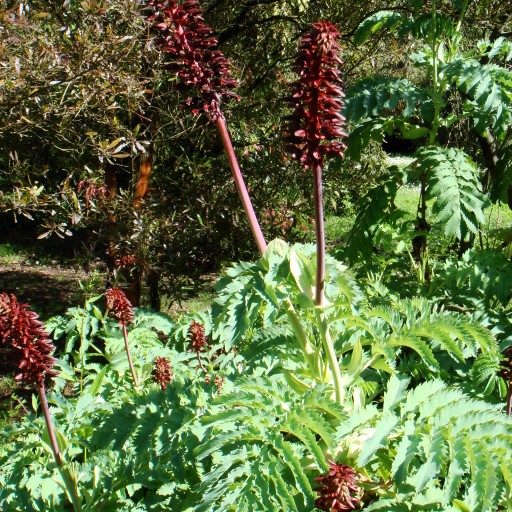
Plant Overview
Known as the "Giant Honey Flower" or "Touch-Me-Not," Melianthus major is a dramatic South African native that brings a prehistoric, architectural flair to any landscape. It is beloved by designers for its striking, oversized silver foliage and its moody, chocolate-maroon flower spikes. While it looks like something from a fantasy novel, it is a hardy survivor that thrives in Mediterranean climates.
🔍 How to Identify
- 🍃 Saw-Toothed Foliage: The most striking feature is its large, deeply divided leaves with sharply serrated (saw-like) edges that look almost structural.
- 🎨 Glaucous Color: The leaves have a distinct powdery, blue-green or silvery-grey finish that catches the light beautifully.
- 🍷 Dark Blooms: In spring and summer, it sends up tall, erect spikes of nectar-rich flowers in deep shades of maroon, brownish-red, or "burnt" purple.
🏡 In Your Garden
- ✂️ Pruning Style: This plant is a fast grower and can become "leggy" or messy over time. To keep it looking its best, many gardeners cut it back hard (nearly to the ground) in late winter to encourage a fresh flush of lush, compact foliage.
- 🥜 The Peanut Butter Test: If you rub or bruise the leaves, they release a very unusual scent. Most people describe it as smelling exactly like peanut butter, though some find it a bit more pungent and "nutty."
⚠️ Safety & Toxicity
- 🚫 Status: TOXIC. Every part of this plant is poisonous if ingested.
- 🐾 Details: It contains cardiac glycosides which can be dangerous to humans, dogs, cats, and livestock. Because the nectar can look tempting to children, it is best planted in areas where it won't be sampled. Always wear gloves when pruning, as the sap may irritate sensitive skin.
✨ Fun Fact
Despite being toxic to most mammals, the Melianthus major produces a nectar so dark and thick that it appears almost black. In its native South Africa, it is a primary food source for bright-colored sunbirds, who act as its main pollinators.

Detailed Care Instructions
| Humidity | Normal |
| Lighting | Part Sun |
| Difficulty | Easy |
| Temperature | 14°C - 30°C |
| Hardiness Zones | 7 - 12 |
To grow Melianthus Major plants, follow these steps:
- Select a suitable planting location: Melianthus Major thrives in full sun to partial shade. Choose a site that offers well-drained soil. Ensure there is enough space for the plant to grow since it can reach a height and width of up to 4-6 feet (1.2-1.8 meters).
- Prepare the soil: Loosen the soil in the planting area to a depth of about 12 inches (30 cm). Remove any weeds or rocks and add organic matter, such as compost or well-rotted manure, to improve soil fertility and drainage.
- Planting: Dig a hole deep and wide enough to accommodate the plant's root ball. Gently remove the Melianthus Major plant from its container and place it into the hole. Make sure the top of the root ball sits level with or slightly above the soil surface. Backfill the hole with soil, firming it gently around the plant.
- Watering: After planting, thoroughly water the Melianthus Major plant to settle the soil and remove any air pockets. Ensure the soil remains consistently moist, but not waterlogged, throughout the plant's growth period. Water deeply when the top inch (2.5 cm) of soil feels dry.
- Mulching: Apply a layer of organic mulch, such as wood chips or straw, around the base of the plant. Mulch helps retain moisture in the soil, suppresses weed growth, and regulates soil temperature.
- Fertilizing: Melianthus Major is not a heavy feeder, but you can apply a balanced fertilizer, such as a slow-release granular fertilizer, during the growing season to provide nutrients. Follow the instructions on the fertilizer package for proper application rates.
- Pruning: Melianthus Major may require some pruning to shape the plant or remove dead or damaged growth. Prune after the plant has finished flowering or in early spring before new growth emerges.
- Winter protection: In areas with freezing winters, provide protection for the Melianthus Major plant. Apply a layer of mulch around the base to insulate the roots. Cover the plant with a frost cloth or move container-grown plants indoors to protect them from cold temperatures.
Remember to monitor the plant for any signs of pests or diseases and take appropriate measures to address them. With proper care, Melianthus Major can grow into a beautiful and unique addition to your garden.

Place in a window with dappled sun or a spot in the middle of a room. Or directly in a window facing west or east.

To water this plant, avoid overwatering it as it can cause root rot. It is best to let the soil dry out slightly before watering thoroughly, but not allowing it to become completely dry. Water from the base of the plant, avoiding getting water on the foliage, as it can cause leaf spotting. During the growth season, the plant may need more frequent watering, while in the dormant season, it will require less water. Additionally, avoid watering in the evenings, as it can increase the likelihood of fungal growth.
First, obtain a well-balanced fertilizer with equal amounts of nitrogen, phosphorus, and potassium. Apply the fertilizer to the base of the plant, taking care not to let it come into direct contact with the foliage. Water the plant thoroughly after fertilization to ensure the nutrients are properly absorbed. Repeat this process every four to six weeks during the growing season to promote healthy growth and development. Avoid over-fertilization, as this can lead to leaf burn and other problems.
Melianthus Major plant prefers a well-draining soil mix that is slightly acidic to neutral in pH. It requires a substrate that is rich in organic matter, such as compost or leaf mold, to help retain moisture and provide nutrients. The soil should have good structure, allowing air and water to penetrate easily. Adding perlite or coarse sand to the soil mix can improve drainage and prevent waterlogging. It is also important to ensure that the plant is not planted too deeply, as the roots should be shallow and spread out. Overall, a loose, well-draining, nutrient-rich soil mix with a pH range of 6-7 is ideal for Melianthus Major plant to thrive.
Melianthus Major plant propagation can be done through several methods such as stem cuttings and division of root clumps. For stem cutting propagation, choose a healthy stem from the plant and cut it at an angle with a sharp knife. Remove any leaves or buds from the lower half of the stem and dip it in rooting hormone powder. Plant the stem cutting in a well-draining soil mix and keep it moist until roots form.
Division of root clumps is another method of propagating Melianthus Major. Dig up the plant and gently separate the root clumps into smaller sections with a sharp knife or garden fork. Each section should have at least one shoot and a good part of the root system. Plant the divided sections in a well-draining soil mix and keep them moist until they establish new roots and shoots.
Propagation of Melianthus Major requires patience and care as the plant may take several months to establish after propagation. Provide adequate sunlight, water, and nutrients to the propagated plants to ensure their healthy growth.








