Plant Overview
Known as the Thick-leaved Mahoe, this New Zealand native looks like a living, wind-swept sculpture. It is a "divaricating" shrub, meaning its branches weave together in a chaotic, springy mass—a clever evolutionary trick to protect its inner leaves from salt spray and hungry prehistoric birds. Whether it's clinging to a rocky coastal cliff or sitting in a modern garden, its rugged, architectural form makes it a standout survivor.
🔍 How to Identify
- 🌿 The "Zig-Zag" Habit: Its branches are stiff, greyish, and highly interlaced, creating a dense, rounded mound that feels springy to the touch.
- 🍃 Leathery Foliage: The leaves are small, teardrop-shaped, and notably thick (as the name crassifolius suggests). They feature subtle, rounded teeth along the edges and a glossy finish.
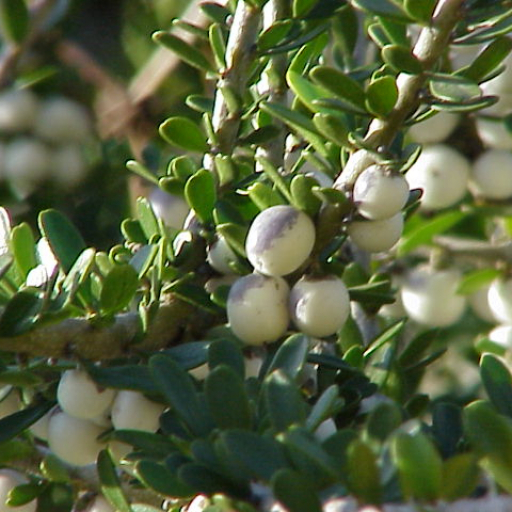
- ⚪ Speckled Berries: Hidden beneath the canopy of branches, you’ll find small, pearly-white berries that are often "splashed" with tiny dots of deep purple or blue.
🏡 In Your Garden
- 🌊 Coastal Warrior: This plant is virtually indestructible when it comes to salt spray and gale-force winds. It is an ideal "frontline" shrub for seaside properties where other plants might wither.
- 🦎 Lizard Lounge: If you want to see local wildlife, this is the plant to choose. Its dense, tangled interior provides a safe fortress for skinks and geckos, who use the branches to hide from predators while they hunt for insects.
⚠️ Safety & Toxicity
- ✅ Safe Status: The Thick-leaved Mahoe is generally considered non-toxic to humans, dogs, and cats.
- 👅 For the Birds: While the berries aren't known to be harmful, they are quite bland and are not considered a "food" crop for people. It’s best to leave them as a feast for the local bird and lizard populations.
✨ Fun Fact
Unlike many plants that rely on bees or birds, the Thick-leaved Mahoe has a special relationship with lizards. In its native New Zealand, geckos and skinks are the primary seed dispersers; they crawl deep into the tangled branches to eat the white berries and then spread the seeds to new rocky outcrops!

Detailed Care Instructions

Place in a bright room that is sun drenched almost all day. Or directly in a south-facing window.

Some plants require more regular watering than others, which should be done every few days. It's critical to maintain the soil moist all of the time. The water requirements of the same plant placed in pots with varying sizes will differ. Because the water in the smaller pot evaporates faster than the water in the larger pot, it will require more watering. Regardless of pot size, the surface should constantly be maintained moist.








