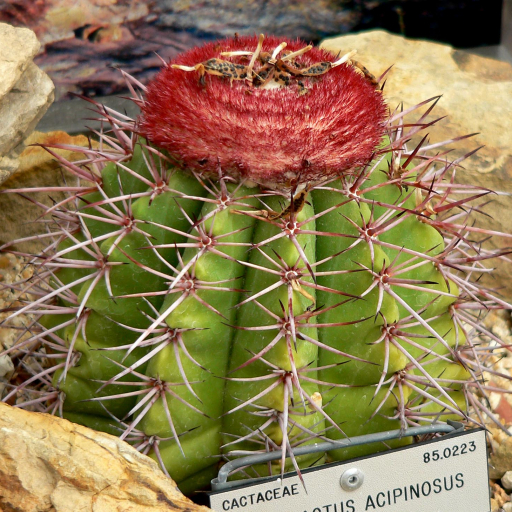
Plant Overview
Known as the "Turk’s Cap Cactus" or "Pope’s Head," this Caribbean native is the ultimate slow-burn of the plant world. It spends years as a simple, ribbed green sphere before undergoing a dramatic mid-life transformation. Once it reaches maturity, it grows a fuzzy, reddish-brown "cap" that looks remarkably like a traditional Turkish fez, marking its transition into its flowering stage.
🔍 How to Identify
- 🌵 The Body: A globose to cylindrical emerald-green stem, featuring deep vertical ribs lined with clusters of sturdy, greyish-brown spines.
- 🎩 The Cephalium: The most iconic feature—a dense, bristly "cap" of reddish wool and orange bristles that sits atop the plant once it stops growing taller.
- 🌸 Hidden Blooms: Tiny, delicate pink flowers emerge directly from the woolly cap, followed by small, waxy pink fruits that look like miniature peppers.
🏡 In Your Garden
- ☀️ The Sun Seekers: This cactus is a child of the tropics; it craves intense, direct light. Without enough sun, the plant will never develop its famous cap, which is the crowning jewel for any collector.
- 🪴 The Homebody: Unlike many succulents, Melocactus intortus has a very sensitive and fragile root system. It famously "hates" being repotted. Once it finds a home in a well-draining, gritty mix, it’s best to leave it undisturbed for as long as possible to avoid root shock.
- 💧 Tropical Humidity: While it is a cactus, it originates from coastal cliffs and prefers slightly more atmospheric humidity and more consistent (but light) watering during the summer than its desert cousins.
⚠️ Safety & Toxicity
- 🌵 Physical Hazard: The spines are exceptionally stiff and sharp. This is not a plant for low shelves where curious pets or toddlers might reach it.
- 🐾 Non-Toxic: The plant itself is not known to be poisonous to cats, dogs, or humans. However, the physical injury from the spines is the primary concern for household safety.
✨ Fun Fact
Once the "Turk’s Cap" (cephalium) begins to grow, the green body of the cactus stops growing entirely. From that point on, all the plant's energy goes into the cap, which can slowly grow to be over a foot tall over several decades!

Detailed Care Instructions
| Humidity | Dry |
| Lighting | Full Sun |
| Difficulty | Medium |
| Temperature | Min 21°C |
To grow a Melocactus Intortus plant, follow these steps:
- Obtain a Melocactus Intortus plant: Purchase a Melocactus Intortus plant from a reputable nursery or garden center. You can also try propagating one from seeds or offsets.
- Choose a suitable pot: Select a pot that has drainage holes at the bottom to prevent waterlogging. Choose a pot that is slightly larger than the current size of the plant.
- Soil mixture: Melocactus Intortus prefers well-draining soil. Use a cactus or succulent potting mix, or make your own by combining regular potting soil with sand or perlite to increase drainage.
- Planting: Gently remove the Melocactus Intortus plant from its current pot and carefully place it into the new pot. Make sure the plant is centered and the root ball is at the same level as the soil surface. Backfill the pot with the soil mixture, gently firming it around the plant.
- Watering: Water the Melocactus Intortus plant sparingly, allowing the soil to dry out between waterings. Overwatering can lead to root rot. During the growing season (spring to autumn), water once every one to two weeks. Reduce watering frequency during the dormant period (winter).
- Light and temperature: Place the plant in a bright location where it receives sufficient indirect sunlight. Melocactus Intortus generally requires 4-6 hours of bright, indirect light per day. Maintain a temperature between 65-85°F (18-29°C).
- Humidity: These plants prefer a moderate level of humidity. You can increase humidity around the plant by placing a tray of water nearby or using a humidifier. Avoid misting the plant directly.
- Fertilizer: Feed the Melocactus Intortus plant with a balanced cactus or succulent fertilizer during the growing season. Follow the instructions on the fertilizer package for dosage and frequency.
- Pruning: Melocactus Intortus plants usually do not require extensive pruning. However, if you notice any dead or damaged parts, you can carefully trim them off using sterilized pruning tools.
- Propagation: If you want to propagate more Melocactus Intortus plants, you can do so by taking offsets or by sowing seeds. For offsets, gently separate them from the mother plant and let them dry out for a few days before planting them in a separate pot with well-draining soil. Seeds can be sown in a similar potting mix and kept warm and moist until they germinate.
Remember to research the specific care requirements of Melocactus Intortus as each plant might have specific needs.

Place in a bright room that is sun drenched almost all day. Or directly in a south-facing window.

To water this species of cactus, it is important to take note of its specific needs. Melocactus Intortus require infrequent watering, as they are adapted to dry desert environments. When watering, it is important to ensure that the soil is completely dry before adding any water. This will prevent overwatering and the potential for root rot.
When watering, you can use a watering can with a narrow spout to direct water towards the base of the plant, avoiding the crown and spines. You can also mist the plant with a spray bottle. It is important to avoid getting water on the growing tip, as this can cause rot or damage to the new growth.
During the summer months, you can water the plant once every two to three weeks. In the winter months, watering should be reduced to once a month or less. Additionally, it is important to ensure that any excess water drains away from the plant, as standing water can lead to root rot.
Overall, Melocactus Intortus require minimal watering and careful attention to ensure they stay healthy and thriving.
To fertilize Melocactus Intortus, use a balanced, water-soluble fertilizer formulated for cacti and succulents. Mix the fertilizer at half strength and apply it to the soil once a month during the growing season. Be sure to thoroughly saturate the soil with water before applying the fertilizer to avoid fertilizer burn. During the winter months, refrain from fertilizing as the plant is in a dormant state.
Melocactus Intortus plant requires a well-draining soil that allows excess water to drain away from the roots. It is best to use a soil mix that is specifically formulated for cacti and succulents. This type of soil typically consists of a blend of coarse sand, peat moss, and perlite or vermiculite. The sand provides excellent drainage, while the peat moss helps to retain moisture and nutrients. Perlite or vermiculite helps to aerate the soil and improve drainage. It is important to avoid using soil that is heavy or compacted, as this can cause root rot and other problems for the plant. Additionally, Melocactus Intortus plants prefer slightly acidic soil, with a pH between 6.0 and 7.0.
To propagate this particular plant, it is recommended to first gather its seeds. Once seeds have been acquired, it is important to prepare a soil mixture that is well-draining and slightly acidic. It is also recommended to pre-moisten the soil before planting the seeds.
Once the soil is prepared, seeds can be planted in small pots or trays. It is important to keep the soil moist but not waterlogged during germination. The germination process can take between 2-4 weeks and it is important to keep the seeds in a warm and well-lit area.
Once seedlings have emerged and have grown individually to at least 2-3 inches tall, they can be transplanted into individual pots with a mixture of sandy and rocky soil. It is important to not overwater the plant and to provide it with bright indirect sunlight.
Over time, Melocactus Intortus can develop offsets or “pups” that can also be used for propagation. To propagate using offsets, remove the offset from the parent plant and allow it to dry out for a few days. Once dried, it can be planted in well-draining soil and treated like a mature plant.








