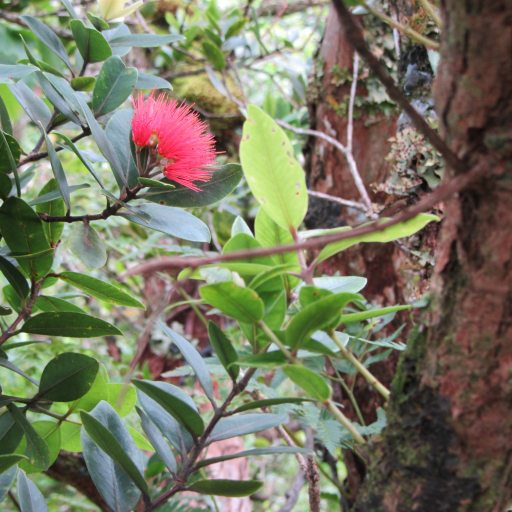
Plant Overview
Known as the "Ridge Lehua" or "Springfire," Metrosideros collina is a stunning Pacific Islander that brings a volcanic burst of color to any landscape. Often confused with its famous Hawaiian cousin, the ʻŌhiʻa lehua, this resilient shrub is beloved for its "pom-pom" blossoms that look like tiny fireworks frozen in time. In Polynesian folklore, these trees are often seen as sacred symbols of strength and beauty, standing firm against the salty winds of the South Pacific.
🔍 How to Identify
- 🌺 The Flowers: The most striking feature is the cluster of bright red (or occasionally yellow) flowers composed of long, showy stamens that create a brush-like, spherical shape.
- 🍃 The Foliage: Leaves are typically oval or rounded, leathery to the touch, and often have a beautiful silvery-grey or blue-green tint due to fine, downy hairs on the underside.
- 🌳 Growth Habit: It usually grows as a dense, woody shrub or a small tree with a multi-stemmed form, reaching a manageable height for most residential gardens.
🏡 In Your Garden
- 🌊 Coastal Warrior: This plant is incredibly salt-tolerant, making it a "must-have" for seaside gardens where other plants might wither from the spray.
- ☀️ Sun Seeker: It thrives in full sun; the more light it gets, the tighter its growth habit and the more prolific its flowering will be. It hates "wet feet," so ensure your soil is gritty and well-draining to avoid root rot.
- ✂️ Pruning Patience: While it handles pruning well to maintain a hedge shape, avoid heavy hacking into old wood, as it prefers to put its energy into those iconic nectar-rich blooms.
⚠️ Safety & Toxicity
- ✅ Safe Status: Metrosideros collina is generally considered non-toxic to humans, dogs, and cats.
- 🐝 Pollinator Party: While safe to touch, be aware that the nectar-rich flowers are magnets for bees and birds. If you have a bee allergy, enjoy the vibrant display from a slight distance during peak blooming season.
✨ Fun Fact
The genus name Metrosideros is derived from the Greek words metra (heartwood) and sideros (iron), referring to the incredibly hard, heavy, and "iron-like" timber produced by these trees!

Detailed Care Instructions
To grow Metrosideros collina (a tree native to New Zealand), you can follow these steps:
- Choose a suitable location: Select an area that receives full sun or partial shade and has well-draining soil. Metrosideros collina prefers slightly acidic soil.
- Propagation: There are two common methods of propagating Metrosideros collina: seed propagation or cutting propagation.
- Seed propagation: Collect mature seeds from the tree during autumn. Soak the seeds in water for a day to remove any inhibitors. Sow the seeds in seed trays or pots filled with seed-raising mix. Keep the soil moist and place the tray in a warm, sunny location. Germination usually occurs within 2-3 weeks.
- Cutting propagation: Take 6-8 inches long semi-ripe cuttings from healthy, disease-free branches during early summer. Dip the base of the cuttings in a rooting hormone powder and place them in a pot filled with a mixture of potting soil and perlite. Keep the soil moist and place the pot in a warm, bright location. Rooting should occur within a few weeks.
- Seed propagation: Collect mature seeds from the tree during autumn. Soak the seeds in water for a day to remove any inhibitors. Sow the seeds in seed trays or pots filled with seed-raising mix. Keep the soil moist and place the tray in a warm, sunny location. Germination usually occurs within 2-3 weeks.
- Planting: Once the seedlings or rooted cuttings are large enough, transplant them into larger pots or directly into the ground. Ensure the soil is well-draining and has been prepared with organic matter or compost. Plant the seedlings with enough space between them to allow for future growth.
- Watering: Water the plant regularly, especially during the first year, to help establish a healthy root system. Avoid overwatering, as Metrosideros collina prefers slightly dry conditions.
- Mulching: Apply a layer of organic mulch around the base of the tree to help retain moisture, suppress weeds, and improve soil fertility.
- Pruning: Prune the tree to maintain its desired shape and remove any dead or diseased branches. This is typically done during late winter or early spring.
- Fertilizing: Metrosideros collina generally does not require heavy fertilization. However, you can apply a slow-release, balanced fertilizer during the growing season to promote healthy growth.
- Protection: Protect young plants from frost or extreme weather conditions, as they can be sensitive initially. Once established, Metrosideros collina is relatively tolerant of various climates.
By following these steps and providing the necessary care, your Metrosideros collina plant should grow and thrive in its new environment.

Place in a bright room that is sun drenched almost all day. Or directly in a south-facing window.

The plant should be placed in well-draining soil and watered regularly, making sure to allow the soil to partially dry out before watering again. The frequency of watering will vary depending on factors such as the temperature and humidity of the plant's environment, as well as the size of the plant. It is recommended to use a moisture meter or stick to test the dryness of the soil before watering. Overwatering can lead to root rot, so it is important to avoid keeping the soil too wet. Additionally, the plant should not be allowed to sit in standing water. If the leaves of the plant begin to wilt or turn yellow, it may be a sign of overwatering or underwatering, and the watering regimen should be adjusted accordingly.
To fertilize this plant, use a water-soluble fertilizer with equal amounts of nitrogen, phosphorus, and potassium. Apply the fertilizer every two weeks during the growing season, diluting it to half the strength recommended on the package. Avoid applying the fertilizer to dry soil, and water the plant thoroughly after fertilizing.
Metrosideros collina is a plant that grows well in well-drained soil with good fertility. The ideal soil for this plant should be slightly acidic with a pH level between 5.5 and 6.5. It should also have good water retention properties, meaning it should be able to hold moisture without becoming waterlogged or soggy.
The soil should be rich in organic matter, such as compost or leaf mold, as this will provide the necessary nutrients for the plant's growth and development. It should also be well-aerated to promote healthy root growth.
When planting, it is recommended to mix in some sand or grit to improve drainage and prevent waterlogging. Adding some slow-release fertilizer to the soil will also help to provide nutrients to the plant over an extended period.
Overall, the soil for Metrosideros collina should be well-drained, slightly acidic, fertile, and rich in organic matter.
Metrosideros Collina plant can be propagated by using stem cuttings. Firstly, select a healthy stem that does not have any signs of disease or damage and make a clean cut just below a leaf node. The cutting should be about 6 inches in length and have at least one or two pairs of leaves.
After obtaining the cutting, remove the lower leaves and dip the cut end into rooting hormone powder. This will help the cutting to form roots more easily. Next, plant the cutting in a well-draining potting soil mix and water it. It is important to keep the soil moist but not waterlogged, as too much water can cause the cutting to rot.
Finally, place the potted cutting in a warm, bright location with indirect sunlight. The cutting should start forming roots within a few weeks. Once it has established a strong root system, it can be transplanted to a larger pot or planted in the ground.








