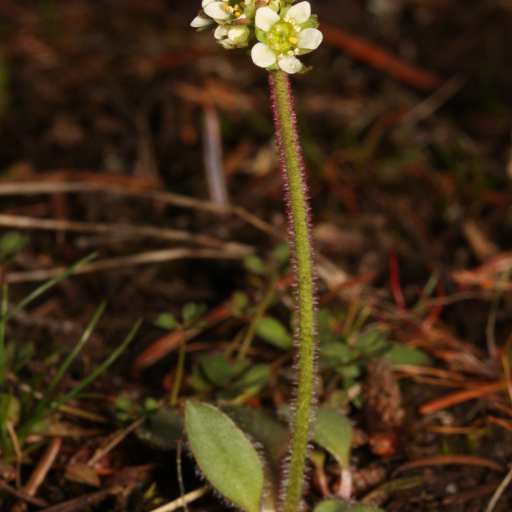
Plant Overview
Often found clinging to moist, rocky ledges or gracing damp meadows as the snow melts, Micranthes integrifolia—commonly known as the Grassland Saxifrage—is a resilient pioneer of the spring season. Native to the rugged landscapes of Western North America, it earns its common name "Whole-leaf Saxifrage" from its smooth-edged leaves that form a tidy ground-level circle. It is a quiet, stoic beauty that signals the official end of winter's grip on the landscape.
🔍 How to Identify
- 🍃 The Foliage: Look for a flat, basal rosette of oval or egg-shaped leaves that hug the ground. Unlike many of its cousins, these leaves usually have smooth or very finely toothed edges.
- 🌸 The Blooms: Tiny, star-shaped white flowers with five petals and yellow centers. They grow in tight, rounded clusters at the very tip of the stalk, resembling a miniature bouquet.
- 📏 The Stem: A single, sturdy, leafless stalk that is often covered in fine, sticky hairs. This stalk (or scape) rises straight from the center of the leaf rosette.
🏡 In Your Garden
- 💧 Ephemeral Moisture: This plant is a specialist in "seasonal wetness." It thrives in spots that are very damp in the spring but may dry out completely by mid-summer. It is perfect for rock gardens or "rain garden" edges.
- 🪨 The Stone-Breaker: The name "Saxifrage" literally means "stone-breaker." While it doesn't actually crack boulders, it is famous for its ability to tuck its roots into the tiniest, most inhospitable rocky crevices where other plants simply cannot survive.
- ☀️ Sun & Competition: It prefers full sun to light shade but lacks the height to compete with tall grasses or aggressive perennials. Give it a dedicated rocky pocket where it can bask in the early spring sun.
⚠️ Safety & Toxicity
- ✅ Safe Status: Micranthes integrifolia is generally considered non-toxic to humans and common household pets like cats and dogs.
- 🧤 Garden Hygiene: While safe, it’s always wise to wear gloves when foraging or weeding around wild plants to avoid skin irritation from neighboring "hitchhiker" plants like stinging nettle or poison oak that often share its habitat.
✨ Fun Fact
The specific epithet integrifolia is botanical Latin for "entire-leaved." In the world of botany, an "entire" leaf is one with a smooth margin—a key clue used to distinguish this species from its many jagged-edged Saxifrage relatives!

Detailed Care Instructions
To grow Micranthes Integrifolia (also known as Wholeleaf Saxifrage), you can follow these steps:
- Choose a suitable planting location: Micranthes Integrifolia prefers moist, shady areas, such as woodland gardens or along the edges of streams. Ensure that the soil is well-drained and rich in organic matter.
- Obtain the plant: You can either purchase Micranthes Integrifolia as a potted plant from a nursery or collect seeds from mature plants in their natural habitat.
- Planting from seeds: If starting from seeds, sow them directly into the prepared soil in early spring or fall. Lightly cover the seeds with a thin layer of soil and keep the soil consistently moist until germination occurs.
- Planting potted plants: If using potted plants, dig a hole slightly larger than the root ball and place the plant in the hole. Backfill the hole with soil, ensuring the plant's crown is at ground level. Gently press the soil around the plant and water thoroughly.
- Watering: Micranthes Integrifolia requires moist conditions, so water the plant regularly, especially during dry spells. Avoid overwatering, as this can lead to root rot. Mulching around the plant can help retain moisture.
- Fertilization: Micranthes Integrifolia usually does not require additional fertilization if planted in fertile soil. However, if the plant appears to be struggling, a light application of a balanced organic fertilizer in early spring can be beneficial.
- Pruning: Micranthes Integrifolia does not require much pruning. However, you can remove any dead or damaged leaves to maintain the plant's appearance.
- Propagation: Once established, Micranthes Integrifolia can spread through rhizomes or by self-seeding. You can divide the plant every few years to control its growth or transplant the new offshoots to start new plants.
- Pest and disease control: Micranthes Integrifolia is generally a hardy plant and not prone to significant pest or disease problems. However, keep an eye out for common garden pests like slugs and snails, and take necessary measures if an infestation occurs.
- Enjoy the blooms: Micranthes Integrifolia produces small, white flowers in late spring or early summer. Enjoy the beauty of the flowers and the foliage of this lovely native plant.
Remember to research and respect any regulations or permits required for collecting seeds or propagating native plants in your area.

Place in a window with dappled sun or a spot in the middle of a room. Or directly in a window facing west or east.

The best way to water this particular plant is to ensure that the soil stays slightly moist, but not overly wet. This can be achieved by watering the plant thoroughly, allowing excess water to drain away, and then waiting until the top inch of soil feels dry to the touch before watering again. It is important to avoid getting water on the leaves as this can promote fungal growth and disease. Additionally, this plant prefers well-draining soil and does not tolerate standing water. Therefore, it is important to ensure that the pot has adequate drainage holes and to avoid over-watering. In general, a regular watering schedule that takes into account the specific growing conditions and needs of this plant will ensure its success and health.
- Choose a well-draining soil for your plant and ensure the pH level is around 6.0 to 7.5.
- Use a balanced fertilizer formula with an N-P-K ratio of 10-10-10 or 20-20-20.
- Apply the fertilizer at half strength once every three to four weeks during the growing season, from spring to fall.
- Avoid over-fertilizing as it can damage the plant and its roots.
- Water the plant thoroughly after fertilizing to help distribute the nutrients evenly throughout the soil.
- Monitor the plant's growth and adjust the fertilizing schedule as necessary.
Micranthes Integrifolia plant thrives in well-draining soil that is rich in organic matter and provides good nutrients. It prefers a pH range of 6.0-7.5 and soil that is moist but not waterlogged. A soil mix consisting of equal parts of peat moss, compost, and perlite or sand is ideal for growing this plant. Additionally, the soil should be well-aerated and loose, providing enough space for the roots to grow and develop. The plant is sensitive to excessive moisture and does not tolerate drought conditions. Therefore, it is important to maintain consistent soil moisture by watering the plant regularly.
Micranthes Integrifolia plant can be easily propagated by using stem cuttings. To do this, choose a healthy plant and snip off a small piece of stem from the base of the plant. Make sure the cutting is at least 2-3 inches in length and has a few sets of leaves.
Remove the lower leaves of the cutting, leaving only a few at the top. This helps to reduce moisture loss from the cutting. Dip the cut end of the stem in rooting hormone powder and plant it in a pot filled with well-draining soil.
Place the pot in a warm, bright spot, but away from direct sunlight. Keep the soil moist but not waterlogged, and cover the cutting with a plastic bag or a clear plastic container to create a humid environment for the cutting to root.
After a few weeks, the cutting will start to develop roots and new growth. At this point, remove the plastic cover and gradually acclimate the new plant to normal growing conditions. Once the plant is well established, it can be transplanted into a larger pot or directly into the garden.








