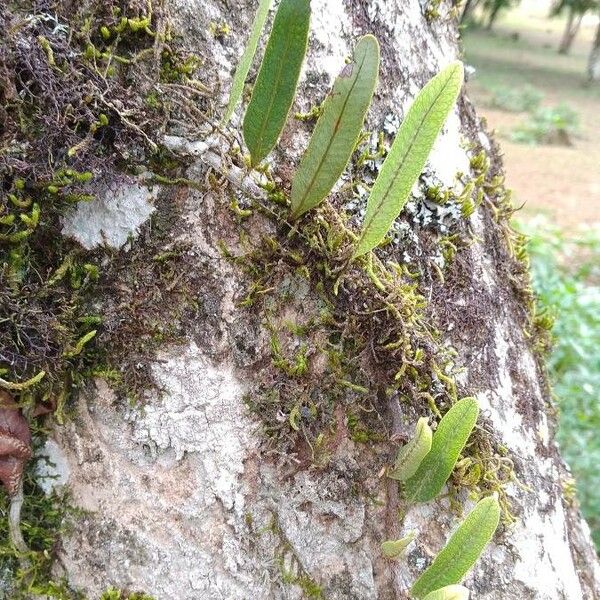
Plant Overview
Often referred to as the Scaly Creeping Fern, Microgramma squamulosa is a miniature marvel of the South American rainforests. This epiphytic traveler doesn't stay put in a pot; instead, it uses its "fuzzy" rhizomes to scale tree trunks and mossy rocks like a slow-moving green vine. In the world of terrariums and indoor jungles, it is prized for its prehistoric appearance and its ability to turn a piece of driftwood into a living sculpture.
🔍 How to Identify
- 🐍 The "Creeping" Rhizome: The most distinct feature is its long, slender stem (rhizome) that crawls across surfaces. It is densely covered in small, ginger-to-silver colored scales that look like tiny fish scales or fur.
- leaf Simple Fronds: Unlike the classic "leafy" fern look, this species has simple, undivided, lance-shaped leaves. They are leathery to the touch and a deep, waxy green.
- 🟠 Fertile Sori: On the underside of some leaves, you will find two neat rows of bright orange or brown circular spots. These are the sori, where the fern produces its spores for reproduction.
🏡 In Your Garden
- ☁️ Mounting vs. Potting: Because this plant is an epiphyte, it often struggles in heavy potting soil. It is happiest when mounted on a piece of cork bark or cedar with a bit of sphagnum moss, allowing its "feet" to breathe and wander.
- 💧 The Humidity Balance: It thrives in high humidity but is surprisingly resilient compared to other delicate ferns. However, it hates "wet feet"—if the rhizomes stay soggy for too long without airflow, they may rot. It prefers a "damp-dry" cycle.
⚠️ Safety & Toxicity
- ✅ Safe Status: Microgramma squamulosa is generally considered non-toxic to humans and common household pets like cats and dogs.
- 🦎 Vivarium Friendly: This fern is a gold-standard plant for reptile and amphibian enclosures (vivariums) because it is sturdy enough to handle small climbing creatures and poses no chemical threat to them.
✨ Fun Fact
The species name squamulosa comes from the Latin word "squamula," meaning "little scale." This refers to the intricate, metallic-looking protective scales that shield the plant's creeping stems from drying out in the wild.

Detailed Care Instructions
| Lighting | Part Sun |

Place in a dark room with little light, like a dark bedroom or a spot far away from a window or directly in a north-facing window.

To water this type of plant, it is important to take into consideration its watering needs. It is recommended to check the soil moisture before watering to avoid overwatering or underwatering. It is best to use a well-draining soil mix to allow excess water to drain away from the plant roots.
When watering, pour the water slowly and directly onto the soil, not on the leaves and stem to avoid trapping moisture, which could lead to rot or disease. Ensure that the top inch of soil remains slightly moist between waterings.
In addition, it is recommended to keep the plant in a location with indirect sunlight and high humidity to promote growth and healthy foliage. Overwatering and low humidity can cause leaf yellowing or browning and could result in plant death.
Microgramma Squamulosa plant is a type of fern that requires specific soil conditions to thrive and grow healthily. It requires soil that is well-drained and has a pH level of between 5.0-6.5. The soil should be rich in organic matter and have good water holding capacity, but not be too wet or too dry. It is recommended to use a mixture of peat moss or cocopeat, perlite or sand, and loamy soil in the ratio of 1:1:2 respectively. This will ensure that the soil has good aeration and drainage, while also retaining moisture for the plant's roots to absorb. It is important to avoid using soil that is too heavy or compacted, as this can lead to root rot. Additionally, fertilizers should be used sparingly, as Microgramma Squamulosa plants prefer nutrient-rich soil but can be sensitive to over-fertilization.








