Plant Overview
Often called the Wart Fern or Monarch Fern, this resilient traveler from the South Pacific is a favorite for those who want a lush "jungle" look without the fragility of more delicate ferns. Its common name comes from the prominent, spore-bearing bumps that line its leaves, but don't let the name fool you—it is one of the most elegant and fragrant additions to a tropical collection. In many cultures, its fronds are woven into leis or used to scent traditional oils.
🔍 How to Identify
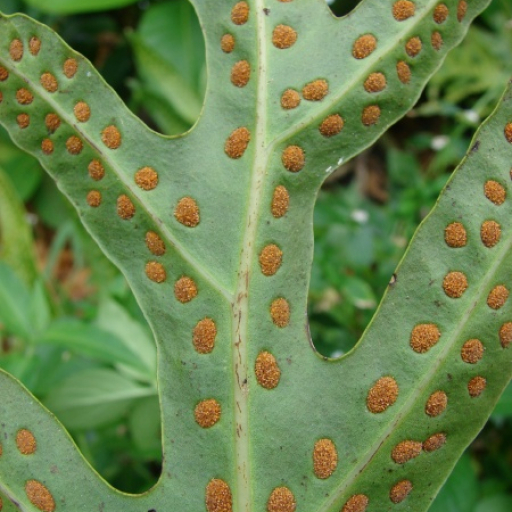
- 🌿 The Fronds: Unlike the "feathery" look of a Boston fern, these leaves are thick, leathery, and deeply lobed, often resembling a hand with many long fingers.
- 🧆 The "Warts": On mature leaves, you will see neat rows of circular sori (spore cases). These press upward, creating distinctive, raised bumps on the top side of the leaf.
- 🐍 Creeping Rhizomes: Look at the base; the plant spreads via thick, dark green or brown "stems" that crawl across the soil or climb up bark, occasionally looking like furry vines.
🏡 In Your Garden
- 🌊 Coastal Survivor: Unlike many ferns that shrivel at a breeze, the Wart Fern is surprisingly salt-tolerant and can handle wind, making it a star player in seaside landscapes or humid balconies.
- 🏺 Space to Roam: Because it grows via creeping rhizomes, it thrives in wide, shallow pots or hanging baskets where it can "overflow" the edges. It hates being root-bound in deep, narrow containers where its rhizomes have nowhere to march.
⚠️ Safety & Toxicity
- 🐾 Non-Toxic: The Monarch Fern is generally considered safe and non-toxic for both cats and dogs.
- 👶 Child Safe: It lacks thorns, prickly hairs, or irritating saps, making it a "worry-free" plant for households with curious toddlers.
✨ Fun Fact
👃 The Island Perfume: When the leaves of the Wart Fern are crushed or dried, they release a sweet, coumarin-like fragrance reminiscent of vanilla or freshly mown hay. In Hawaii and other Pacific islands, it is traditionally used to add a pleasant scent to handcrafted coconut oils and clothing.

Detailed Care Instructions
To grow a Microsorum scolopendria plant, also known as a staghorn fern, you can follow these steps:
- Choose a suitable location: Staghorn ferns can be grown indoors or outdoors, depending on your climate. If grown indoors, choose a spot with indirect light or filtered sunlight. If grown outdoors, find a place with partial shade or dappled sunlight.
- Mount or pot the fern: Staghorn ferns are epiphytic plants, meaning they naturally grow on trees or other surfaces. You can mount them on a wooden board or place them in a hanging basket. If you prefer a pot, ensure it has good drainage.
- Prepare the mounting board: If using a wooden board, attach a layer of sphagnum moss to it. This will provide moisture and nutrients for the fern. Secure the fern on the moss with wire, ensuring it stays in place.
- Provide the right environment: Staghorn ferns thrive in high humidity and consistent moisture. Mist the plant regularly or place a tray with water nearby to maintain humidity. Avoid direct sunlight, as it can scorch the fronds.
- Water correctly: Water the fern when the top inch of the soil or moss feels dry to the touch. Thoroughly soak the plant until water drains from the bottom, then allow it to dry out slightly before watering again. Overwatering can lead to root rot.
- Fertilize occasionally: Use a balanced liquid fertilizer diluted to half strength. Apply it every 2-3 months during the growing season (spring to summer). Avoid fertilizing during winter when the plant is dormant.
- Prune and clean: Remove any dead or dying fronds to maintain the plant's health and appearance. Clean the fronds occasionally by gently wiping them with a damp cloth to keep them looking glossy and dust-free.
- Propagation: Staghorn ferns can be propagated by dividing the clumps or by spores on the undersides of fronds. If you want to propagate from spores, collect them and sow them in a small pot filled with moist sphagnum moss. Keep the pot covered and in a warm location until the spores germinate.
By following these care instructions, you can successfully grow a Microsorum scolopendria plant and enjoy its unique and attractive appearance.

Place in a dark room with little light, like a dark bedroom or a spot far away from a window or directly in a north-facing window.

Microsorum Scolopendria is a plant that requires a specific watering routine to ensure its health and optimum growth. Here are the details on how to water this plant without mentioning its common names:
1. Assess the soil moisture: Before watering the Microsorum Scolopendria, check the moisture level of the soil. Insert your finger about an inch deep into the soil near the base of the plant. If the soil feels slightly dry, it's time to water.
2. Use room temperature water: When watering, make sure to use room temperature water. Fill a watering can or any container with water and let it sit for a few hours to reach room temperature. Cold water can shock the plant's roots and hinder its growth.
3. Water the soil directly: Unlike some other plants, Microsorum Scolopendria prefers watering the soil instead of its leaves. Pour water directly onto the soil, aiming for the root zone. Avoid wetting the leaves excessively as this can promote the growth of fungal diseases.
4. Water thoroughly: To ensure proper hydration, water the plant until you see water starting to come out of the drainage holes at the bottom of the pot. This ensures that the water reaches the root zone and provides enough moisture.
5. Allow excess water to drain: After watering, allow any excess water to drain out of the pot or container. Empty the saucer or tray underneath the pot to prevent the root system from sitting in standing water, as this can lead to root rot.
6. Monitor soil moisture levels: Keep track of the moisture level in the soil. Wait until the top inch of the soil dries out before watering again. Overwatering can lead to root rot, yellowing leaves, or other plant health issues.
7. Consider environmental factors: The watering frequency for Microsorum Scolopendria may vary depending on environmental factors such as humidity, temperature, and season. Monitor the plant's response to watering and adjust accordingly.
Remember that it is always important to observe the specific needs of your Microsorum Scolopendria plant, as different plants may have varying preferences when it comes to watering.
For fertilizing Microsorum scolopendria plant, you can follow these instructions:
- Choose a balanced liquid houseplant fertilizer or a specifically formulated fern fertilizer. Make sure it is free from any additives or chemicals harmful to ferns.
- Dilute the fertilizer according to the manufacturer's instructions. Usually, a quarter or half-strength solution is recommended.
- Water the plant thoroughly with plain water before applying the fertilizer. This will prevent the roots from burning due to concentrated fertilizer solution.
- Pour the diluted fertilizer solution evenly around the base of the plant, avoiding direct contact with the foliage.
- Take care not to over-fertilize, as this can lead to the build-up of salts in the soil. It is best to err on the side of under-fertilization.
- Repeat the fertilization process every 2-4 weeks during the growing season (spring and summer). Reduce or stop fertilization during the plant's winter dormancy period.
- Monitor the plant closely after fertilizing. If you notice any signs of fertilizer burn or adverse reactions (such as browning tips, yellowing leaves), flush the soil with plenty of water to wash away excess salts and dilute the fertilizer.
- Regularly clean the foliage of the plant by gently wiping it with a damp cloth. This will remove dust and help improve the plant's ability to absorb nutrients.
Please note that while these instructions are generally suitable for Microsorum scolopendria, it is always advisable to refer to specific care guidelines for your particular plant species.
Microsorum Scolopendria, also known by its common names, is a type of fern that requires specific soil conditions to thrive. It is typically found in tropical regions and needs a well-drained but moisture-retentive substrate to grow successfully. To create the ideal soil for Microsorum Scolopendria, you can mix several components in specific proportions.
Firstly, start with a base of high-quality potting soil or a mixture of equal parts peat moss, coconut coir, and perlite. This base provides a good structure while retaining the necessary moisture and allowing proper drainage.
To enhance the soil's fertility, incorporate organic matter like well-rotted compost or leaf mold. This will provide the necessary nutrients for the plant's growth and development.
Adding sphagnum moss or sphagnum peat to the mix can help increase water retention, which is beneficial for Microsorum Scolopendria as it prefers consistently moist conditions. However, make sure not to overwater as excessive moisture can lead to root rot.
To improve aeration and prevent compaction, adding orchid bark, perlite, or coarse sand can be beneficial. These components will create air pockets within the soil, allowing oxygen to reach the roots and promoting healthy growth.
Creating a slightly acidic to neutral pH of around 6.0 to 7.0 is preferred for Microsorum Scolopendria. To adjust the pH, you can consider incorporating powdered lime to raise the pH or sulfur to lower it gradually. However, maintaining a range close to the plant's preference is usually sufficient without the need for significant alterations.
Overall, Microsorum Scolopendria thrives in a soil mix that provides adequate drainage, moisture retention, fertility, and aeration. By creating the optimal soil conditions, you can support the plant's growth and enhance its overall health and vitality.
Microsorum Scolopendria, also known as the Crocodile Fern, can be propagated through several methods:
- Division:
- Select a mature, healthy Crocodile Fern plant.
- Gently remove it from its pot and examine the root system.
- Carefully separate the plant into two or more sections, ensuring each section has both roots and fronds.
- You can use a sharp, sterile knife or your hands to divide the plant.
- Replant each divided section into a separate pot filled with well-draining soil.
- Provide adequate moisture and indirect light to promote healthy growth.
- Select a mature, healthy Crocodile Fern plant.
- Spores:
- Look for mature fronds that have developed sori, which are small round structures on the undersides of the leaves.
- Cut off a frond that has fully grown sori using clean scissors or a knife.
- Place the frond in a paper bag and allow it to dry, ensuring that the spores fall off into the bag.
- Prepare a seed tray or a small pot with a well-draining, sterile potting mix.
- Sprinkle the spores evenly over the soil surface, ensuring good coverage but without overcrowding.
- Lightly mist the surface with water to moisten it, and cover the tray or pot with a clear plastic bag to create humidity.
- Place the tray or pot in a warm, bright location, avoiding direct sunlight.
- Keep the soil consistently moist and mist the spores occasionally to maintain humidity.
- In a few weeks, you should start to see tiny green structures called prothalli, which will eventually develop into ferns.
- Once the prothalli have grown several fronds, carefully transplant them into individual pots or a larger container.
- Look for mature fronds that have developed sori, which are small round structures on the undersides of the leaves.
- Stolon cuttings:
- Locate a mature Crocodile Fern plant that has developed stolons, which are horizontal stems that grow above or below the soil surface.
- Look for a healthy, established stolon with its own set of roots.
- Using clean scissors or a knife, cut the stolon carefully from the parent plant, ensuring it has roots attached.
- Plant the stolon cutting into a small pot with well-draining potting mix, burying the roots but allowing the fronds to remain above the soil level.
- Provide adequate moisture and indirect light to encourage root and frond development.
- You may cover the pot with a clear plastic bag or place it in a propagation tray to create humidity and retain moisture.
- Once new growth appears, you can transfer the young plant to a larger container.
By employing these propagation methods, you can successfully propagate Microsorum Scolopendria and expand your collection of this beautiful fern species.
- Locate a mature Crocodile Fern plant that has developed stolons, which are horizontal stems that grow above or below the soil surface.








