Plant Overview
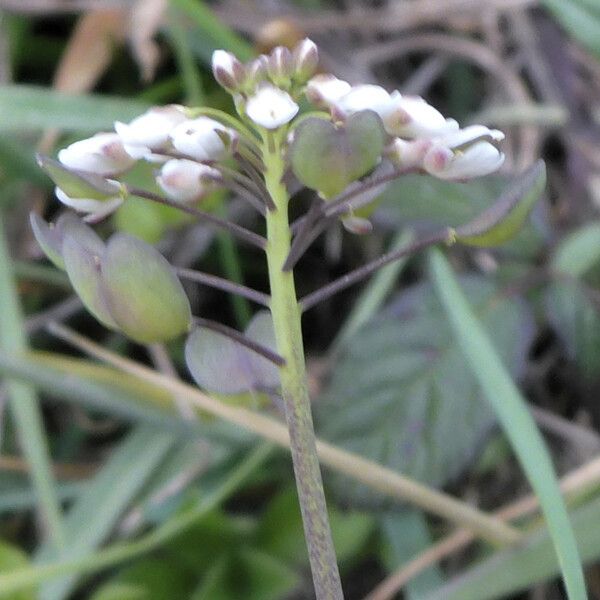
Often called the Cotswold Pennycress or Perfoliate Pennycress, this delicate winter annual is one of the earliest heralds of spring. Its charm lies in its tiny, heart-shaped seed pods and the unique way its leaves seem to "hug" the stem. Originally from Eurasia, it has traveled the world, often popping up in the rocky cracks of old walls or at the edges of garden beds as a tiny, transient pioneer.
🔍 How to Identify
- 🤍 Tiny Flowers: Clusters of minute white blossoms with four petals, a classic signature of the Mustard family (Brassicaceae).
- 🍃 Clasping Leaves: The upper leaves are "perfoliate," meaning the base of the leaf completely encircles the stem, making it look as though the stem is growing directly through the center of the foliage.
- 💚 Heart-Shaped Pods: After the flowers fade, they leave behind flat, notched seed pods (silicles) that resemble tiny green valentines or miniature pouches.
🏡 In Your Garden
- 🌱 The Limestone Lover: This plant is an indicator species; it thrives in alkaline, chalky, or limestone-rich soils. If you see it thriving, you likely have "sweet" soil with a high pH.
- ⏳ A Quick Life: As a winter annual, it completes its entire lifecycle in the blink of an eye. It germinates in the cool autumn, stays low to the ground in winter, and blooms in early spring before disappearing entirely when the summer heat arrives.
⚠️ Safety & Toxicity
- ✅ Generally Safe: Perfoliate Pennycress is not known to be toxic to humans, cats, or dogs.
- 👅 Peppery Profile: Like its cousins, the Radish and Mustard, it has a spicy, peppery flavor, though it is rarely used in cooking because it is so small and fibrous.
- 🚜 Environmental Caution: Be careful with wild specimens found near roadsides; plants in the Mustard family are known to accumulate nitrates or heavy metals from polluted runoff.
✨ Fun Fact
- 📜 Ancient Logic: The species name Perfoliatum comes from the Latin words per (through) and folium (leaf). In the era of the "Doctrine of Signatures," ancient herbalists believed plants with "pierced" leaves could help heal puncture wounds!

Detailed Care Instructions
To grow a Microthlaspi Perfoliatum plant, also known as Pennywort or Dollarweed, follow these steps:
- Choose a location: Find a suitable location with partial shade or full sun. Pennywort prefers moist soil and can tolerate sandy or clay soil types.
- Prepare the soil: Loosen the soil with a garden fork or tiller to a depth of at least 6 inches. Remove any rocks, weeds, or debris from the area.
- Sow the seeds: Scatter the seeds evenly over the prepared soil. Pennywort seeds are very small, so mix them with some sand or vermiculite to make seeding easier. Gently press the seeds into the soil without covering them completely, as they need light to germinate.
- Watering: Water the area thoroughly immediately after planting, ensuring the soil is evenly moist. Afterward, keep the soil consistently moist but avoid overwatering, as this can lead to root rot.
- Mulch: Apply a layer of organic mulch, such as shredded leaves or straw, around the seedlings to help retain moisture and suppress weed growth.
- Maintenance: Once the plants germinate and grow to a suitable size, thin them out if they are overcrowded to allow proper growth. Avoid letting the plants dry out, especially during hot periods, and regularly water them as needed.
- Fertilization: Pennywort plants often do not require additional fertilization if grown in fertile soil. However, if the soil is poor, you can apply a balanced, slow-release fertilizer according to the package instructions.
- Pest and weed control: Keep an eye out for pests like aphids or slugs and treat accordingly with organic pest control methods. Regularly remove any weeds that may compete with the Pennywort plants for nutrients and space.
- Harvesting: Pennywort plants are typically harvested for their leaves, which can be eaten raw or cooked. After four to six weeks of growth, when the plants have several sets of leaves, you can start harvesting by cutting the leaves near the base.
Remember, growing conditions and care may vary, so it's essential to monitor the plants and adjust accordingly.

Place in a bright room that is sun drenched almost all day. Or directly in a south-facing window.

Microthlaspi perfoliatum is a plant that requires moderate watering. The plant prefers moist soil, but it should not be overwatered or sit in water to avoid root rot. It is important to water the plant deeply once a week, allowing the water to soak into the soil and reach the roots. The frequency of watering may vary depending on the climate and the soil's moisture retention.
Before watering, it is necessary to check the topsoil's moisture level to determine if watering is necessary. This can be done by sticking a finger or a soil moisture meter into the soil. If the topsoil is dry, it is time to water.
When watering the plant, it is recommended to use a watering can or a garden hose with a spray nozzle. The water should be directed towards the soil, not the leaves or flowers. This prevents water droplets from accumulating on the plant's foliage, leading to the development of fungal diseases.
After watering, it is crucial to allow the soil to drain excess water. Overwatering or leaving the plant in standing water can quickly kill the plant.
In summary, to water Microthlaspi perfoliatum plant, check the soil moisture level, water deeply once a week, avoid overwatering, water the soil and not the leaves, and allow excess water to drain.
To fertilize this plant, apply a balanced fertilizer (such as 10-10-10 or 20-20-20) at a rate of 1/4 teaspoon per gallon of water once a month during the growing season (typically spring to fall). Be sure to water the plant thoroughly before and after fertilizing to prevent burning the roots. Avoid over-fertilizing, as this can lead to excessive growth and weakened plants.
The soil that is best suited for the Microthlaspi Perfoliatum plant is a well-draining type. Sandy loam or clay loam soils are ideal. The soil should be slightly acidic to neutral with a pH of 6.0 to 7.0. It should be rich in organic matter and nutrients such as nitrogen, phosphorus, and potassium.
The plant requires a moist soil that remains consistently damp but not waterlogged. It should be planted in an area where it receives full to partial sunlight exposure. The soil should be kept evenly moist, but not soggy as the plant does not tolerate waterlogged conditions.
To prepare the soil, it is recommended to mix in organic matter such as compost, well-rotted manure, or leaf mold. This will help to improve the soil texture, as well as add nutrients to the soil.
It is important to avoid using heavy fertilizers as the Microthlaspi Perfoliatum plant is sensitive to excess amounts of nitrogen. A balanced slow-release fertilizer can be applied every two months during the growing season to provide the necessary nutrients to the plant.
Microthlaspi perfoliatum is a plant that can be easily propagated through different methods, such as seed propagation, vegetative propagation, and division. If you want to propagate this plant through seed propagation, you should gather the ripe seeds in the late summer, once the seedpods have dried and turned brown. You can then sow the seeds in individual pots, placing them roughly 1/8 inch deep, and covering them with a layer of soil. Water the pots regularly, and keep them in a cool and shaded spot until the seeds start to germinate.
If you'd like to propagate the plant through vegetative propagation, you can take stem cuttings in the early summer. To do this, find a healthy and well-established plant from which to take the cuttings, and remove a section of stem that's around 4 inches long. Remove the lower leaves from the cutting, leaving only a few at the top. Dip the cutting in rooting hormone, and plant it in a pot filled with well-draining soil. Cover the pot with a plastic bag to create a humid environment, and keep the soil moist until the cutting has started to root (this can take a few weeks).
Finally, if you'd like to propagate the plant through division, you should wait until the plant is well-established and has formed a clump. Carefully dig up the clump, and separate it into smaller sections, making sure that each section has some foliage and roots. Plant each section in its own pot filled with well-draining soil, and water it regularly until it's established.








