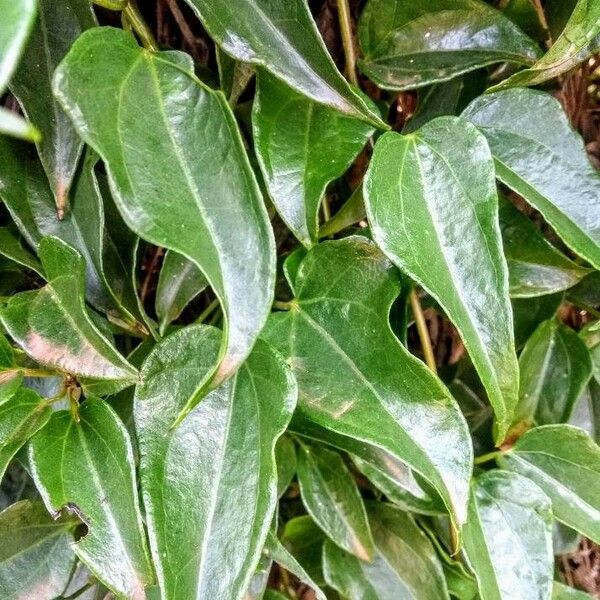
Plant Overview
Often called the "Climbing Healer" or "Erva de Cobra," Mikania Guaco is a vigorous, woody vine native to the lush rainforests of South America. It is legendary in Brazilian folk medicine, where it has been brewed into aromatic syrups for centuries to soothe stubborn coughs and respiratory ailments. Beyond its medicinal fame, it is prized by gardeners for its rapid growth and its ability to create a "living green wall" in a single season.
🔍 How to Identify
- 🍃 Heart-Shaped Foliage: The leaves are large, glossy, and distinctly heart-shaped (cordate), growing in neat, opposite pairs along the stem.
- 🌸 Creamy Clusters: It produces dense, fuzzy clusters of small, white to pale-yellow flowers that emerge at the ends of the branches, giving the vine a "frothy" appearance when in full bloom.
- 🪜 Twining Woody Stems: Unlike vines with tendrils, Guaco climbs by twisting its entire woody stem around supports, creating thick, rope-like structures over time.
🏡 In Your Garden
- 🧗 Structural Support: Because this is a heavy, "scandent" climber, it requires a sturdy trellis, fence, or pergola. It is a persistent grower and will quickly overwhelm flimsy supports or nearby small shrubs if not monitored.
- 💧 Tropical Hydration: Guaco thrives in high-humidity environments that mimic the rainforest floor. If you are growing it in a drier climate, regular misting or placing it near a water feature will keep the leaves from turning brown at the edges.
⚠️ Safety & Toxicity
- 🩸 Anticoagulant Properties: Guaco contains high levels of coumarin. While used medicinally, it can act as a blood thinner. It should never be consumed by individuals on blood-thinning medication or those scheduled for surgery.
- 🐾 Pet Sensitivity: While not listed as highly "poisonous," the coumarin content can be dangerous to small pets (cats and dogs) if they chew on the leaves, potentially leading to stomach upset or, in extreme cases, bleeding issues.
✨ Fun Fact
The nickname "Snake Herb" (Erva de cobra) comes from an ancient folk belief that forest dwellers who drank Guaco tea would become immune to snake venom. In some regions, the crushed leaves were even applied directly to bites in hopes of neutralizing the poison!

Detailed Care Instructions
To grow a Mikania Guaco plant, you can follow these steps:
- Obtain a Mikania Guaco plant: You can either buy a young Mikania Guaco plant from a nursery or obtain seeds to start growing it from scratch.
- Select an appropriate location: Mikania Guaco plants thrive in warm climates and require partial shade to full sunlight. Choose a spot in your garden or indoors where the plant will receive at least 4-6 hours of sunlight per day.
- Prepare the soil: Mikania Guaco plants prefer well-draining soil. Mix organic compost or well-rotted manure into the soil to improve its fertility and drainage.
- Sow seeds or transplant the plant: If you have seeds, sow them directly into the prepared soil at a depth of about ¼ inch. Alternatively, if you have a young plant, carefully transplant it into a hole that is large enough to accommodate its root ball.
- Water and fertilize: Keep the soil consistently moist but not waterlogged. Water the plant whenever the top inch of soil feels dry. Fertilize the plant with a balanced liquid fertilizer every 2-4 weeks during the growing season to promote vigorous growth.
- Provide support if necessary: Mikania Guaco plants are vines and can benefit from trellises or supports to climb. Install a sturdy structure near the plant to provide support as it grows.
- Control weeds: Regularly weed around the Mikania Guaco plant to prevent competition for nutrients and water. Be careful when weeding as the plant can be fragile.
- Prune regularly: Pruning will help to control the growth and shape of the plant. Remove any dead or damaged leaves and stems to maintain the plant's health and appearance.
- Protect from pests: Mikania Guaco plants are generally resistant to pests. However, aphids or whiteflies can occasionally infest them. Use organic insecticidal soap or neem oil to control any pest infestations.
- Harvest leaves: Once the plant has grown to a suitable size, you can harvest the leaves for medicinal use. Take care not to remove all leaves at once, as the plant needs some foliage for photosynthesis. Instead, selectively prune leaves from different parts of the plant.
By following these steps, you should be able to successfully grow a Mikania Guaco plant.
Mikania Guaco plant requires regular watering to thrive. It prefers moist soil but not waterlogged. It's essential to check the soil's moisture level before watering to avoid overwatering or underwatering. You can do this by inserting your finger about 1 inch into the soil, and if it feels dry, it's time to water the plant.
When watering, it's best to use lukewarm water to avoid shocking the plant's root system. You can water the plant from the top or bottom, depending on your preference. Watering from the top is ideal if the plant needs a thorough soak, while bottom watering is best for smaller amounts of water.
During hot or dry weather, you may need to water the plant more frequently to keep the soil moist. If your Mikania Guaco plant is in a container, make sure it has good drainage to prevent waterlogging. Otherwise, it may lead to root rot, which can kill the plant.
It's also essential to avoid getting water on the plant's foliage, as this can cause fungal diseases. Watering early in the morning allows enough time for the plant to dry before nightfall.
In summary, water your Mikania Guaco plant regularly, check the soil's moisture level before watering, use lukewarm water, avoid waterlogging, and avoid getting water on the foliage.
To fertilize the aforementioned plant, mix a balanced fertilizer (such as a 10-10-10 or 20-20-20) with water according to the instructions on the label. Apply the fertilizer mixture to the soil around the plant once every two weeks during the growing season (spring to fall). Avoid getting the fertilizer on the leaves or stems of the plant, as it may cause burning. Be sure to water the plant thoroughly before and after fertilizing.
Mikania Guaco plant thrives in well-draining soil that is rich in organic matter. It prefers a slightly acidic soil pH of around 6.0 to 6.5. The soil should be kept moist but not waterlogged. It is recommended to use a soil mixture that consists of high-quality potting soil, perlite, and coarse sand in equal parts to ensure proper drainage and aeration. Additionally, adding a slow-release fertilizer to the soil every few months will provide the plant with essential nutrients it needs to grow healthy and strong. It is important to avoid using heavy clay soils or soils with a high clay content, as these can cause root rot and other issues.
To propagate this plant, you will need to take stem cuttings from a mature and healthy parent plant. The stem cuttings should be about 6-8 inches long and should have a few leaves attached to them.
Next, remove the bottom leaves from the stem cuttings, leaving only a few leaves at the top. This will reduce moisture loss and encourage the development of roots.
Then, dip the bottom of the stem cuttings into rooting hormone, which will help stimulate root growth.
Next, plant the stem cuttings in a well-draining soil mixture that has been moistened beforehand.
Cover the pot with a plastic bag to create a humid environment and place it in a warm, bright location, but out of direct sunlight.
Water the soil regularly, but avoid overwatering, as this can cause the stem cuttings to rot.
After a few weeks, you should start to see new growth and roots forming. Once the new plant has established a few leaves and visible roots, you can remove the plastic bag and move it to a larger pot or into the garden.








