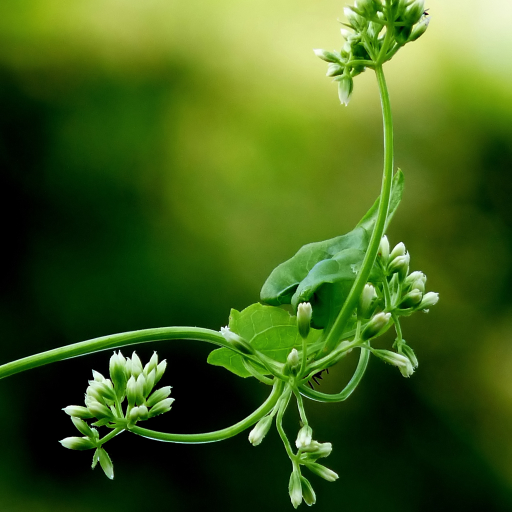
Plant Overview
Known as the "Mile-a-Minute Weed" or "The Green Cancer," Mikania micrantha is a vigorous, perennial vine that lives up to its name. Originating from the tropical Americas, it has become a notorious traveler, famous for its ability to smother entire forests under a dense, emerald blanket. While its heart-shaped leaves and delicate white blooms can look charming in a wild landscape, it is widely regarded as one of the world's most invasive species.
🔍 How to Identify
- 🌿 The Leaves: Distinctly heart-shaped (cordate) with a pointed tip and slightly wavy or toothed edges. They grow in opposite pairs along the stem.
- 🌸 The Flowers: Small, fragrant, white to greenish-white clusters that appear at the ends of branches. Each tiny flower looks like a miniature fringed star.
- 🧶 The Stem: Slender, ribbed, and yellowish-green. It doesn’t use tendrils to climb; instead, the entire stem twines spirally around any support it can find.
🏡 In Your Garden
- 🌱 Growth Strategy: This vine is a master of "smothering." It grows over the top of other plants and trees, blocking out sunlight and essentially "strangling" the host plant by preventing photosynthesis.
- 💧 Environmental Preference: It thrives in high-humidity areas with rich, moist soil. You’ll often find it taking over disturbed sites, forest edges, and abandoned gardens where it can spread without competition.
- ✂️ Control Nuance: Managing this plant is a challenge because it can regrow from the tiniest fragment of a stem. If you are pulling it out, every piece must be removed and disposed of carefully to prevent a "zombie" return.
⚠️ Safety & Toxicity
- 🟢 General Status: Mikania micrantha is generally considered non-toxic to humans and pets if accidentally touched or brushed against.
- 🧴 Skin Sensitivity: Some individuals may experience mild skin irritation or allergic dermatitis if they have sensitive skin and handle the sap or crushed leaves for extended periods.
- 🌳 Ecological Danger: The real "toxicity" of this plant is to the environment. It is a major threat to local biodiversity, as it can quickly kill off native flora and disrupt local ecosystems.
✨ Fun Fact
Mikania micrantha is truly the "sprinter" of the plant world. Under perfect tropical conditions, a single vine has been recorded growing up to 8 or 9 centimeters (over 3 inches) in just 24 hours!

Detailed Care Instructions
| Toxicity | Poisonous |
To grow a Mikania Micrantha plant, also known as the Mile-a-Minute vine or American Rope, you can follow these steps:
- Obtain seeds or cuttings: You can either buy seeds or obtain cuttings from an existing Mikania Micrantha plant. Seeds can be purchased online or from a plant nursery, while cuttings can be taken from a healthy plant.
- Prepare a pot or a planting area: If you are growing the plant in a pot, make sure it has drainage holes to prevent waterlogging. If you are planning to plant it outdoors, choose a spot with partial shade to full sun, as this plant thrives in bright light.
- Soil preparation: Mikania Micrantha prefers well-draining soil. Prepare a mixture of equal parts peat moss, perlite, and compost to create a fertile and well-draining soil mix.
- Planting the seeds or cuttings: If using seeds, follow the instructions on the packet for sowing depth and spacing. If using cuttings, dip the cut end in a rooting hormone and plant it in the prepared soil. For both seeds and cuttings, cover them lightly with soil and gently water.
- Watering: Keep the soil consistently moist but not waterlogged. Water the plant when the topsoil is dry and avoid over-watering, as it can lead to root rot.
- Provide support: Mikania Micrantha is a climbing vine and requires support as it grows. Install trellis, stakes, or any other appropriate support structure for the plant to climb on.
- Fertilization: Fertilize the plant with a balanced, slow-release fertilizer or organic compost once every two to three months during the growing season.
- Pruning: To control its growth and prevent it from spreading out of control, prune the plant regularly. Trim back any excessive growth and remove dead or damaged parts to promote healthy growth.
- Monitor for pests and diseases: Keep an eye out for common pests like aphids, mealybugs, and spider mites. Treat any infestations promptly with appropriate insecticides or insecticidal soap. Also, be aware of any signs of plant diseases and take appropriate action if necessary.
Mikania Micrantha is an invasive species in many areas, so be mindful of your local regulations and avoid planting it if it is considered a threat to native plants in your region.

Place in a bright room that is sun drenched almost all day. Or directly in a south-facing window.

Mikania Micrantha is a plant species that requires consistent watering to thrive. When watering, it is crucial to avoid overwatering, which may lead to root rot and other plant diseases. Here are tips on how to water Mikania Micrantha effectively:
1. Check soil moisture: Before watering, check the soil moisture by inserting your finger about an inch deep into the soil. If it feels dry, it is time to water.
2. Water deeply: When watering, make sure to saturate the soil all the way to the roots. This helps to encourage deep root growth and ensures optimal nutrient uptake.
3. Avoid waterlogging: Ensure that the pot or planting area has proper drainage to prevent waterlogging. Standing water can cause root suffocation, which can result in plant death.
4. Use the right watering tool: Use a gentle stream or mist when watering to avoid damaging the plant or causing soil erosion.
5. Water at the right time: The best time to water plants is early in the morning or late in the evening when temperatures are cooler. Watering during the heat of the day can lead to water evaporation and water stress for the plant.
By following these watering tips, Mikania Micrantha plant will receive the right amount of water to promote healthy growth and development.
To fertilize this plant, mix a balanced fertilizer that contains equal amounts of nitrogen, phosphorus, and potassium in a 10-10-10 ratio. Apply the fertilizer to the soil around the base of the plant, making sure to avoid getting any on the leaves. Water the plant thoroughly after fertilizing. Repeat this process every 6-8 weeks during the growing season. Avoid fertilizing during the winter months when the plant is dormant.
The ideal soil for the Mikania Micrantha plant is a well-draining soil that is rich in organic matter. The soil should be slightly acidic, with a pH of around 5.5-6.5. A mixture of peat moss, perlite, and compost can be used to create a suitable soil for this plant. The soil should be kept consistently moist, but not waterlogged, as the plant does not tolerate dry conditions well. It is also important to ensure proper drainage to prevent root rot. Fertilization can be done every 6-8 weeks during the growing season with a balanced fertilizer that includes micronutrients.
Mikania Micrantha is a vine plant that can be propagated through stem cuttings. Here's a step-by-step guide to do it:
- Choose healthy stems: Look for strong and healthy stems for stem cuttings. They should be at least 4-6 inches in length and free from any disease or pest infestation.
- Cut the stem: Using a sharp and sterilized cutting tool, cut the stem at a 45-degree angle just below a node (the point where leaves emerge).
- Remove leaves: Strip off the leaves at the bottom half of the stem, leaving only a few at the top.
- Dip in hormone: Take a rooting hormone powder and dip the bottom of the stem in it. Shake off the excess powder.
- Plant in soil: Fill a small pot with well-draining potting soil. Make a hole with a pencil or stick, and gently insert the stem cutting into the soil. Firmly press the soil around the stem.
- Water: Water the soil well, making sure it's moist but not soaking wet.
- Cover with plastic: Cover the pot with a clear plastic bag or a plastic wrap to create a mini greenhouse. This will help keep the humidity high and prevent the cutting from drying out.
- Place in a bright location: Place the pot in a bright, warm location but out of direct sunlight.
- Monitor: Check regularly to make sure the soil is moist. If it feels dry, water the plant lightly.
- Transplant: After 3-4 weeks, gently tug on the stem. If there's resistance, roots have formed, and you can transplant the cutting to a larger pot with regular potting soil.
With proper care and attention, your Mikania Micrantha stem cutting should root and grow into a beautiful plant.








