Plant Overview
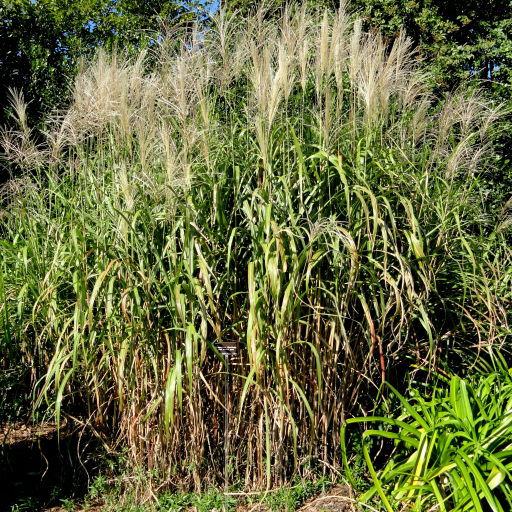
Standing tall like a shimmering wall of silver, Miscanthus floridulus—commonly known as Giant Miscanthus or Pacific Island Silvergrass—is the undisputed titan of the ornamental grass world. Native to the islands of the Pacific and East Asia, this perennial powerhouse is often nicknamed "Sword Grass" due to its imposing height and sharp-edged blades. It is a favorite for gardeners looking to create instant privacy or a dramatic, swaying backdrop that catches the wind and light beautifully.
🔍 How to Identify
- ⚔️ The Foliage: Long, narrow leaves arch gracefully from the center. They feature a prominent, silvery-white mid-rib and edges that are surprisingly sharp to the touch.
- 🌾 The Plumes: In late summer and autumn, the plant sends up massive, feathery flower panicles. These start with a pinkish or purplish tint before maturing into a fluffy, silvery-white cloud that persists through winter.
- 🎋 The Stems: The stalks are remarkably sturdy and cane-like, resembling bamboo. They can reach heights of 10 to 12 feet (3-4 meters) in a single season, maintaining their structure even in heavy winds.
🏡 In Your Garden
- 🛡️ Natural Privacy: Because of its rapid growth and dense habit, it is the perfect "living fence." It provides an excellent visual screen for pools or property lines without the need for a permit or a carpenter.
- 🌊 Coastal Warrior: Unlike many delicate garden plants, this grass thrives in coastal conditions. It is highly salt-tolerant and can handle the buffeting winds of a shoreline environment without snapping.
- 🌱 Spacing is Key: This is a clumping grass, but it is a "giant" for a reason. Give it plenty of room at the start, as its root system is vigorous and it can be difficult to relocate once the massive root ball is established.
⚠️ Safety & Toxicity
- 🩹 Physical Hazard: While the plant is non-toxic to humans, cats, and dogs, its leaves are "serrated" on a microscopic level. Handling the plant without gloves can result in painful "paper cuts" on the skin.
- 🐾 Pet Safety: It is generally considered safe and non-poisonous, though the tough fibers can cause mild digestive upset if a curious pet decides to chew on the coarse leaves.
✨ Fun Fact
In its native Pacific habitats, the sturdy stalks of Miscanthus floridulus have been used for centuries as a traditional material for thatching roofs and crafting arrows, proving that it is as functional as it is beautiful!

Detailed Care Instructions
To grow Miscanthus floridulus (giant miscanthus) plant, follow these steps:
- Choosing the Right Location: Select a location that receives full sun or partial shade. The plant can tolerate poor soil conditions and is ideal for erosion control, making it suitable for a variety of soil types.
- Preparing the Soil: Clear the area of any weeds or grass before planting. Use a garden fork or tiller to loosen the soil to a depth of 12-16 inches. Incorporate organic matter (such as compost or well-rotted manure) into the soil to improve fertility and drainage.
- Planting: Dig a hole that is deep enough to accommodate the root ball of the plant. Place the Miscanthus floridulus plant in the hole, making sure that the crown sits slightly above the soil level. Backfill the hole with soil, firming it gently around the roots.
- Watering: Water the plant thoroughly after planting to help settle the soil and eliminate any air pockets around the roots. Keep the soil consistently moist but not waterlogged, especially during the first growing season.
- Mulching: Apply a layer of organic mulch, such as wood chips or straw, around the base of the plant to help conserve moisture, suppress weeds, and insulate the roots.
- Maintenance: As the plant grows, keep it well-watered but avoid overwatering. However, once established, Miscanthus floridulus is known to be drought-tolerant. Remove any weeds that may compete with the plant for nutrients and water. In late winter or early spring, cut the plant back to a few inches above the ground level to promote new growth.
- Propagation: Miscanthus floridulus can be propagated through division, which is best done in early spring. Dig up the plant and divide it into sections, each with an equal portion of roots and shoots. Replant the divided sections as individual plants in suitable locations.
By following these steps, you can successfully grow Miscanthus floridulus plant in your garden or landscape.

Place in a bright room that is sun drenched almost all day. Or directly in a south-facing window.

1. Determine the water needs: Before watering, it is important to know how much water the Miscanthus Floridulus plant requires. The water requirements of the plant depend on factors such as its age, size, weather conditions, and soil type.
2. Check the soil moisture: To determine whether the plant needs water, check the soil moisture level. Insert your finger about an inch deep into the soil. If the soil feels dry at this depth, it is time to water the plant.
3. Water thoroughly: When watering the Miscanthus Floridulus plant, make sure to water it thoroughly. This means watering it until the water reaches the root system. Avoid only watering the surface of the soil, which can lead to shallow root growth.
4. Avoid overwatering: Overwatering can be just as harmful as underwatering. To avoid overwatering, wait until the soil is dry before watering the plant again.
5. Water on a schedule: It is best to water the Miscanthus Floridulus plant on a regular schedule rather than on an as-needed basis. This helps prevent underwatering and overwatering by establishing a consistent moisture level in the soil.
6. Water in the morning: It is best to water the plant in the morning rather than in the evening. This gives enough time for the excess water to evaporate from the soil and the plant to absorb the water it needs during the day.
7. Use room temperature water: It is recommended to use room temperature water to prevent shocking the roots of the plant. Cold water can sometimes cause stress to the plant, while hot water can damage the root system.
8. Water at the base of the plant: When watering, avoid getting the foliage wet. Instead, water at the base of the plant to direct the water to the root system.
To fertilize this particular plant, apply a balanced fertilizer with equal parts nitrogen, phosphorus, and potassium. Apply the fertilizer in early spring before new growth begins and again in midsummer. Spread the fertilizer evenly over the soil around the base of the plant, being careful not to get any on the leaves. Water the plant thoroughly after fertilizing. Avoid over-fertilizing as this can lead to weak, spindly growth.
If you are planning to grow the plant with the scientific name Miscanthus Floridulus, it is recommended to use a well-draining soil with a pH level between 6.0 and 7.5. Furthermore, the soil should be rich in organic matter to support the growth of the plant. It can be planted in a loamy soil with a mixture of sand and compost to aid drainage and to encourage healthy root growth. Avoid using heavy soils as they can impede drainage and cause root rot. Additionally, adding mulch to the soil surface can help to retain moisture and provide nutrients to the plant. It is also recommended to regularly test the soil to ensure the plant is receiving the proper nutrients for optimal growth.
To propagate this plant, one can take stem cuttings from the parent plant and place them in a rooting hormone solution to encourage root growth. The stem cuttings should be at least 6 inches long and have several nodes where leaves or stems emerge.
Next, remove the lower leaves from the stem cutting and dip the cut end into the rooting hormone solution.
Plant the stem cutting into a pot filled with well-draining soil and keep it moist while it develops roots. It is important to keep the pot in a warm, bright location but out of direct sunlight.
Once roots have developed, the plant can be transplanted into a larger pot or directly into the ground.








