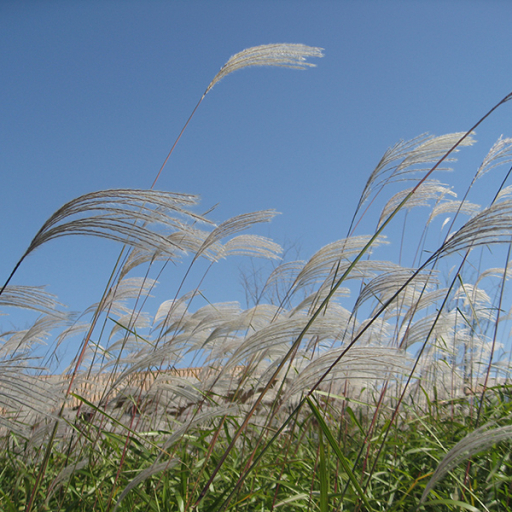
Plant Overview
Known as the Amur Silvergrass or Silver Plumegrass, this towering beauty is the elegant giant of the grass world. Native to the riverbanks of East Asia, it creates shimmering, rhythmic waves in the wind that have inspired poets and garden designers for centuries. While it looks like a delicate ornamental, it is a powerhouse of growth, often used to create living privacy screens in a single season.
🔍 How to Identify
- 🌾 The Foliage: Long, arching blades that can reach up to 8 feet in height, featuring a prominent, silvery-white midrib running down the center of each leaf.
- ☁️ The Plumes: In late summer, it produces spectacular, silky-white flower heads (panicles) that sit high above the leaves, catching the light like polished silver.
- 🎋 The Structure: Unlike its cousin Miscanthus sinensis, this species spreads via underground runners (rhizomes), creating dense, bamboo-like thickets over time.
🏡 In Your Garden
- 🌊 Thirst for Moisture: Its name sacchariflorus hints at its "sweet" or "sugar-like" flowers, but its real secret is a love for water. It thrives in damp soil and is a perfect choice for stabilizing pond edges or soggy spots where other plants fail.
- 🏃 Space Management: Be aware that this plant is a "runner." Without a root barrier or plenty of space, it will quickly expand its territory. It’s best used in large landscapes or contained areas where its aggressive growth can be appreciated as a natural hedge.
⚠️ Safety & Toxicity
- ✅ Status: Generally non-toxic to humans and common household pets like dogs and cats.
- ✂️ Physical Hazard: Use caution when pruning or walking through dense patches; the edges of the leaves are finely serrated and can cause "paper-cut" style nicks on sensitive skin.
✨ Fun Fact
In its native regions, Miscanthus sacchariflorus isn't just a pretty face—it is a traditional source for high-quality papermaking! Today, scientists are studying it as a high-yield "bioenergy crop" because it grows so quickly and captures massive amounts of carbon from the atmosphere.

Detailed Care Instructions
To grow Miscanthus Sacchariflorus plant, here are some steps you can follow:
- Climate and soil requirements: Ensure that you are in a suitable climate zone for growing Miscanthus Sacchariflorus, which is typically USDA hardiness zones 5 to 9. The plant grows well in fertile, well-drained soil with a pH range of 5.5 to 7.5.
- Planting: Choose a sunny location for planting the Miscanthus Sacchariflorus. You can either sow the seeds directly into the ground or start with young plants obtained from a nursery. If growing from seeds, sow them in early spring, about 1/4 inch deep, and keep the soil consistently moist until the seeds germinate.
- Watering: Once established, Miscanthus Sacchariflorus is quite drought-tolerant. However, it is recommended to water the plant regularly during the first growing season to help establish deep roots. After that, water sparingly, only during prolonged dry spells.
- Fertilizing: Apply a balanced, slow-release fertilizer in spring to provide the necessary nutrients for healthy growth. Follow the instructions on the fertilizer packaging for the correct dosage.
- Maintenance: Miscanthus Sacchariflorus is a low-maintenance plant. However, it can benefit from annual winter pruning to remove dead or damaged stems. Cut back the foliage to about 6 inches from the ground in late winter or early spring before new growth emerges.
- Division: Every few years, Miscanthus Sacchariflorus may become crowded and require division. Dig up the plant in early spring, separate the clumps into smaller sections, and replant them in well-prepared soil.
- Pests and diseases: Miscanthus Sacchariflorus is generally resistant to pests and diseases. However, keep an eye out for common garden pests like aphids or spider mites. If an infestation occurs, treat it with an appropriate insecticidal soap or pesticide.
Remember to check your local gardening guidelines and recommendations specific to your region when growing Miscanthus Sacchariflorus, as certain practices might differ depending on local conditions.

Place in a bright room that is sun drenched almost all day. Or directly in a south-facing window.

To water this plant, it is important to ensure that the soil remains consistently moist, but not waterlogged. This can be achieved by watering deeply once or twice a week, depending on the local climate and soil conditions, taking care not to let the soil completely dry out between waterings. It may be helpful to check the moisture level of the soil before watering, either by using a soil moisture meter or by sticking your finger into the soil to a depth of about an inch. If the soil feels dry at this depth, it is time to water. Avoid getting the foliage wet, as this can lead to fungal growth and other plant diseases. In general, this plant prefers well-draining soil and regular irrigation to help it thrive.
To fertilize the Miscanthus Sacchariflorus plant, follow these instructions:
- Choose a balanced, slow-release granular fertilizer with a ratio of nitrogen (N), phosphorus (P), and potassium (K), such as a 10-10-10 or 14-14-14 NPK fertilizer.
- Apply the fertilizer in early spring or early summer when new growth emerges.
- Calculate the appropriate amount of fertilizer to use based on the size of the plant and the manufacturer's recommendations. Generally, use about 1/4 to 1/2 cup of fertilizer per plant.
- Sprinkle the fertilizer evenly around the base of the plant, keeping it about 6-12 inches away from the stem.
- Gently work the fertilizer into the top inch of soil using a garden rake or cultivator, taking care not to damage the plant's roots.
- Water the plant thoroughly after fertilizing to ensure the nutrients are absorbed into the soil.
- Repeat the fertilization process annually in spring or summer to provide a continuous supply of nutrients for healthy growth.
- Monitor the plant's overall health and growth throughout the year, adjusting the fertilization schedule or amount if necessary. This plant generally requires moderate fertilization to avoid nutrient depletion in the soil.
The ideal soil for the plant has a neutral to slightly acidic pH level and is well-draining. The soil should be rich in organic matter and nutrients, as the plant requires ample nourishment to grow to its full potential. A sandy loam or loamy soil that is not too heavy on clay content is a good choice for Miscanthus Sacchariflorus. The soil should also be able to retain moisture but not stay waterlogged for extended periods. Fertilizers that are high in potassium and nitrogen should also be applied to the soil periodically to promote healthy growth.
To propagate the genus of grass commonly known as Miscanthus Sacchariflorus, here is a detailed guide:
- Obtaining Seeds:
- Identify the parent plant(s) from which you wish to collect seeds.
- During late summer or early autumn, wait for the seed heads to become mature and fluffy.
- Cut the seed heads from the parent plant, ensuring they are fully ripe but not yet releasing seeds.
- Identify the parent plant(s) from which you wish to collect seeds.
- Seed Preparation:
- Spread the seed heads on a clean, dry surface and allow them to air dry for about a week.
- Once dried, gently rub or shake the seed heads to separate the seeds from the fluffy pappus.
- Collect the seeds and store them in a labeled paper envelope or an airtight container in a cool, dry place until ready for sowing.
- Spread the seed heads on a clean, dry surface and allow them to air dry for about a week.
- Seed Stratification:
- Miscanthus Sacchariflorus seeds often require stratification to overcome dormancy.
- In early spring, transfer the seeds to a damp paper towel or place them in a plastic bag with a moistened paper towel.
- Seal the bag or cover the paper towel-wrapped seeds with another damp cloth or plastic wrap.
- Store the seeds in a refrigerator or a cool location with a temperature between 33-41°F (1-5°C) for about 4-6 weeks.
- Miscanthus Sacchariflorus seeds often require stratification to overcome dormancy.
- Choosing a Planting Site:
- Select a planting site that provides full or partial sunlight and well-draining soil.
- Prepare the soil by removing any weeds, rocks, or debris, and loosen it to a depth of at least 6-8 inches (15-20 cm).
- Amend the soil with organic matter, such as compost, to improve fertility and drainage if necessary.
- Select a planting site that provides full or partial sunlight and well-draining soil.
- Sowing Seeds:
- After the stratification period, sow the stratified seeds in early spring, once the danger of frost has passed.
- Broadcast the seeds evenly over the prepared soil surface or sow them in rows, maintaining a spacing of 2-3 feet (60-90 cm) between plants.
- Lightly cover the seeds with a thin layer of soil, around 1/8 inch (3 mm), and gently press them down.
- After the stratification period, sow the stratified seeds in early spring, once the danger of frost has passed.
- Germination and Transplanting:
- Keep the seeded area consistently moist but not waterlogged until germination occurs.
- Germination typically takes 2-4 weeks, but it can vary depending on temperature, moisture, and seed quality.
- Once the seedlings have developed several sets of leaves and are around 4-6 inches (10-15 cm) tall, transplant them to their permanent location.
- Dig a hole slightly larger than the root ball, place the seedling, and backfill with soil, gently firming it around the roots.
- Water the transplanted seedlings thoroughly to settle the soil.
- Keep the seeded area consistently moist but not waterlogged until germination occurs.
- Care and Maintenance:
- Water the plants regularly during the growing season to keep the soil evenly moist.
- Apply a layer of organic mulch around the plants to conserve moisture, suppress weed growth, and insulate the roots.
- Fertilize the Miscanthus Sacchariflorus plants annually in early spring with a balanced slow-release fertilizer according to the package instructions.
- Prune the plants in late winter or early spring before new growth emerges by cutting back the previous year's foliage to ground level.
- Divide overcrowded clumps every 3-4 years in early spring to maintain plant health and vigor.
Note: It is important to research and comply with any legal requirements or agricultural regulations related to the propagation of Miscanthus Sacchariflorus, as it may be subject to restrictions due to its potential invasive characteristics.
- Water the plants regularly during the growing season to keep the soil evenly moist.








