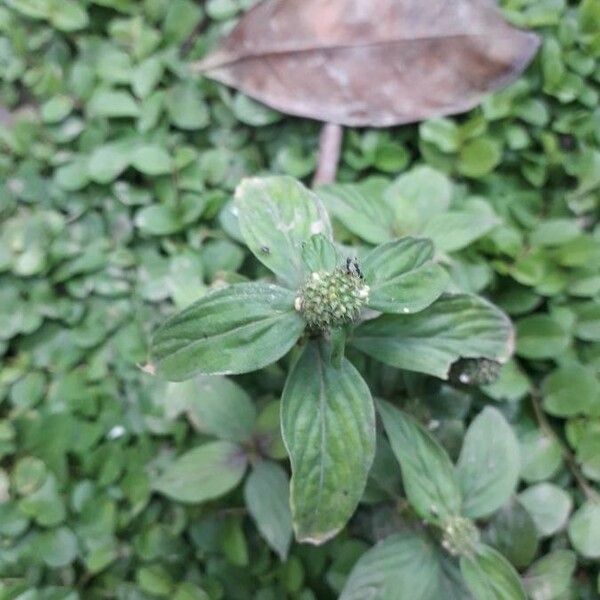
Plant Overview
Often called the White Girdlepod or Shaggy Mitracarpus, this resilient little herb is a master of disguise. While many gardeners might dismiss it as just another "weed" in the lawn, it is a fascinating world traveler that originated in the American tropics before spreading across the globe. It gets its name from the way its flower clusters "girdle" the stem, looking like tiny, snowy white belts wrapped around a fuzzy green stalk.
🔍 How to Identify
- ⚪ The "Girdle" Blooms: Look for tiny, four-petaled white flowers packed into dense, spherical clusters. These appear at the points where the leaves meet the stem (axils) and at the very tips of the branches.
- 🌿 Hairy Stems: True to its Latin name hirtus (meaning "hairy"), the stems are distinctly fuzzy and usually square-shaped, giving the plant a rugged, textured feel.
- 🍃 Opposite Leaves: The leaves grow in pairs directly across from one another. They are narrow, lance-shaped, and feature prominent veins that look like they’ve been pressed into the leaf surface.
🏡 In Your Garden
- 🌱 The Opportunist: You will most likely find the White Girdlepod in "disturbed" areas—cracks in the sidewalk, edges of flower beds, or patches of thin grass. It thrives where other plants struggle because it can tolerate compacted, poor-quality soil.
- ☀️ Sun Seeker: This plant is a sun-lover. If it pops up in your garden, it’s a sign that the area is getting plenty of direct light. Because it has a strong taproot, it is surprisingly drought-tolerant and difficult to pull out in one piece once established.
⚠️ Safety & Toxicity
- ✅ Low Risk: Mitracarpus hirtus is not considered a toxic plant for humans or common household pets like dogs and cats.
- 🧤 Skin Sensitivity: While not poisonous, the "shaggy" hairs on the stems and leaves can be slightly abrasive. If you have very sensitive skin, handling a large amount of it while weeding might cause mild, temporary itching.
✨ Fun Fact
In various parts of Africa and South America, this "weed" is actually highly respected in traditional medicine. It is often crushed into a paste and applied topically to treat fungal skin infections like ringworm, thanks to its natural antifungal properties!

Detailed Care Instructions
To grow Mitracarpus hirtus, also known as "Bullhead," you can follow these steps:
- Choose a suitable location: Find a location with full or partial sun exposure. Bullhead prefers warm climates and well-draining soil.
- Prepare the soil: Before planting, prepare the soil by loosening it and removing any weeds or rocks. Bullhead thrives best in sandy or loamy soil.
- Sow seeds or plant cuttings: You can propagate Mitracarpus hirtus either by seeds or cuttings. If using seeds, sow them directly in the prepared soil, making sure they are covered just lightly with a thin layer of soil. For cuttings, take a stem cutting from a healthy Bullhead plant and plant it in the soil.
- Watering: Keep the soil moist but not waterlogged. Water regularly, especially during dry periods, but avoid overwatering as it may lead to root rot. Bullhead prefers to be slightly dry between waterings.
- Mulching: Adding a layer of organic mulch around the base of the plant can help retain moisture and control weeds.
- Fertilizing: Apply a balanced organic fertilizer during the growing season to promote healthy growth. Follow the package instructions for the recommended dosage.
- Pruning: Mitracarpus hirtus can benefit from occasional pruning to maintain its shape and promote bushier growth. Pruning also helps remove any dead or diseased branches.
- Pests and diseases: Bullhead is generally a hardy plant and not prone to pests or diseases. However, keeping an eye out for common garden pests like aphids or spider mites is always a good practice. In case of any infestations or diseases, treat them promptly using organic insecticides or fungicides.
- Propagation: If you wish to propagate more Mitracarpus hirtus plants, you can collect seeds from mature fruits or take stem cuttings during the growing season.
With proper care and environment, your Mitracarpus hirtus plant should grow steadily and provide an attractive addition to your garden.

Place in a bright room that is sun drenched almost all day. Or directly in a south-facing window.

To properly water this plant, you should begin by thoroughly saturating the soil around its base, ensuring that the water penetrates deep into the roots. The frequency of watering will depend on the climate and the location of the plant, but generally, you should aim to keep the soil consistently moist without allowing it to become waterlogged. It is also important to avoid getting water on the leaves as this can lead to fungal diseases. Consider using a watering can or hose with a gentle spray nozzle to direct the water towards the soil while avoiding the foliage. Additionally, if the plant is growing in a container, it may require more frequent watering than if it were growing in the ground. As with all plants, it is important to monitor the soil moisture levels closely and adjust your watering routine as needed to ensure optimal growth and health.
To fertilize this plant, you should choose a balanced fertilizer with equal amounts of nitrogen, phosphorus, and potassium. Apply the fertilizer once every two weeks during the growing season, which is usually in the spring and summer months. It is important to follow the instructions on the fertilizer package, as over-fertilizing can harm the plant. Additionally, make sure to water the plant thoroughly before and after fertilizing to avoid burning the roots.
When growing Mitracarpus Hirtus, it is important to use a well-draining soil that is rich in organic matter. The ideal soil should have a pH range of 6.0-7.0 and should not be too compacted or dense, as this can impede root growth and lead to nutrient deficiencies.
A good soil mix for Mitracarpus Hirtus should include a blend of peat moss, perlite, and vermiculite to increase drainage and promote healthy root growth. The soil should also be enriched with a slow-release fertilizer that contains essential micronutrients such as phosphorus, potassium, and nitrogen.
It is essential to ensure that the soil remains moist but not saturated, as over-watering can lead to root rot and other fungal diseases. Additionally, the soil should be amended regularly with organic matter such as compost or well-rotted manure to improve soil fertility and maintain optimal soil structure.
Overall, providing Mitracarpus Hirtus with well-draining, nutrient-rich soil is essential for promoting healthy growth and robust blooming of this beautiful, low-maintenance plant.
Mitracarpus Hirtus plant can be propagated through stem cuttings. The process involves taking a healthy stem cutting of about 4-6 inches in length from the mother plant using a sharp knife. The cutting should be taken from a mature, disease-free stem that has at least three nodes.
Once the cutting is obtained, the lower part of the stem should be stripped of leaves, and the cutting should be treated with rooting hormone to encourage root development. Then, the cutting can be inserted into moist soil or a rooting medium such as sand, vermiculite, or perlite.
The cutting should be kept in a warm, humid environment with bright, indirect sunlight, and the soil should be kept moist but not waterlogged. It's advisable to cover the cutting with a clear plastic bag or a humidity dome to maintain high humidity levels and prevent moisture loss.
After about 2-3 weeks, the cutting should develop roots and start to grow. Once roots are well-established and the plant has grown a few inches, it can be transplanted into a pot or the ground. With proper care and maintenance, the plant will continue to grow and flourish.








