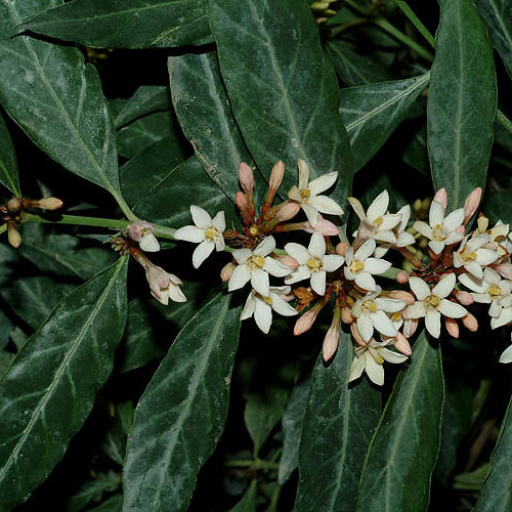
Plant Overview
Often whispered about as the "African Gardenia" or "African False Coffee," this enchanting evergreen shrub hails from the coastal forests of South Africa. It is a favorite among indoor gardeners who crave the intoxicating, jasmine-like scent of a Gardenia but lack the patience for their finicky nature. This plant is a storyteller of the shade, filling the air with perfume while showing off its jewel-like orange berries.
🔍 How to Identify
- 🍃 Glossy Foliage: The leaves are a deep, lustrous green, shaped like elegant lances with slightly wavy edges that catch the light.
- 🌸 Axillary Blooms: Unlike many plants that flower at the tips, these creamy-white, star-shaped blossoms emerge in clusters right from the leaf axils (the "armpits" of the plant).
- 🍒 Colorful Berries: After the flowers fade, small oval fruits appear, transitioning from a humble green to a striking, waxy orange or red when mature.
🏡 In Your Garden
- ☁️ The Shade Dweller: In its natural habitat, this plant lives under the canopy of tall trees. In your home or garden, it shuns the harsh afternoon sun, preferring the soft, filtered light of a morning window or a dappled patio.
- 💧 Humidity Lover: It thrives in "heavy" air. If the leaf tips start to brown, it’s likely a plea for a pebble tray or a nearby humidifier to mimic its native subtropical mist.
- 🌱 Acidic Appetites: It performs best in rich, organic soil that leans slightly acidic. Using a potting mix designed for Azaleas or Camellias will keep those glossy leaves from turning yellow.
⚠️ Safety & Toxicity
- 🐾 Mild Caution: While not considered high-risk like Oleander or Lilies, the berries and foliage of the Mitriostigma can cause mild digestive upset if ingested.
- 👶 Keep Out of Reach: Because the bright orange berries look like candy to curious toddlers or pets, it is best kept on a high shelf or a stand where the "forbidden fruit" remains out of reach.
✨ Fun Fact
The name "False Coffee" isn't just a coincidence! Mitriostigma axillare belongs to the Rubiaceae family, making it a direct relative of the plant that produces your morning cup of Joe. While you can't brew these berries, they share the same signature "twin-seed" structure found inside real coffee cherries.

Detailed Care Instructions
Mitriostigma axillare, commonly known as African Gardenia, is a beautiful and relatively rare plant that can thrive under the right conditions. Here's a step-by-step guide to help you grow and care for this plant:
Growing Conditions
- Light:
- Indoors: Bright, indirect sunlight is ideal. Avoid direct sunlight, which can scorch the leaves.
- Outdoors: Partial shade is best if you're growing it outdoors in a suitable climate. It can tolerate some morning or late afternoon sun but should be protected from harsh midday sun.
- Indoors: Bright, indirect sunlight is ideal. Avoid direct sunlight, which can scorch the leaves.
- Temperature:
- Mitriostigma axillare prefers temperatures between 60-77°F (15-25°C). It can tolerate slightly cooler temperatures but should be protected from frost.
- Mitriostigma axillare prefers temperatures between 60-77°F (15-25°C). It can tolerate slightly cooler temperatures but should be protected from frost.
- Humidity:
- High humidity is beneficial. If you’re growing it indoors, consider using a humidity tray or a room humidifier to maintain adequate moisture levels around the plant.
- High humidity is beneficial. If you’re growing it indoors, consider using a humidity tray or a room humidifier to maintain adequate moisture levels around the plant.
- Soil:
- Use a well-draining, acidic to neutral potting mix. A mixture of peat, perlite, and pine bark is effective. Good drainage is crucial to prevent root rot.
- Use a well-draining, acidic to neutral potting mix. A mixture of peat, perlite, and pine bark is effective. Good drainage is crucial to prevent root rot.
- Watering:
- Keep the soil consistently moist, but not waterlogged. Water when the top inch of the soil feels dry. Reduce watering slightly in the winter months when the plant’s growth slows down.
- Keep the soil consistently moist, but not waterlogged. Water when the top inch of the soil feels dry. Reduce watering slightly in the winter months when the plant’s growth slows down.
- Fertilizer:
- During the growing season (spring and summer), fertilize every 4-6 weeks with a balanced, water-soluble fertilizer diluted to half strength. Do not fertilize in the winter.
Planting and Propagation
- During the growing season (spring and summer), fertilize every 4-6 weeks with a balanced, water-soluble fertilizer diluted to half strength. Do not fertilize in the winter.
- Propagation by Seed:
- Seeds of Mitriostigma axillare should be fresh. Sow them in a well-draining seed-starting mix and keep the substrate moist. Maintain warm temperatures (70-75°F or 21-24°C) and high humidity to encourage germination. Seedlings may take several weeks to appear.
- Seeds of Mitriostigma axillare should be fresh. Sow them in a well-draining seed-starting mix and keep the substrate moist. Maintain warm temperatures (70-75°F or 21-24°C) and high humidity to encourage germination. Seedlings may take several weeks to appear.
- Propagation by Cuttings:
- Take semi-hardwood cuttings during the growing season (late spring to early summer).
- Cut a 4-6 inch (10-15 cm) section just below a node.
- Remove the lower leaves and dip the cut end in rooting hormone.
- Plant the cutting in a pot with a well-draining mix and keep it in a warm, humid environment. Covering the pot with a plastic bag can help maintain humidity.
- Ensure the soil remains moist, and roots should develop in a few weeks.
General Care
- Take semi-hardwood cuttings during the growing season (late spring to early summer).
- Pruning:
- Prune the plant lightly to maintain its shape and remove any dead or yellowing leaves. Pruning can also encourage bushier growth.
- Prune the plant lightly to maintain its shape and remove any dead or yellowing leaves. Pruning can also encourage bushier growth.
- Pests and Diseases:
- Watch for common pests such as aphids, spider mites, and mealybugs. Treat infestations with insecticidal soap or neem oil.
- Ensure good air circulation around the plant to prevent fungal infections. Avoid overwatering to reduce the risk of root rot.
- Watch for common pests such as aphids, spider mites, and mealybugs. Treat infestations with insecticidal soap or neem oil.
- Repotting:
- Repot your Mitriostigma axillare every 2-3 years or when it outgrows its current pot. Choose a slightly larger container and refresh the potting soil to provide new nutrients.
Providing the right conditions and care will help your Mitriostigma axillare thrive, offering you beautiful foliage and fragrant flowers.
- Repot your Mitriostigma axillare every 2-3 years or when it outgrows its current pot. Choose a slightly larger container and refresh the potting soil to provide new nutrients.

Place in a window with dappled sun or a spot in the middle of a room. Or directly in a window facing west or east.

Watering Mitriostigma axillare requires a good understanding of its natural habitat and specific needs. Here's a detailed guide on how to do it properly:
1. **Soil Moisture**: This plant prefers consistently moist soil but does not tolerate waterlogged conditions. Check the soil moisture regularly by inserting your finger about an inch deep into the soil. If it feels dry at that depth, it's time to water.
2. **Water Quality**: Use room-temperature, distilled, or rainwater whenever possible. This plant can be sensitive to the chemicals found in tap water.
3. **Watering Frequency**: During the growing season (spring and summer), water the plant more frequently, ensuring the soil remains moist. In the dormant period (fall and winter), reduce watering but do not let the soil dry out completely.
4. **Watering Method**: Water the soil directly rather than from above the plant to avoid wetting the foliage, which can promote fungal growth. Pour water slowly and evenly until it begins to seep out of the drainage holes at the bottom of the pot. Allow the soil to drain completely before placing the pot back on its saucer.
5. **Humidity**: This plant thrives in a humid environment. If your indoor air is dry, consider placing a humidity tray nearby or using a room humidifier to maintain adequate moisture levels in the air.
6. **Pot and Drainage**: Ensure the plant is in a pot with adequate drainage holes to prevent water from accumulating at the bottom. A well-draining soil mix is also essential to avoid root rot.
7. **Monitoring and Adjustment**: Pay attention to your plant's response to watering. If the leaves begin to yellow and fall off, you may be overwatering. Conversely, if the leaves are wilting or curling, you might need to increase the watering frequency.
By following these guidelines, you can provide appropriate hydration to Mitriostigma axillare and promote its health and growth.
To fertilize Mitriostigma axillare properly, follow these guidelines:
- Choosing the Fertilizer: Use a balanced, water-soluble fertilizer with a ratio such as 10-10-10 or 20-20-20. This ensures an even distribution of nitrogen, phosphorus, and potassium, which are essential for healthy growth.
- Frequency: During the growing season (spring and summer), fertilize every 4-6 weeks. In the dormant period (fall and winter), reduce fertilizing to once every 8-10 weeks, or stop completely, depending on the plant's growth and health.
- Dilution: Always dilute the fertilizer to half the recommended strength. Over-fertilizing can harm the plant’s roots and lead to nutrient burn.
- Application: Water the plant thoroughly before and after applying the fertilizer. This helps distribute the nutrients evenly and prevents root burn from the concentrated solution.
- Soil and pH: Ensure the soil is well-draining and slightly acidic to neutral (pH 6.0-7.0) for optimal nutrient absorption.
- Monitoring: Regularly check the plant for signs of nutrient deficiency or excess, such as yellowing leaves or slowed growth, and adjust your fertilizing schedule accordingly.
Always make sure to assess the specific needs of your plant and the growing conditions it is in, as these can influence how often and how much fertilizer should be applied.
Mitriostigma axillare is a plant that is best grown in conditions that mimic its natural habitat. For optimal growth, consider the following soil characteristics:
- Well-Draining Soil: This plant requires soil that allows excess water to drain quickly to avoid root rot. A mix designed for African violets or a custom mix that includes peat, perlite, and coarse sand can be beneficial.
- Slightly Acidic pH: Aim for a soil pH that is slightly acidic, ideally between 5.5 and 6.5. This helps the plant to absorb nutrients effectively.
- Organic Matter: Enrich the soil with organic matter such as leaf mold, compost, or well-rotted manure. This will improve soil texture and fertility, providing the nutrients required for healthy growth.
- Nutrient-Rich: Ensure the soil is fertile and contains the necessary nutrients. You can mix in some balanced slow-release fertilizer or supplement with liquid fertilizer during the growing season.
- Aeration: Good aeration is critical to allow for root breathing and reduce risks of compaction which could lead to poor growth. Adding components like perlite or orchid bark can improve aeration.
By carefully selecting or preparing a soil mix that meets these criteria, you can create a conducive environment for the optimal growth of Mitriostigma axillare.
Mitriostigma axillare can be propagated through both seeds and cuttings. Here's a detailed guide for each method:
Propagation by Seeds
- Seed Collection:
- Collect seeds from mature fruits. Ensure that the fruits are ripe.
- Collect seeds from mature fruits. Ensure that the fruits are ripe.
- Cleaning:
- Clean the seeds by removing any pulp or organic residue to prevent mold growth. Rinse them thoroughly with water.
- Clean the seeds by removing any pulp or organic residue to prevent mold growth. Rinse them thoroughly with water.
- Stratification (Optional):
- Some seeds may benefit from a stratification period. Place the seeds in a moist medium like sand or peat moss. Store them in a refrigerator for about 4 to 6 weeks.
- Some seeds may benefit from a stratification period. Place the seeds in a moist medium like sand or peat moss. Store them in a refrigerator for about 4 to 6 weeks.
- Sowing:
- Sow the seeds in a well-draining, sterile seed-starting mix.
- Push the seeds lightly into the soil, covering them just slightly, as they may need some light to germinate.
- Sow the seeds in a well-draining, sterile seed-starting mix.
- Watering and Humidity:
- Keep the soil consistently moist. Use a spray bottle to mist the soil surface gently.
- Cover the seed tray with a plastic dome or clear plastic wrap to maintain high humidity.
- Keep the soil consistently moist. Use a spray bottle to mist the soil surface gently.
- Lighting:
- Place the seed tray in a location with bright, indirect light. Avoid direct sunlight.
- Place the seed tray in a location with bright, indirect light. Avoid direct sunlight.
- Germination:
- Germination can take several weeks to a few months. Keep an eye on the moisture level and maintain a stable temperature (around 20-25°C or 68-77°F).
- Germination can take several weeks to a few months. Keep an eye on the moisture level and maintain a stable temperature (around 20-25°C or 68-77°F).
- Transplanting:
- Once seedlings have grown a few sets of true leaves, they can be transplanted into individual containers.
Propagation by Cuttings
- Once seedlings have grown a few sets of true leaves, they can be transplanted into individual containers.
- Selecting Cuttings:
- Take cuttings from a healthy, mature plant. Choose semi-hardwood cuttings (neither too young nor too old), about 10-15 cm (4-6 inches) long.
- Take cuttings from a healthy, mature plant. Choose semi-hardwood cuttings (neither too young nor too old), about 10-15 cm (4-6 inches) long.
- Preparing Cuttings:
- Remove the lower leaves, leaving only a few at the top.
- If desired, dip the cut end in rooting hormone to enhance root development.
- Remove the lower leaves, leaving only a few at the top.
- Planting:
- Insert the cuttings into a well-draining, sterile rooting medium such as a mix of perlite and peat moss.
- Plant the cuttings about one-third of their length into the medium.
- Insert the cuttings into a well-draining, sterile rooting medium such as a mix of perlite and peat moss.
- Watering and Humidity:
- Water the cuttings lightly to moisten the medium.
- Cover the container with a plastic bag or place it in a propagator to create a humid environment.
- Water the cuttings lightly to moisten the medium.
- Lighting:
- Place the container in a bright but indirect light location. Avoid direct sunlight, which can scorch the cuttings.
- Place the container in a bright but indirect light location. Avoid direct sunlight, which can scorch the cuttings.
- Root Development:
- Check the cuttings regularly and keep the medium moist but not waterlogged.
- Rooting typically takes several weeks. Tug gently on the cuttings to check for resistance, indicating root formation.
- Check the cuttings regularly and keep the medium moist but not waterlogged.
- Transplanting:
- Once the cuttings have established roots and show new growth, they can be transplanted into individual pots with regular potting soil.
By following these steps, you should be able to successfully propagate Mitriostigma axillare through either seeds or cuttings.
- Once the cuttings have established roots and show new growth, they can be transplanted into individual pots with regular potting soil.
Common pests of the african gardenia include Scale insect, mealybugs, spider mites. Make a habit of checking your african gardenia frequently for pests so that any infestations can be caught and managed early.








