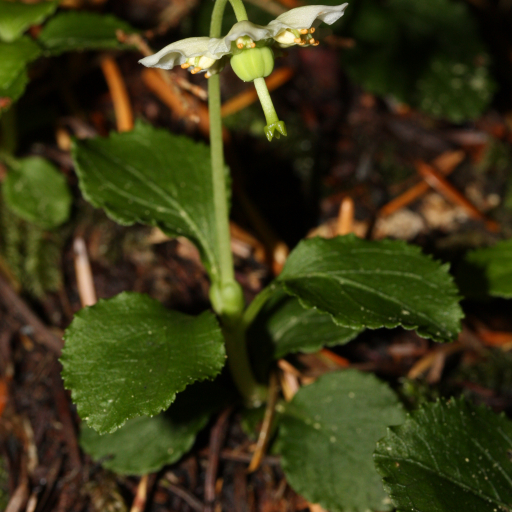
Plant Overview
Known as the "Single Delight" or the "Wood Nymph," Moneses uniflora is a tiny, ethereal treasure of the deep forest floor. Unlike its wintergreen relatives that bloom in crowded clusters, this plant lives up to its name by producing just one exquisite, nodding flower. It is a symbol of the quiet, untouched beauty found in ancient, mossy woodlands.
🔍 How to Identify
- 🌸 The Blossom: A single, five-petaled, waxy white or pale pink flower that hangs downward like a shy bell.
- 🟢 The "Elephant Trunk": At the center of the flower, a long, prominent green pistil (the female part) protrudes and curves upward, looking remarkably like a tiny trunk.
- 🍃 Ground Rosette: A small cluster of dark green, rounded leaves with lightly toothed edges stays close to the ground, often hidden by moss.
- 🕯️ The Stalk: A thin, leafless stem that curves gracefully at the top to display its solitary bloom.
🌲 Habitat & Ecology
- 🍄 Fungal Partnership: This plant is "mycoheterotrophic," meaning it relies on a complex relationship with underground fungal networks to get nutrients. This is why it is almost impossible to transplant; if the fungi aren't there, the plant cannot eat.
- 🌲 Old-Growth Resident: You will typically find it in cool, damp, coniferous forests, often tucked away in thick carpets of sphagnum moss or near rotting logs where the air stays humid and the light is filtered.
⚠️ Safety & Toxicity
- ✅ Status: Moneses uniflora is generally considered non-toxic to humans, dogs, and cats.
- 🛑 Ethical Warning: While it isn't poisonous, it is extremely sensitive to habitat changes. In many regions, it is rare or protected. Because it is so difficult to grow in gardens, it is best admired in the wild—picking the flower can prevent the plant from spreading its seeds for the next season.
✨ Fun Fact
- 🍦 The Scent of the Woods: If you are lucky enough to find one, get close to the ground. The Single Delight has a surprisingly strong and sweet fragrance, often described as a mix of lily of the valley and spicy cloves.

Detailed Care Instructions
To grow Moneses uniflora, also known as the one-flowered pyrola, follow these steps:
- Choose the right location: Moneses uniflora prefers shady, moist environments such as deciduous or coniferous forests. Select an area in your garden that receives partial to full shade throughout the day.
- Prepare the soil: The soil should be rich, well-draining, and slightly acidic. Amend the soil with organic matter like compost or peat moss to improve its fertility and drainage.
- Planting: In early spring or fall, when the plant is dormant or semi-dormant, dig a hole slightly larger than the root ball. Place the plant in the hole, ensuring the crown (where the roots meet the stem) is level with the soil surface. Backfill the hole with soil and gently firm it around the plant.
- Watering: Moneses uniflora prefers consistently moist soil. Water your plant regularly, keeping the soil evenly moist but not waterlogged. Avoid allowing the soil to dry out completely between waterings.
- Mulching: Apply a layer of organic mulch around the base of the plant to conserve moisture and suppress weed growth. This will also help maintain a cool root environment.
- Fertilizing: Moneses uniflora does not typically require heavy fertilization. However, you can apply a balanced, slow-release fertilizer in spring to provide nutrients for healthy growth. Follow the instructions on the fertilizer packaging for application rates.
- Pruning: Pruning is generally not necessary for Moneses uniflora. However, if any dead or damaged parts appear, you can carefully remove them to maintain plant health and appearance.
- Protecting from pests and diseases: Moneses uniflora is generally pest and disease resistant. However, keep an eye out for slugs or snails, which may feed on the foliage. Use natural pest control methods or remove pests by hand.
- Propagation: Moneses uniflora can be propagated by seed or division. Seeds can be collected after the flowers have faded and sown in a container or directly in the garden. Division can be done in early spring or fall by carefully separating the rhizomes and replanting them.
- Winter care: Moneses uniflora is hardy in USDA hardiness zones 4-8. It typically does not require any special winter care, but applying a layer of mulch around the base of the plant can help insulate the roots during extreme cold.
Remember to consult local gardening resources or experts for specific advice tailored to your region and climate.

Place in a window with dappled sun or a spot in the middle of a room. Or directly in a window facing west or east.

To water this type of plant, it is recommended to water it consistently with a moderate amount of water. It is important to avoid over-watering as it can lead to root rot and other complications. The frequency of watering will depend on various factors such as the type of soil it is planted in, humidity levels, and temperature. It is recommended to water the plant when the top layer of soil feels dry to the touch. Watering should be done at the base of the plant, directly into the soil, rather than on the leaves or flowers. To prevent water from sitting on the soil surface, it is recommended to use a pot with drainage holes. Additionally, it is important to avoid getting water on the leaves to prevent the development of fungal diseases. It is recommended to water early in the morning or in the evening when temperatures are cooler to prevent the water from evaporating quickly.
To fertilize the Moneses Uniflora plant, use a balanced, water-soluble fertilizer and apply it once a month during the growing season. Be careful not to over-fertilize, as this can cause damage to the roots and foliage. Water the plant thoroughly before and after fertilizing to ensure that the nutrients are distributed evenly throughout the soil. Avoid getting fertilizer on the leaves of the plant, as this can cause burning and damage.
Moneses Uniflora prefers a well-draining soil that is humus-rich and slightly acidic. A mix of peat moss, perlite, and sand is ideal. It is important to avoid using heavy soils that retain moisture for extended periods as this may lead to root rot. Organic matter such as sphagnum moss or shredded bark can also be added to improve soil texture and moisture retention. When planting, ensure that the soil is not too compacted and allow for proper drainage.
To propagate this plant, you will need to collect its seeds when they are mature and dry in the late summer or early fall. The seeds should be planted in a well-draining soil mix and lightly covered with soil. Keep the soil moist and in a cool, shaded area for germination to occur. After germination, transplant seedlings into individual pots and gradually expose them to more light and warmer temperatures. Once they have established a strong root system, they can be planted in their permanent location. Another method of propagation is through division of the plant in early spring or fall. Gently dig up the plant and separate it into clumps, making sure each clump has several healthy stems and roots. Replant the clumps in their new location and water thoroughly.








