Plant Overview
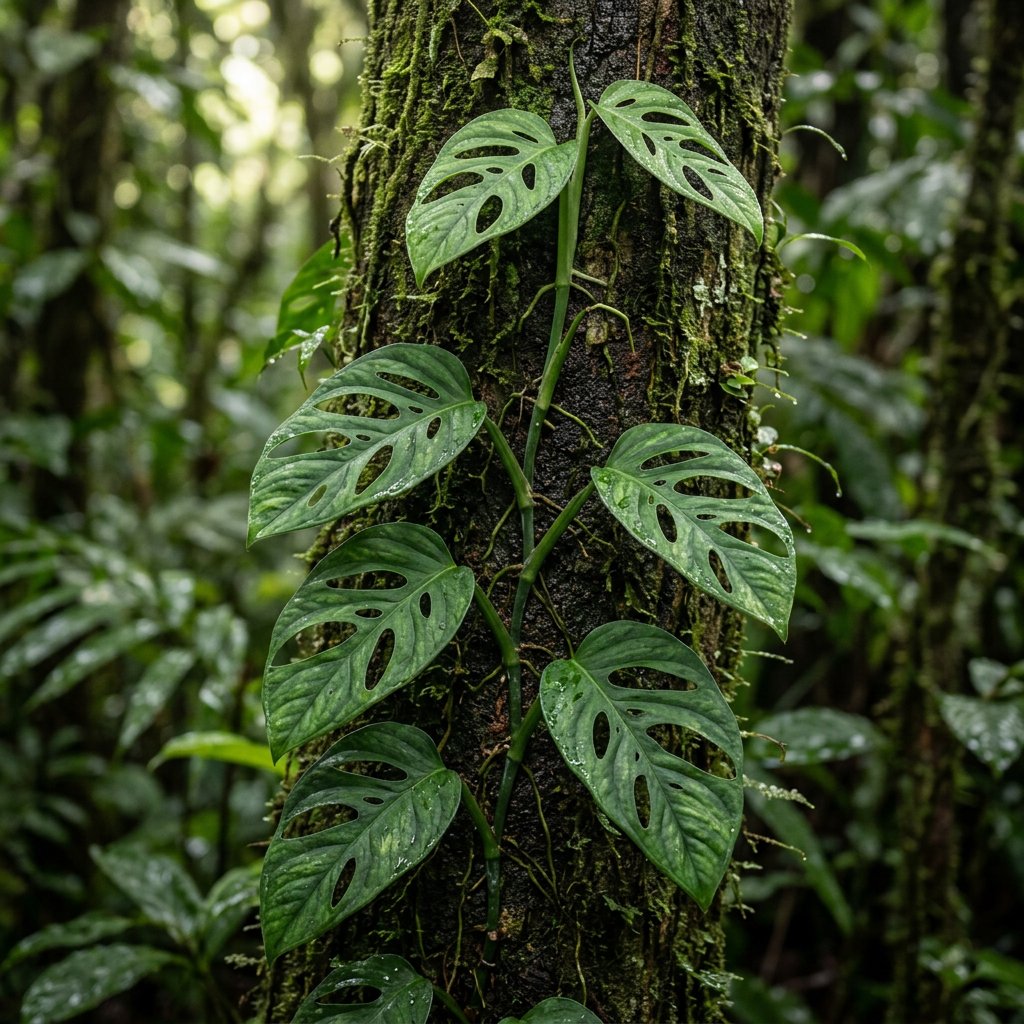
Often called the "Shingle Plant" in its youth, Monstera acuminata is a hidden gem of the Central American rainforests. It is a master of transformation, starting its life hugging tree trunks tightly like green scales before maturing into a dramatic climber with elegant, perforated leaves. It’s the perfect choice for indoor gardeners who find the classic Monstera deliciosa a bit too bulky but still want that iconic "Swiss Cheese" look.
🔍 How to Identify
- 🍃 Leaf Shape: Juvenile leaves are small, heart-shaped, and grow flat against surfaces. As the plant matures, the leaves become larger, more elongated (lance-shaped), and pointier at the tips.
- 🕳️ Fenestrations: Unlike the giant splits in a deliciosa, this species develops neat, oval-shaped "windows" within the leaf blade that rarely break through to the outer edge.
- 🪜 Growth Habit: It is famous for "shingling," a process where the leaves overlap each other perfectly like shingles on a roof as it climbs upward.
🏡 In Your Garden
- 🌳 Vertical Ambition: This plant is a true climber at heart. To see it transition from its juvenile form to its perforated adult form, you must provide a moss pole or wooden plank. Without a vertical surface to "shingle" up, the leaves will remain small and solid.
- ☁️ Microclimate Needs: Coming from tropical lowlands, it craves high humidity (60% or higher). While it is more drought-tolerant than some of its cousins, it performs best when the air is moist and the soil is kept consistently damp but never soggy.
⚠️ Safety & Toxicity
- 🚫 Status: Toxic to humans and pets.
- 🐾 Details: Like all Monsteras, it contains insoluble calcium oxalate crystals. If any part of the plant is chewed or swallowed, it can cause intense mouth irritation, drooling, and swelling of the throat in cats, dogs, and curious children.
✨ Fun Fact
- 🌒 Shadow Seeker: Most plants grow toward the light (phototropism), but juvenile Monstera acuminata exhibits "skototropism." It actually grows toward the darkest shadows it can find, instinctively knowing that a dark patch in the jungle usually signifies a sturdy tree trunk waiting to be climbed!

Detailed Care Instructions
| Humidity | Normal |
| Lighting | Part Sun |
| Difficulty | Easy |
| Temperature | 18°C - 30°C |
| Hardiness Zones | 10 - 12 |
To grow Monstera Acuminata plants, follow these steps:
- Choose the right location: Monstera Acuminata plants prefer bright indirect light. Avoid direct sunlight, as it can burn the leaves. Place the plant near a window where it can receive filtered or indirect sunlight.
- Temperature and humidity: Monstera Acuminata plants thrive in temperatures between 65-85°F (18-29°C). They also prefer high humidity levels, so you can use a humidifier or place the pot on a tray with water filled with pebbles to increase humidity.
- Watering: Keep the soil moist but not soggy. Water the plant when the top inch of soil feels dry. Make sure the pot has drainage holes to prevent waterlogging. Avoid overwatering, as it can lead to root rot.
- Soil and container: Use a well-draining potting mix composed of peat moss, perlite, and vermiculite. Monstera Acuminata plants prefer slightly acidic soil with a pH of around 5.5-7. Plant the Monstera in a pot that allows for proper drainage.
- Fertilization: Feed the plant every 2-4 weeks during the growing season (spring and summer) with a balanced, water-soluble fertilizer. Follow the instructions on the fertilizer package for the correct dosage.
- Pruning: Trim off any yellow or brown leaves to promote healthy growth. You can also selectively prune to control the size and shape of the plant.
- Propagation: Monstera Acuminata can be propagated using stem cuttings. Take a cutting with at least one node and place it in water or moist soil until it develops roots. Once the roots have formed, transplant it into a pot.
- Support: As the Monstera grows, it will benefit from a trellis or moss pole for support. The aerial roots of the Monstera like to cling to something as they grow.
Remember that Monstera Acuminata plants are slow growers, so be patient and provide them with care and favorable conditions.

Place in a window with dappled sun or a spot in the middle of a room. Or directly in a window facing west or east.

To water the Monstera Acuminata plant, you should first check the soil to ensure it is dry to the touch. Then, prepare a watering can or a jug of room temperature water. Slowly pour the water onto the soil, taking care to avoid getting water on the leaves or stem of the plant. Allow the water to seep down into the soil until you see it coming out of the drainage holes at the bottom of the pot. Wait for the excess water to drain completely before placing the plant back in its normal location. The frequency of watering will depend on factors such as the size of the pot, the amount of sunlight the plant receives, and the humidity levels in the environment.
Apply a balanced fertilizer once a month during the growing season (spring and summer). Use a small amount of fertilizer diluted in water. Water the soil thoroughly before applying the fertilizer solution. Do not fertilize in the winter when the plant is in its dormant phase. Always follow the instructions on the fertilizer package.
When planting Monstera Acuminata, it is important to choose the right type of soil. The best soil for this plant is one that has good drainage, is rich in organic matter, and has a pH level of 5.5 to 7.5. Sandy loam soil mixed with vermiculite or perlite can provide the ideal soil conditions. Additionally, a good quality potting mix, containing peat moss, perlite, and vermiculite, can be mixed with garden soil to make a rich and well-draining soil for the plant. It is important to ensure that the soil is moist but not waterlogged and that the plant is fed with a balanced fertilizer regularly to promote healthy growth.
Propagation of this plant can be achieved through stem cuttings. Choose a healthy stem and cut it just below a node. Remove the lower leaves and put the cutting in water or soil. Make sure that the soil is moist but not waterlogged. Keep the cutting in a bright but indirect light and mist it regularly to keep it moist. It should take about a month for roots to form, at which point you can transplant it into a larger pot with well-draining soil. Keep the soil moist but not waterlogged and avoid direct sunlight.
Common pests of the monstera acuminata include Mealybugs, spider mites, fungus gnats, thrips. Make a habit of checking your monstera acuminata frequently for pests so that any infestations can be caught and managed early.








