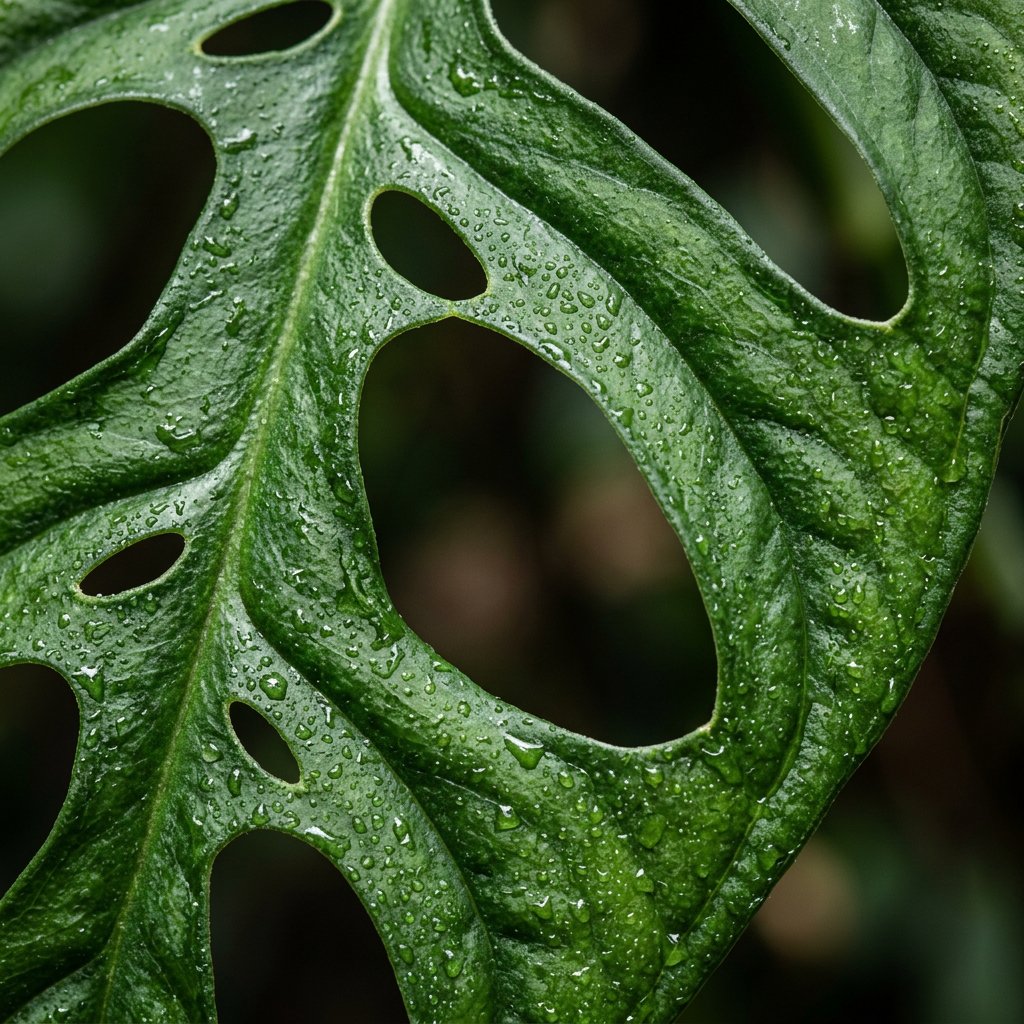
Plant Overview
Known affectionately as the "Swiss Cheese Vine" or "Monkey Mask," this tropical beauty is a darling of the houseplant world. Hailing from the humid jungles of Central and South America, it captures the imagination with its delicate, lace-like foliage. While it shares a name with the giant Monstera deliciosa, the Adansonii offers a more compact, vining charm that is perfect for vertical gardening or cascading from high shelves.
🔍 How to Identify
- 🍃 Leaf Texture: The leaves are heart-shaped, relatively thin, and slightly wavy compared to the thick, leathery feel of other Monsteras.
- 🕳️ Fenestrations: It is famous for the oval-shaped holes (fenestrations) that develop within the leaf blade. Unlike its larger cousins, these holes rarely break through the leaf's edge.
- 🧗 Growth Habit: Look for "aerial roots" emerging from the stem nodes; these brown, nubbly protrusions are designed to help the plant "walk" up trees in the wild.
🏡 In Your Garden
- 🧗 The Climbing Choice: While it looks lovely trailing from a hanging basket, providing a moss pole will result in much larger, more mature leaves as the plant mimics its natural ascent up rainforest canopies.
- ☁️ Humidity is Key: Coming from the tropics, it thrives in high humidity. If you notice "crispy" brown edges on the leaves, it’s likely the air is too dry, rather than a lack of water in the soil.
- 🌱 Gentle Feeders: They are fast growers during the spring and summer. They appreciate a consistent, diluted fertilizer, but "salt burn" can occur if the soil isn't flushed with plain water occasionally.
⚠️ Safety & Toxicity
- 🐾 Toxic to Pets: The plant contains insoluble calcium oxalate crystals, which are a defense mechanism against herbivores.
- 👄 The Risk: If leaves or stems are chewed or swallowed, they cause immediate stinging and swelling of the mouth, tongue, and throat. Keep this plant on high shelves away from curious cats, dogs, and toddlers.
✨ Fun Fact
🔬 Nature’s Sun-Catcher: Botanists believe those iconic holes evolved for two reasons: to allow the plant to withstand heavy tropical downpours without the leaves tearing, and to let dappled sunlight pass through to the lower leaves in the dense, dark jungle understory.

Detailed Care Instructions
| Color | Purple, Cream |
| Soil Ph | 5.5 To 7.5 |
| Humidity | High |
| Lighting | Part Sun |
| Toxicity | Toxic |
| Soil Type | Peat-Based Potting Soil |
| Bloom Time | Spring, But Usually Only In The Wild |
| Difficulty | Hard |
| Plant Type | Flowering Plant |
| Hibernation | Cold Period |
| Mature Size | Can Reach Up To 10 To 20 Meters With Adequate Support |
| Native Area | Central And South America |
| Temperature | 18°C - 25°C |
| Sun Exposure | Indirect Sun |
| Hardiness Zones | 10-11 |
To help grow Monstera Adansonii, also known as Swiss cheese vine or monkey mask plant, you can follow these steps:
- Choose the right location: Monstera Adansonii prefers bright indirect sunlight, so place it near a window that receives filtered or indirect light. Avoid placing it in direct sunlight as it may scorch the leaves.
- Use well-draining soil: Use a mixture of equal parts potting soil, perlite, and orchid bark to provide adequate drainage. This will prevent the roots from staying too wet and help prevent root rot.
- Watering: Water the plant thoroughly when the top inch of the soil feels dry. Avoid overwatering, as this can lead to root rot. Ensure that the pot has drainage holes to allow excess water to escape.
- Humidity: Monstera Adansonii thrives in humid conditions. Increase humidity levels by misting the leaves with water or placing the plant on a tray filled with pebbles and water. Avoid placing it near air vents, which can cause dry air.
- Temperature: Ideally, Monstera Adansonii prefers temperatures between 60-80°F (15-26°C). Protect it from cold drafts and keep away from heaters or air conditioning units that produce hot or dry air.
- Fertilization: Feed the plant with a balanced liquid fertilizer diluted to half strength every two weeks during the growing season (spring and summer). Reduce fertilization to once a month during the dormant period (fall and winter).
- Support for climbing: Monstera Adansonii is a vining plant, so provide a trellis or a moss pole for it to climb. You can also allow it to trail down from a hanging basket.
- Pruning: Regularly prune the plant to encourage fuller growth and control its size. To encourage bushier growth, pinch off the tips of the stems.
- Propagation: Monstera Adansonii can be easily propagated through stem cuttings. Take a cutting with a few nodes and place it in water or moist soil until roots develop. Then, pot it up into a well-draining mix.
By following these care tips, you can successfully grow and enjoy your Monstera Adansonii plant.

Place in a window with dappled sun or a spot in the middle of a room. Or directly in a window facing west or east.

To water this plant, first, you need to check the moisture level of the soil. Insert your finger about an inch deep into the soil, and if it feels dry, then it's time to water the plant. Fill a watering can with water and slowly pour it over the soil until you see water coming out of the drainage holes at the bottom of the pot. Make sure not to over-water the plant as it can cause root rot. It is recommended to allow the soil to dry out slightly between watering sessions. Additionally, do not let water accumulate in the saucer under the pot as it can damage the roots.
To provide optimal nutrients for the plant, it is recommended to fertilize it once a month during the growing season (spring and summer). A balanced, water-soluble fertilizer with equal amounts of nitrogen, phosphorus, and potassium is ideal. It should be diluted according to the package instructions and applied to moist soil. Avoid fertilizing during the dormant period (fall and winter) to prevent overfeeding and burning the roots.
The ideal soil mix for the Monstera Adansonii plant is a loose, well-draining soil that is rich in organic matter. A mix of peat moss, perlite, and vermiculite in a ratio of 2:1:1 is a good choice. The soil should be slightly acidic with a pH range of 5.5 to 7.0. It is important to avoid using heavy soils that can retain too much moisture and lead to root rot. The soil should also be well-aerated with good drainage to prevent waterlogging. Adding a slow-release fertilizer to the soil can provide the necessary nutrients for healthy growth. It is also important to monitor the soil moisture levels and water the plant when the top 1-2 inches of soil feel dry to touch.
- Select a healthy stem: The first step in propagating this plant is to select a stem that is healthy and strong. Look for a stem with several leaves and nodes on it.
- Cut the stem: Using a clean, sharp knife or scissors, cut the stem just below a node. Make sure the stem is at least 4 inches long.
- Prepare the cutting: Remove any leaves from the lower 1-2 inches of the stem. This will create a section of bare stem that will be inserted into the soil. You can also dip the cut end of the stem in rooting hormone to help encourage root growth.
- Plant the cutting: Fill a pot with well-draining soil and make a hole in the center. Insert the stem into the hole, making sure the bare section is covered. Water the soil around the cutting, making sure it is moist but not waterlogged.
- Provide proper care: In order for the cutting to establish, it will need humid conditions and bright, indirect light. Consider placing a plastic bag over the cutting to increase humidity. Keep the soil moist and be patient. It can take a few weeks to a few months for roots to develop. Once you see new growth, you can gradually remove the plastic bag.
- Transfer to a larger pot: Once the cutting has established roots and begun to grow, it can be transferred to a larger pot. Make sure the pot has drainage holes and use a well-draining soil. Provide the plant with bright, indirect light and continue to keep the soil moist.
Common pests of the swiss-cheese-plant include Mealybugs, spider mites, fungus gnats, thrips. Make a habit of checking your swiss-cheese-plant frequently for pests so that any infestations can be caught and managed early.








