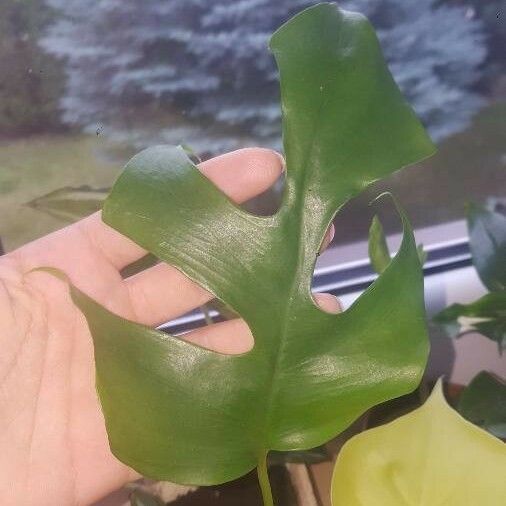
Plant Overview
Often called the "Mini Monstera" or "Ginny Philodendron," this plant is actually a master of disguise. Despite its appearance, it isn't a Monstera at all—it belongs to the Rhaphidophora genus from Southeast Asia. It is the perfect choice for urban jungle enthusiasts who want the iconic "Swiss cheese" look but don't have the space for a massive, room-filling giant.
🔍 How to Identify
- 🌿 Fenestrated Leaves: It features glossy, small green leaves with deep, signature splits (fenestrations) that reach almost to the midrib, appearing even on very young foliage.
- 🪜 Climbing Habit: This is a natural-born climber. It possesses a slender, flexible stem that grows rapidly upward rather than spreading out in a wide bush.
- 🧶 Aerial Roots: You will notice small, brown root nubs or long "tentacles" emerging from the leaf nodes, which the plant uses to anchor itself to trees or moss poles.
🏡 In Your Garden
- 🪵 The Need for Support: Because it is a vigorous climber, this plant thrives best when given a moss pole or trellis. If left to trail, its leaves often grow smaller and lose their dramatic splits over time.
- ⛅ Light & Legginess: It is a "Goldilocks" plant regarding light. It needs bright, indirect sun to maintain its compact shape; if the light is too low, the stem will become "leggy" (stretched out) as it searches for the sun.
⚠️ Safety & Toxicity
- 🐾 Toxic to Pets: This plant is considered toxic to cats, dogs, and horses.
- 👄 Calcium Oxalate: It contains insoluble calcium oxalate crystals. If leaves are chewed or swallowed, they cause immediate oral irritation, swelling of the throat, and drooling. It is best kept on high shelves out of reach of curious paws or toddlers.
✨ Fun Fact
In 2021, a rare variegated version of this plant (featuring white splashes on the leaves) sold at an auction in New Zealand for over $19,000 USD, briefly making it one of the most expensive houseplants in the world!

Detailed Care Instructions
To grow a Monstera Minima plant, follow these steps:
- Choose a suitable spot: Monstera Minima plants prefer bright, indirect light. They can also tolerate low light conditions, but this may slow down their growth. Avoid placing them in direct sunlight, as it can scorch their delicate leaves.
- Provide the right temperature and humidity: Monstera Minima plants prefer temperatures between 60-75°F (15-24°C). They thrive in a humid environment, so try to maintain humidity levels of at least 50%. Placing a tray of water near the plant or using a humidifier can help increase humidity.
- Select the right soil: Use a well-draining potting mix that retains some moisture but doesn't become soggy. A mix of peat moss, perlite, and orchid bark is a good option. This will prevent waterlogged soil, which can lead to root rot.
- Watering: Water your Monstera Minima when the top inch of soil feels dry. Avoid overwatering, as this can lead to root rot. Ensure the pot has good drainage to allow excess water to escape.
- Fertilizing: Feed your Monstera Minima with a balanced liquid fertilizer every four to six weeks during the growing season (spring and summer). Dilute the fertilizer to half the recommended strength to avoid burning the plant's roots.
- Pruning: Prune your Monstera Minima to remove any dead or damaged leaves and to shape the plant. Pruning can also promote bushier growth. Use clean pruning shears to avoid spreading diseases.
- Propagation: Monstera Minima can be propagated through stem cuttings. Cut a healthy stem just below a node and place it in water or moist soil. Roots should develop within a few weeks, at which point you can transfer the cutting to a pot with well-draining soil.
- Provide support: As Monstera Minima plants grow, they may need support to climb. Place a trellis, moss pole, or stake in the pot for the plant to climb on.
Remember to regularly check your plant for pests, such as spider mites or mealybugs, and take appropriate measures to eliminate them if needed. With proper care, your Monstera Minima plant should thrive and grow beautifully.
To water the plant, start by checking the dryness of the soil. Insert your index finger an inch deep into the soil and see if it feels dry or moist. If it feels dry, then it's time to water the plant.
Water the plant at the base only, avoiding getting water on the leaves as this can encourage fungal growth. Use room temperature water, and water until you see the water beginning to come out of the drainage holes of the pot. This will ensure that the soil is fully hydrated and watered.
It's important not to overwater the plant as it can lead to root rot, which can be fatal for the plant. Allow the soil to dry out slightly before watering again. The frequency of watering will depend on various factors such as the climate, humidity, and soil type, but generally, once or twice a week is sufficient.
As with any plant, observe the Monstera Minima plant to ensure that it is not showing signs of over or under watering. The plant may appear wilted, droopy or yellowing leaves can indicate overwatering, while brown, crispy, or curling leaves can mean under watering.
To properly fertilize this plant, you should use a slow-release, balanced fertilizer during the growing season, typically from spring to fall. Apply the fertilizer to the soil according to the package instructions, making sure not to over-fertilize as this can damage the plant. Additionally, consider supplementing the fertilizer with organic matter, such as compost or well-rotted manure, to add nutrients and improve soil quality. Finally, be sure to water the plant thoroughly after fertilizing to help the nutrients reach the roots.
For optimal growth, it is recommended to use a well-draining soil mix with good aeration and moisture retention. The ideal soil should be a blend of organic matter such as peat moss or coco coir, vermiculite or perlite for drainage and aeration, and coarse sand or grit to improve drainage. Avoid using heavy soils that retain too much moisture, as this can lead to root rot and other issues. It is also important to ensure that the soil is slightly acidic with a pH between 6.0 to 6.5. Additionally, supplementing the soil with fertilizer can help promote healthy growth and development.
Monstera Minima is a type of plant that belongs to the arum family. It is a popular houseplant due to its attractive appearance and low maintenance requirements. Propagating Monstera Minima is easy and can be done using several methods.
One of the most common methods to propagate Monstera Minima is through stem cuttings. To do this, you need to select a healthy stem that is approximately 6-7 inches long. Cut the stem using a sharp and clean pair of scissors just below a node. Nodes are the points where new leaves grow from the stem. Remove the lower leaves from the stem, leaving only a few on the top. Dip the cut end of the stem in rooting hormone powder and plant it in a pot with well-draining soil. Water the plant well and keep it in a warm and bright location with indirect sunlight. In a few weeks, the plant will develop roots and new leaves.
Another way to propagate Monstera Minima is through division. To do this, you need to carefully remove the plant from its pot and separate the root ball into two or more sections. Each section should have a healthy stem and roots. Plant each section in a separate pot with well-draining soil and water it well. Keep the plant in a warm and bright location with indirect sunlight and water it regularly. In a few weeks, the plant will begin to grow new leaves.
Lastly, you can also propagate Monstera Minima through air layering. To do this, select a healthy stem and make a small incision in the bark with a sharp knife. Insert a toothpick or a wooden stick into the incision to keep it open. Wrap a moist sphagnum moss around the incision and cover it with plastic wrap. Secure the moss and plastic wrap with a string or tape. Keep the moss moist and wait for the roots to develop. Once the roots are well-developed, cut the stem below the air layer and plant it in a pot with well-draining soil. Water the plant well and keep it in a warm and bright location with indirect sunlight.








