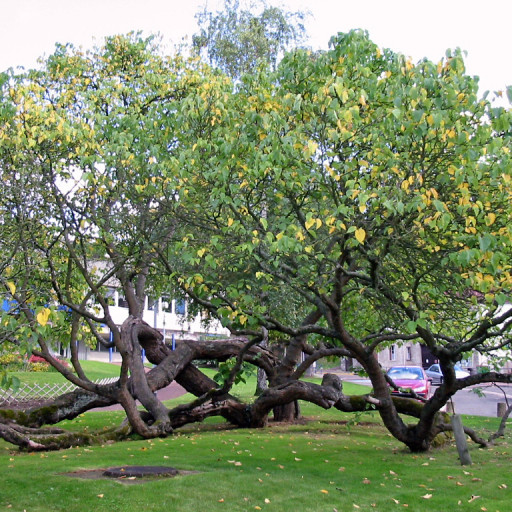
Plant Overview
Commonly known as the Black Mulberry, this tree is the ancient aristocrat of the orchard. Originating from Western Asia, it has been cherished for millennia not just for its luscious, honey-sweet berries, but for its gnarled, architectural beauty. In Greek mythology, its fruit was said to have been stained dark red by the tragic blood of ill-fated lovers, Pyramus and Thisbe.
🔍 How to Identify
- 🍃 The Foliage: Look for heart-shaped, deeply serrated leaves that feel rough or "sandpapery" on the top surface, unlike the smoother leaves of the White Mulberry.
- 🍇 The Fruit: The berries resemble elongated blackberries. They transition from green to a vibrant red before ripening into a deep, staining purple-black.
- 🌳 The Bark: Older trees develop a distinctive, rugged character with dark, fissured bark and a twisting, spreading canopy that often leans with age.
🏡 In Your Garden
- 🌱 Patience is a Virtue: Unlike its cousin, the White Mulberry, Morus nigra is slow-growing but incredibly long-lived. It prefers a sunny spot with deep, well-draining soil to accommodate its extensive root system.
- 🧹 The "Mess" Factor: Because the berries are incredibly juicy and rich in pigment, avoid planting this tree near white fences, paved driveways, or patios. The falling fruit will leave a semi-permanent purple "ink" on everything it touches.
- ✂️ Pruning Nuance: Only prune during the winter when the tree is fully dormant. If cut during the growing season, the branches tend to "bleed" a milky sap, which can weaken the plant and attract pests.
⚠️ Safety & Toxicity
- ✅ Edible Fruit: The ripe black fruits are perfectly safe and highly prized for jams, wines, and fresh eating.
- 🧪 Milky Sap: The stems and leaves contain a white, milky latex. In some individuals, this sap can cause mild skin irritation (dermatitis) upon contact.
- 🐾 Pets & Kids: While the ripe fruit is safe, eating large quantities of unripe (green) berries may cause mild stomach upset or hallucinations in some animals and children due to low levels of certain alkaloids.
✨ Fun Fact
The Black Mulberry is a master of longevity; some specimens in Britain and Europe are over 400 years old. It was once so popular that King James I famously ordered the planting of 10,000 mulberry trees to start a silk industry, only to accidentally buy the Black Mulberry instead of the White Mulberry—which is the only one silkworms actually like to eat!

Detailed Care Instructions
| Humidity | Normal |
| Lighting | Full Sun |
| Difficulty | Medium |
| Hibernation | Cold Period |
| Temperature | 10°C - 30°C |
| Hardiness Zones | Min 5A |
To grow a Morus Nigra plant, also known as the black mulberry, follow these steps:
- Obtain a healthy Morus Nigra plant either by purchasing one from a reputable nursery or by propagating it from cuttings or seeds. If growing from seeds, keep in mind that Morus Nigra seeds often have low germination rates and may take longer to grow.
- Select a suitable location for planting. Morus Nigra plants thrive in full sunlight, so choose a spot that receives at least 6-8 hours of direct sunlight daily. The soil should be well-draining and rich in organic matter.
- Prepare the soil by loosening it thoroughly with a garden fork or tiller. Incorporate compost or well-rotted manure to enrich the soil and improve its drainage properties.
- Dig a hole that is twice the size of the plant's root ball. Gently remove the plant from its container and place it in the hole, ensuring that the top of the root ball is level with or slightly above the soil surface.
- Backfill the hole with soil, gently tamping it down around the root ball to remove any air pockets. Water the plant thoroughly immediately after planting to help settle the soil.
- Mulch around the base of the plant with a layer of organic mulch, such as wood chips or straw, to help retain moisture, suppress weeds, and regulate soil temperature.
- Water the plant regularly, especially during dry periods, making sure to keep the soil consistently moist but not waterlogged. Monitor the moisture levels and adjust watering frequency accordingly.
- Prune the Morus Nigra plant in late winter or early spring to remove any dead, diseased, or crossing branches. This will help maintain its shape and promote healthy growth.
- Fertilize the plant once or twice a year with a balanced, slow-release fertilizer specifically formulated for fruit trees or shrubs. Apply the fertilizer according to the manufacturer's instructions and water it in thoroughly.
- Protect the plant from extreme cold temperatures or frost by covering it with a frost cloth or mulching heavily around the base in late fall or winter.
With proper care, your Morus Nigra plant should grow and produce delicious black mulberries for you to enjoy!

Place in a bright room that is sun drenched almost all day. Or directly in a south-facing window.

To water the plant in question, you should first thoroughly soak the soil around its base until the water begins to drain from the bottom of the container. It is important to avoid allowing the plant to sit in standing water, as this can lead to root rot. Instead, wait until the top inch of soil feels dry to the touch before watering again. The frequency of watering will depend on the plant's specific needs, which can be influenced by factors such as the temperature, humidity, and amount of sunlight it receives. In general, it is better to underwater than to overwater this type of plant.
To fertilize this plant, begin by choosing a balanced fertilizer with a 10-10-10 or 12-12-12 ratio of nitrogen, phosphorus, and potassium. Apply the fertilizer in early spring, before new growth begins, and again in late spring or early summer. Be sure to follow the instructions on the fertilizer label and avoid over-fertilizing, as this can lead to excessive growth and weak stems. Water the plant thoroughly after fertilizing to help the nutrients soak into the soil.
The soil that is best suited for Morus Nigra plant should be well-draining and rich in organic matter, with a pH range of 6.0 to 7.5. It should not be too alkaline or too acidic as this can affect the growth of the plant. A soil that is loamy or sandy loam in texture is also recommended as it allows for better aeration and drainage.
In addition to soil type, it is important to ensure that the soil is nutrient-rich, with adequate levels of nitrogen, phosphorus, and potassium, as well as other trace minerals that the Morus Nigra plant requires for healthy growth. This can be achieved through the addition of organic fertilizers such as compost or manure.
Finally, it is important to ensure that the soil is not too compacted, as this can restrict the growth of roots and prevent the plant from accessing important nutrients and water. Regular cultivation of the soil or the use of a raised bed can help prevent soil compaction and ensure optimal growing conditions for the Morus Nigra plant.
To propagate Morus Nigra plant, take a softwood cutting in spring or early summer. Choose a healthy stem with no signs of damage or disease and cut it at a 45-degree angle. Strip the bottom leaves from the stem, leaving only a few at the tip. Dip the stem in rooting hormone powder and plant it in a pot with well-draining soil. Water it well and cover the pot with a plastic bag to create a greenhouse effect. Keep the soil moist and the cutting in bright, indirect light until it develops roots. After a few months, the cutting should have a healthy root system and can be transplanted to a larger pot or outside in a sunny, protected spot in the garden.








