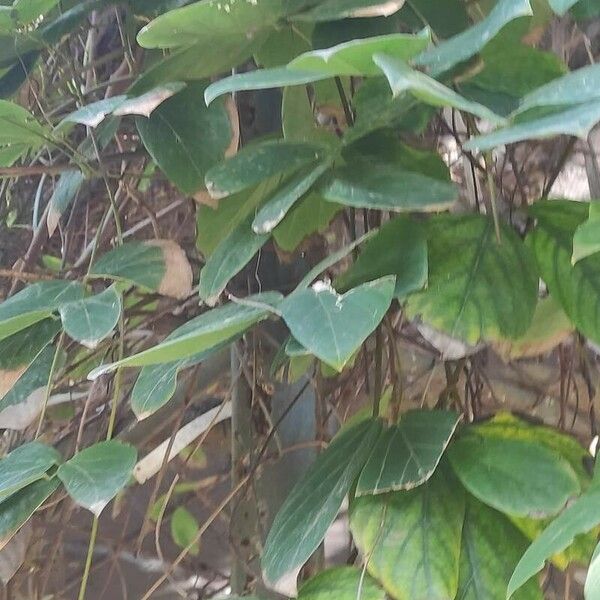
Plant Overview
Known as the Large-fruited Mucuna or the Rusty-leafed Mucuna, this woody giant is a true king of the jungle canopy. This vigorous liana is famous for its dramatic, cascading floral displays that look like something out of a prehistoric forest. In its native Southeast Asian habitats, it acts as a massive natural ladder, weaving through the treetops to create intricate bridges for arboreal wildlife.
🔍 How to Identify
- 🍇 The Flowers: Large, pea-like blossoms that are deep maroon to dark purple, often appearing in massive, pendulous clusters that hang directly from the old woody stems (a trait known as cauliflory).
- 🍃 The Foliage: Robust, trifoliate leaves (sets of three) that are leathery to the touch, providing a dense green backdrop for the striking flowers.
- 🫛 The Pods: Giant, woody seed pods that can reach over a foot in length. They are thick and persistent, often remaining on the vine long after the seeds have dropped.
🏡 In Your Garden
- 🏗️ Structural Support: This is not a plant for a flimsy trellis. Due to its incredible weight and "woody" nature, it requires a heavy-duty pergola or a large, established tree to climb. It can easily pull down weak structures as it matures.
- 💧 Tropical Requirements: To thrive, it demands high humidity and rich, loamy soil. While it loves the sun, its "feet" (the roots) prefer to stay cool and mulched, mimicking the shaded floor of a rainforest.
⚠️ Safety & Toxicity
- ✋ Status: Generally safe to touch, but the seeds and pods require caution.
- 🐾 Details: Like many members of the Mucuna genus, the seeds contain high concentrations of L-dopa and should never be ingested by humans or pets. Additionally, the outer skin of the pods in some varieties can have fine, irritating hairs that cause skin itchiness—handle mature pods with gloves.
✨ Fun Fact
🐿️ Mammal Pollination: Unlike most flowers that rely on bees or butterflies, Mucuna macrocarpa is primarily pollinated by bats and squirrels! These animals are strong enough to pry open the heavy, waxy petals to reach the nectar hidden inside.

Detailed Care Instructions

Place in a window with dappled sun or a spot in the middle of a room. Or directly in a window facing west or east.

When the top few inches of soil dry out, water your plants. If the top few inches of soil are still moist, do not water your plant. Wait a few days, then poke your finger into the soil to see if anything has changed. Overwatering poses a disease risk, such as the development of fungal diseases in the roots. These plants have adaptations in there leaves that allow them to survive in low water supply.








