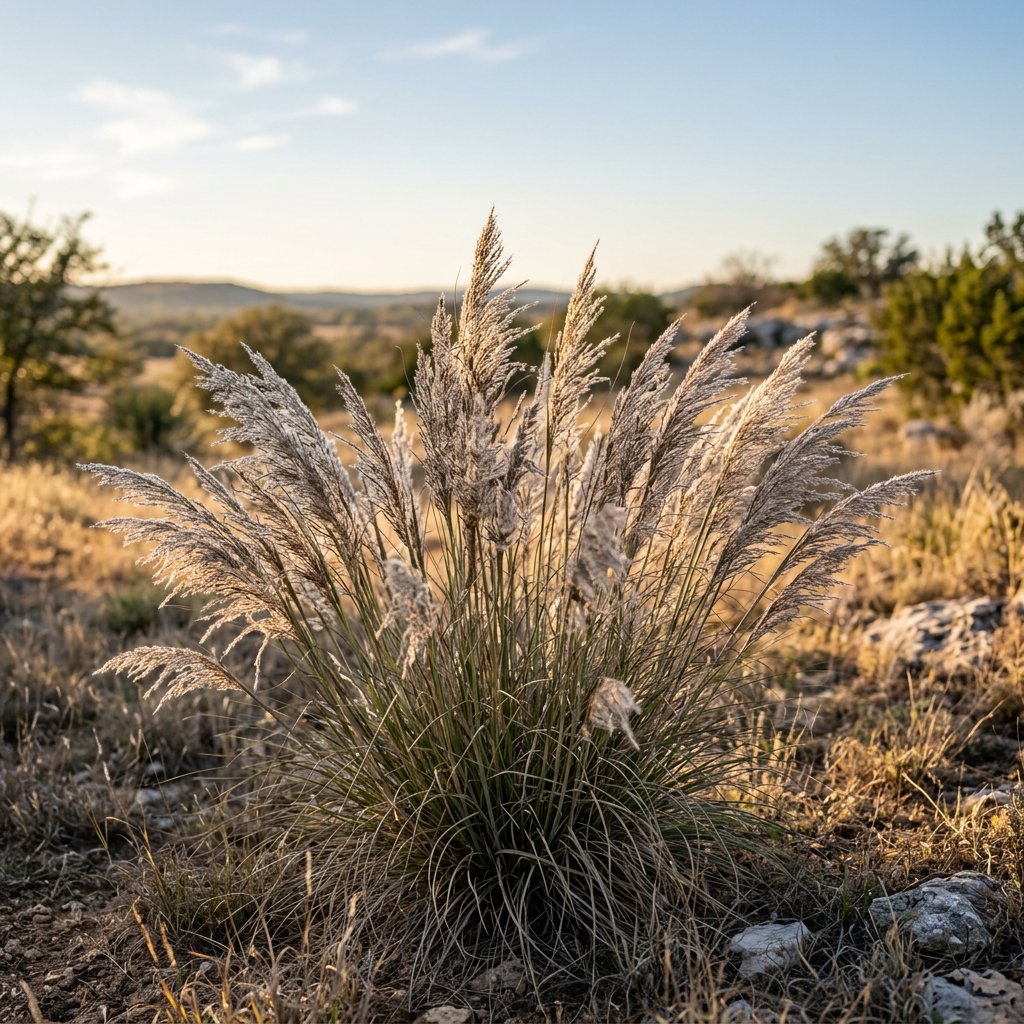
Plant Overview
Often called "Lindheimer's Muhly" or simply "Big Muhly," this majestic perennial grass is a cornerstone of the American Southwest landscape. Named after Ferdinand Lindheimer, the "Father of Texas Botany," it serves as a sophisticated, non-invasive alternative to the often-overpowering Pampas grass. Its blue-tinted foliage and shimmering autumn plumes add a sense of movement and architectural "wow factor" to any sunny garden.
🔍 How to Identify
- 🌿 The Foliage: Look for dense, fountain-like clumps of narrow, arching blades that boast a distinct blue-gray or sea-green hue.
- 🌾 The Plumes: In late summer and autumn, it sends up tall, narrow flower spikes (panicles) that emerge with a subtle purple tint before aging to a silvery-white or toasted tan.
- 📏 The Stature: Unlike the smaller, airy Pink Muhly, Lindheimeri is a "big brother," standing tall and upright at 4 to 5 feet, maintaining its structural shape even under the weight of winter frost.
🏡 In Your Garden
- 🌱 Soil & Resilience: This grass is a champion of "tough love." It thrives in rocky, limestone-heavy soils and is exceptionally drought-tolerant once its deep root system is established. It actually prefers lean soil over rich, fertilized ground, which can cause it to grow too fast and "flop."
- ✂️ Winter Care: While it provides beautiful winter interest with its dried tan stalks, it benefits from a "haircut" in late winter. Trimming it down to about 6 inches before the new spring growth starts ensures the plant remains tidy and vibrant for the coming year.
⚠️ Safety & Toxicity
- ✅ Status: Non-toxic and generally safe.
- 🐾 Details: This plant is considered safe for households with dogs, cats, and horses. It is a "friendly" ornamental; however, the leaf edges can be slightly sharp or "saw-toothed," so it is best planted slightly back from narrow walkways where it won't brush against bare skin.
✨ Fun Fact
Because of its ability to thrive on minimal water and its resistance to heat, Muhlenbergia lindheimeri is a superstar of "Xeriscaping"—a landscaping method designed specifically for water conservation. It’s a plant that looks lush and expensive while using almost no resources!

Detailed Care Instructions
To successfully grow Muhlenbergia Lindheimeri (also known as Lindheimer's Muhly), follow these steps:
- Choose a suitable location: Muhlenbergia Lindheimeri prefers full sun but can tolerate some light shade. Ensure the soil is well-draining and not too compacted.
- Prepare the soil: Before planting, check the soil pH and make sure it ranges between 6.0 to 7.2. If the soil is too acidic, add lime to reduce acidity. If it is too alkaline, adding sulfur can help lower it. Mix organic matter (compost or well-rotted manure) into the soil to improve fertility and drainage.
- Planting: Dig a hole twice as wide and slightly deeper than the root ball. Place the plant in the hole, ensuring the top of the root ball is level with the surrounding soil. Backfill the hole with soil and gently firm it around the plant.
- Watering: Water the plant thoroughly after planting to settle the soil. Muhlenbergia Lindheimeri is drought-tolerant but requires regular watering until established. Water deeply once or twice a week, allowing the soil to dry between watering sessions.
- Mulching: Apply a layer of organic mulch around the plant, leaving some space around the stem to prevent rot. Mulch helps retain moisture, suppresses weed growth, and insulates the roots.
- Fertilizing: Muhlenbergia Lindheimeri is typically low-maintenance and does not require regular fertilization. If desired, you can apply a slow-release, balanced fertilizer in early spring to promote healthy growth.
- Pruning: Prune the plant in late winter or early spring to remove any dead or damaged stems. You can also cut back the plant if it becomes unruly or to promote denser growth.
- Dividing: Every few years, you can divide the plant to propagate new individuals or rejuvenate an existing plant. Dig up the plant carefully in early spring or fall, separate the clumps, leaving some roots on each division, and replant them in a suitable location.
- Pests and diseases: Muhlenbergia Lindheimeri is generally resistant to pests and diseases. However, occasional issues may include aphids, spider mites, and fungal diseases. Monitor the plant regularly, and if you notice any problems, take appropriate measures such as using insecticidal soap or treating with organic fungicides.
Overall, Muhlenbergia Lindheimeri is a hardy and versatile plant that can thrive with minimal care. Regular water during establishment, proper soil preparation, and suitable pruning help ensure its healthy growth.

Place in a bright room that is sun drenched almost all day. Or directly in a south-facing window.

To properly water this specific plant species, it is important to ensure that the soil is consistently moist but not overwatered, as this can lead to root rot. This plant prefers well-draining soil that is often sandy or rocky, allowing water to easily seep through and not accumulate. It is recommended to water deeply and infrequently, rather than frequently with shallow watering. This means allowing the water to thoroughly penetrate the soil and reach the roots before letting it dry out slightly before the next watering. It is also important to avoid watering the foliage, as this can promote fungal growth. Overall, monitoring the moisture levels and adjusting watering frequency as needed is crucial for the success of this plant.
To fertilize this plant, it is recommended to use a slow-release, balanced fertilizer with equal parts nitrogen, phosphorus, and potassium. Apply the fertilizer in early spring before new growth appears, and then again in mid-summer. Be sure to water the plant thoroughly after fertilizing. Avoid over-fertilizing, as this can cause excessive growth and weak stems.
Muhlenbergia Lindheimeri plant prefers well-draining soil that is moist, yet not waterlogged. The ideal soil pH is between 6.0-7.5. The soil should be rich in organic matter and nutrients, such as nitrogen, phosphorus, and potassium. It is important to avoid using heavy clay soils, as they can lead to root rot and other plant diseases. A sandy loam soil with good drainage is the best option for this plant. A layer of compost or other organic mulch can also be added to the soil to help retain moisture and nutrients. Fertilizer should be applied sparingly, as this plant does not require heavy feeding.
To propagate this plant, you will need to gather some of the mature seeds from the plant. Once you have collected them, you will need to prepare the planting area. The area should be well-draining and covered in a light layer of soil.
Next, you will want to scatter the seeds on the prepared planting area. You will want to cover the seeds with a thin layer of soil, just enough to cover them. Do not bury the seeds too deep, as this can hinder germination.
After planting, you will need to water the area lightly. The soil should remain moist until the seeds start to sprout. Germination can take up to 3 weeks, but once the seeds sprout, growth should be rapid.
Once the plants have grown to about 2-3 inches tall, you can transplant them to their permanent location. This plant prefers well-draining soil and full sun, so keep this in mind when selecting a location.
With proper care and maintenance, your new plants should grow into beautiful specimens that are sure to add beauty to your garden.
Common pests of the lindheimer's muhly include Thrips. Make a habit of checking your lindheimer's muhly frequently for pests so that any infestations can be caught and managed early.








