Plant Overview
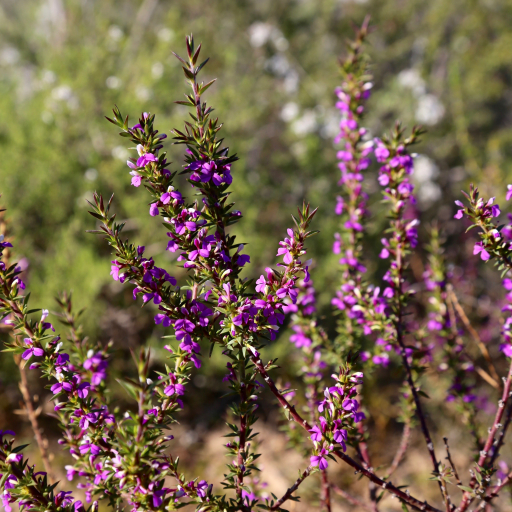
Known as the African Gorse, Muraltia heisteria is a tough, resilient shrub hailing from the diverse Fynbos region of South Africa. While it might look like a delicate heather from a distance, it earns its common name through its prickly, defensive foliage. It is a master of survival, perfectly adapted to nutrient-poor soils and the windy, coastal slopes of the Cape.
🔍 How to Identify
- 💜 The Flowers: Small, asymmetrical blossoms that resemble tiny pea flowers, usually appearing in shades of vibrant purple, pink, or white. They sit nestled among the leaves along the stems.
- 🗡️ The Foliage: The leaves are "ericoid" (heather-like)—short, needle-shaped, and incredibly stiff. Each leaf ends in a sharp, spine-like point that can be quite painful to the touch.
- 🌿 Growth Habit: A woody, evergreen shrub that typically grows between 2 to 4 feet tall. It has a dense, brush-like appearance with many branching stems.
🏡 In Your Garden
- 🏜️ The "Tough Love" Rule: This plant thrives on a bit of neglect. Because it originated in the Fynbos, it prefers sandy, acidic, and nutrient-poor soil. Adding too much fertilizer can actually overwhelm and harm it.
- 🚫 Don’t Move Me: Like many plants with deep taproots, Muraltia heisteria hates being transplanted. Once you choose a sunny, well-draining spot for it, try to leave it there permanently to avoid root shock.
- 🌬️ Coastal Warrior: It is exceptionally wind-tolerant and drought-resistant, making it a perfect choice for rock gardens or coastal landscapes where other plants might wither under the salt spray and breeze.
⚠️ Safety & Toxicity
- 🩹 Physical Hazard: While not known to be chemically toxic to humans or pets, the plant is physically "aggressive." The needle-sharp leaf tips can easily puncture the skin or cause irritation to curious pets.
- 🧤 Handling Advice: Always wear thick gardening gloves when pruning or weeding around this shrub. It is best planted away from high-traffic walkways where children or guests might accidentally brush against it.
✨ Fun Fact
The genus was named by the famous botanist Linnaeus in honor of Johannes Conrad Muralt, a Swiss botanist, while the species name heisteria commemorates Lorenz Heister, a 18th-century German surgeon and botanist who was a contemporary of Linnaeus.

Detailed Care Instructions

Place in a bright room that is sun drenched almost all day. Or directly in a south-facing window.

Some plants require more regular watering than others, which should be done every few days. It's critical to maintain the soil moist all of the time. The water requirements of the same plant placed in pots with varying sizes will differ. Because the water in the smaller pot evaporates faster than the water in the larger pot, it will require more watering. Regardless of pot size, the surface should constantly be maintained moist.








