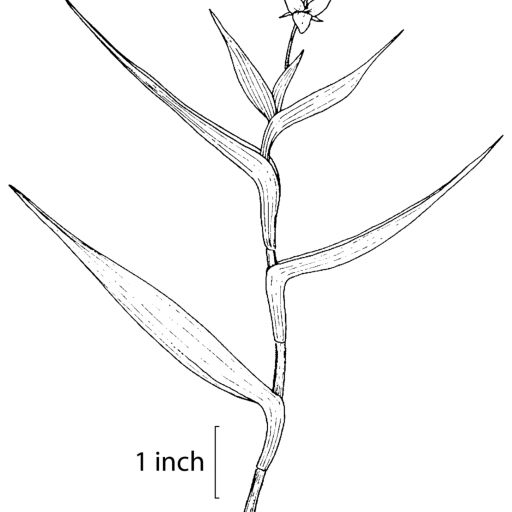
Plant Overview
Known as the Marsh Dewflower or Asian Spiderwort, this resilient semi-aquatic traveler hails from the wetlands of East Asia. While it creates a lush, bamboo-like green carpet in soggy environments, it is a world-class "hitchhiker," having successfully naturalized in many parts of the United States. It is a plant that truly thrives where others drown, turning muddy banks into vibrant green mats.
🔍 How to Identify
- 🍃 Lush Foliage: The leaves are narrow, lance-shaped, and grow alternately along the stem. Look closely at the base of the leaf; it "clasps" or wraps slightly around the stem rather than growing from a petiole.
- 🌸 Delicate Blooms: It produces small, solitary flowers with three distinct, rounded petals. These range from a pale, ghostly pink to a soft lavender and usually only open for a few hours a day.
- 🌱 Creeping Stems: The stems are somewhat succulent and fleshy. They possess the unique ability to root at every "node" (the joint on the stem), allowing a single fragment to start an entirely new colony.
🏡 In Your Garden & Habitat
- 💧 The Water Lover: This plant is a specialist in "wet feet." It thrives in mud, marshy edges, or shallow standing water. It is rarely a successful indoor plant unless kept in a saturated terrarium or a dedicated water garden.
- 🚧 Ambitious Spreader: Because it can regrow from a tiny broken piece of stem, it is often considered a weed in rice paddies and natural wetlands. If you are planting it in a backyard pond, keep it contained in a submerged pot to prevent it from "walking" into nearby drainage areas.
⚠️ Safety & Toxicity
- ✅ Generally Safe: There are no widely recorded toxicities for Murdannia keisak regarding humans. It is not known to be a skin irritant.
- 🐾 Pet Watch: While not listed as toxic to cats or dogs, the succulent nature of the leaves can cause mild digestive upset if grazed upon in large quantities. As with any ornamental plant, it is best kept out of reach of curious nibblers.
✨ Fun Fact
In some historical Asian texts, this plant was referred to as the "Wart-removing Herb." It was believed that the sap within its fleshy stems contained properties that could help clear up skin blemishes, though modern science views it primarily as a beautiful—yet aggressive—wetland dweller.

Detailed Care Instructions
To grow Murdannia Keisak, also known as Asian Spiderwort or False Dayflower, follow these steps:
- Obtain a Murdannia Keisak plant: You can either purchase a mature plant from a nursery or obtain seeds for germination.
- Choose the right location: Murdannia Keisak prefers partial shade to full sun, so select a spot that receives bright but indirect sunlight. If you are planting it indoors, place it near a window that provides adequate sunlight.
- Prepare the soil: Murdannia Keisak thrives in well-draining soil. Improve the soil by adding organic matter like compost. The pH range for this plant should be slightly acidic to neutral.
- Planting: If you have seeds, sow them directly into the soil at a depth of about ¼ inch. If you have a young plant, dig a hole slightly larger than the plant's root ball and place it in the hole. Gently backfill the soil and firm it around the plant.
- Watering: Keep the soil consistently moist but not waterlogged. Water the plant regularly, especially during the growing season, and adjust watering frequency based on weather conditions. Avoid letting the soil dry out completely.
- Fertilization: Murdannia Keisak generally doesn't require much fertilizer. However, you can use a balanced, slow-release fertilizer once or twice during the growing season to promote healthier growth.
- Propagation: Murdannia Keisak can be propagated by dividing mature plants or by collecting and sowing seeds. Division is best done in early spring when new shoots appear.
- Pruning: Regularly prune the plant to maintain its shape and promote bushier growth. Pruning also helps rejuvenate older plants.
- Pests and diseases: This plant is relatively pest and disease resistant. However, watch out for common garden pests like aphids, mealybugs, and spider mites. Treat them with organic or chemical methods accordingly.
- Winter care: Murdannia Keisak is not frost-tolerant and should be protected during winter. If you live in an area with harsh winters, consider growing it in a container and moving it indoors during cold months.
By following these steps, you can successfully grow Murdannia Keisak and enjoy its vibrant flowers and attractive foliage.

Place in a bright room that is sun drenched almost all day. Or directly in a south-facing window.

To water this plant, you will need to ensure that the soil is always slightly moist but not overly saturated. This means that you should water the plant thoroughly, allowing the water to completely soak through the soil until it starts to drain out of the bottom of the pot. Be sure to allow the soil to dry out slightly before watering again, as this plant is susceptible to root rot if the soil is too wet consistently. It is also important to avoid letting the water sit in the saucer beneath the pot, as this can lead to stagnant water and potential fungal growth. Finally, be sure to monitor the plant closely during periods of high humidity or rainfall, as it may require less frequent watering during these times.
- Choose a well-draining potting mix with a balanced pH level.
- Mix a slow-release fertilizer into the soil before planting or repotting.
- Water the plant thoroughly before fertilizing.
- Apply a water-soluble fertilizer at one-quarter strength every two weeks during the growing season.
- Ensure that the fertilizer is distributed evenly around the plant's root zone.
- Avoid fertilizing during the plant's dormant period.
- Monitor the plant for signs of over-fertilization, such as yellowing leaves or burned roots, and adjust your fertilization schedule accordingly.
Murdannia Keisak plant requires a well-drained, nutrient-rich soil for optimal growth. The soil should have a pH range of 5.5-7.5. It is recommended to use a potting mix that is made up of a blend of peat moss, perlite, and vermiculite. This type of soil mix will provide good drainage, moisture retention, and aeration for the plant roots. Additionally, it is important to ensure that the soil is free from any pests or diseases that could harm the plant. Regular fertilization with a balanced fertilizer will also help to promote healthy growth and development of this plant.
Murdannia Keisak plant can be propagated through stem-cuttings. To do this, you need to select a healthy and mature plant from which to take the cutting. The stem should be about 6-8 inches long, and should not have any flowers or buds on it. Using a sharp and clean pair of scissors, cut the stem at a 45-degree angle and remove any leaves from the bottom third of the stem.
Next, fill a small pot with moist soil and make a hole in the center using a finger or ruler. Dip the cut end of the stem in rooting hormone powder, shake off the excess, and gently insert it into the hole. Firm the soil around the stem to ensure that it is stable.
Water the cutting thoroughly, until the soil is moist but not soaking wet. Cover the pot with a clear plastic bag, making sure that it does not touch the cutting. This will create a greenhouse-like environment, which will help the cutting to root and grow.
Place the pot in a bright, warm spot, but not in direct sunlight. Keep the soil moist but not waterlogged, and mist the cutting daily to maintain high humidity. After a few weeks, the cutting should have developed roots and new growth. At this point, you can remove the plastic bag and begin to care for the new plant as you would a mature Murdannia Keisak plant.








