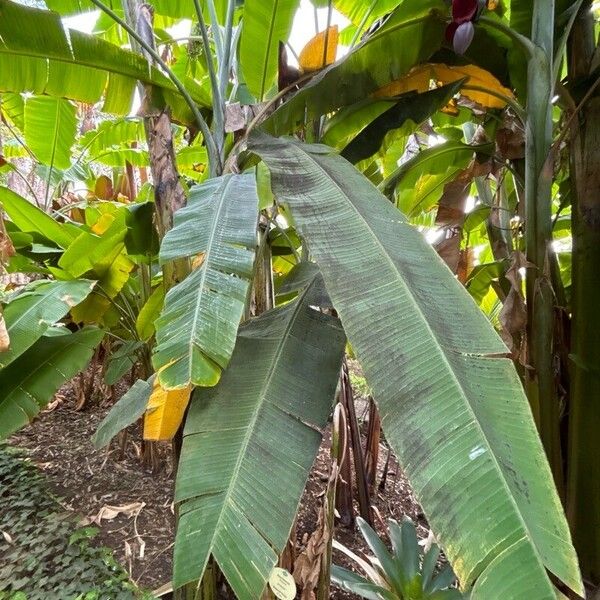
Plant Overview
Known as the "Wandering Banana" or the "Burmese Blue Banana," Musa itinerans is a fast-growing giant hailing from the lush jungles of Southeast Asia and Southern China. Unlike most garden bananas that stay in a neat clump, this species is a true explorer, sending out long underground runners to "walk" across your landscape. It is most famous for its stunning, ornamental fruits that trade the typical grocery-store yellow for shades of dusty purple and violet-blue.
🔍 How to Identify
- 🍃 The Foliage: Massive, paddle-shaped leaves that can reach over 2 meters in length. They are vibrant green, often featuring a subtle silvery-waxy coating on the undersides.
- 🍇 The Fruit: Small, slightly angled bananas that transition from green to a distinct purplish-blue or lavender hue as they mature.
- 🪵 The Pseudostem: A thick, sturdy "trunk" that often displays a reddish or purple tint at the base, covered in a powdery white "bloom" that feels smooth to the touch.
🏡 In Your Garden
- 🏃 Space to Roam: Because this plant spreads via long rhizomes (runners), it doesn't stay in one spot. It is best used as a "jungle-maker" for large areas rather than a focal point in a small, cramped pot.
- ❄️ Surprising Hardiness: Among the banana family, the Wandering Banana is remarkably resilient. It handles cooler temperatures better than many tropical cousins, often surviving mild frosts if the root system is well-protected with thick mulch.
⚠️ Safety & Toxicity
- ✅ Safe Status: Musa itinerans is non-toxic to humans, dogs, and cats. It is a "friendly" giant for household landscapes.
- 🦷 Dental Hazard: While the fruit is technically edible and sweet, it is filled with large, rock-hard black seeds. Biting into one can easily chip a tooth, so they are generally grown for their beauty rather than for snacks.
✨ Fun Fact
🐘 The Elephant’s Choice: In its native habitat, this plant is a favorite snack for wild Asian elephants. They don't just eat the fruit; they consume the moisture-rich trunks to stay hydrated, inadvertently helping the plant "wander" even further by dispersing seeds throughout the forest!

Detailed Care Instructions

Place in a bright room that is sun drenched almost all day. Or directly in a south-facing window.

The presence of a dry surface layer of soil does not indicate that the plant requires water. Instead, stick your finger 1-2" (3-5 cm) deep in the soil to feel dampness or moisture content. If the soil seems dry, it's time to water your greens. If the soil is still moist, however, it is better not to water your plant and instead wait a day or two. Overwatering or waterlogging raises the risk of root rot. So if the soil takes longer than a week to dry, check the light conditions because it's likely that the plant isn't getting enough light. It's fine if the upper layer of soil is dry between waterings, but the deeper soil layer should always have some moisture.
These plant needs regular fertilizing during growing seasons. Fertilizing your plants in dormant state during the winter, might result in scorching or browning of the leaf tips. If mature plants display signs of nutrient insufficiency, fertilizer administration is necessary to restore the plant to its previous state.
You may use All Purpose Plant Food or Green Plant Food or Vegetable Plant Food for your Yunnan Banana
Common pests of the yunnan banana include Mealybugs, spider mites, thrips. Make a habit of checking your yunnan banana frequently for pests so that any infestations can be caught and managed early.







