Plant Overview
Meet the world's most popular "giant herb." Often mistaken for a tree, Musa × paradisiaca is actually a botanical heavyweight related to ginger and cardamom. Often referred to as "Adam’s Fig" in historical texts, this lush hybrid is the source of the bananas and plantains we find in every kitchen, bringing an instant Jurassic-period vibe to any tropical garden.
🔍 How to Identify
- 🍃 Massive Foliage: Features gargantuan, paddle-shaped leaves that can reach up to 9 feet in length, radiating from the center of the plant.
- 🌴 The Pseudo-stem: It lacks a woody trunk; instead, it has a "pseudostem" formed by tightly overlapping leaf sheaths that are surprisingly sturdy but full of water.
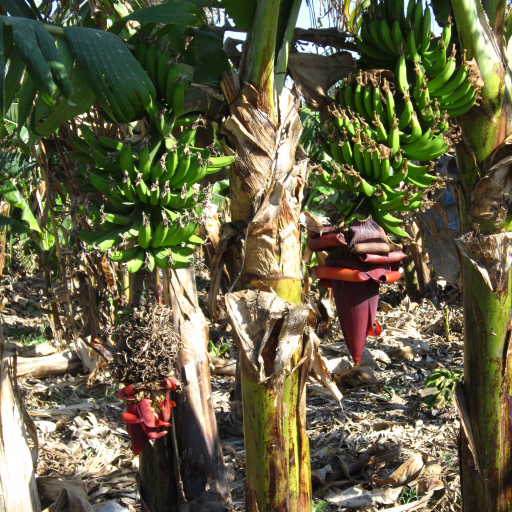
- 🌺 The Heart: A large, heavy, teardrop-shaped purple bud hangs from the top, peeling back layers to reveal rows of small, tubular flowers that eventually turn into fruit.
🏡 In Your Garden
- 💨 Shelter from the Storm: Because the leaves are so broad and thin, they act like sails. High winds will easily shred them into ribbons, so plant them near a wall or windbreak to maintain their pristine look.
- 🍽️ Heavy Feeders: These are "hungry" plants that require frequent applications of organic fertilizer and compost to support their rapid growth and fruit production.
- 💧 Drainage is Key: While they crave humidity and consistent moisture, they are highly susceptible to root rot. They need "moist but not soggy" soil to thrive.
⚠️ Safety & Toxicity
- ✅ Pet & Human Friendly: Musa × paradisiaca is generally non-toxic to cats, dogs, and humans. It is one of the safest tropical plants to have around a family home.
- 👕 Staining Sap: Be cautious when pruning! The clear sap from the stems and leaves turns into a permanent, dark brown stain on clothing and can be slightly sticky or irritating to very sensitive skin.
✨ Fun Fact
Botanically speaking, the banana is actually a berry! Because it grows from a single ovary and has a fleshy middle, it fits the scientific definition perfectly, whereas the "banana tree" is technically the world's largest perennial herb.

Detailed Care Instructions
| Color | Purple Buds |
| Soil Ph | 5.5-6.5 |
| Humidity | Normal |
| Lighting | Full Sun |
| Soil Type | Moist, Well-Drained |
| Bloom Time | Summer |
| Difficulty | Medium |
| Plant Type | Herbaceous Perennial |
| Hibernation | Cold Period |
| Mature Size | 12-15 Feet |
| Native Area | Southeast Asia, Malaysia, New Guinea |
| Temperature | 18°C - 28°C |
| Sun Exposure | Full Sun |
| Hardiness Zones | 8-11 |
To grow Musa × Paradisiaca, commonly known as banana plant or plantain, follow these steps:
- Climate requirements: Ensure you live in a suitable climate for growing banana plants. They thrive in tropical and subtropical regions, as they require warm temperatures between 75°F to 90°F (24°C to 32°C) throughout the year.
- Sunlight: Choose a location that receives full sun or partial shade. Banana plants require at least 6 hours of direct sunlight daily.
- Soil: The soil should be well-draining and fertile. It should also have good water retention properties. Sandy loam or loamy soil is ideal for banana plants.
- Propagation: You have two options for propagation: using suckers (pups) or seeds. Propagating through suckers is simpler and faster. Select healthy suckers with a few leaves already formed and cut them at an angle using a sterilized sharp knife.
- Dig a hole wide and deep enough to accommodate the entire root ball of the sucker.
- Plant the sucker in the hole with the top of the corm (bulb-like structure at the base) level with the surface.
- Firmly press the soil around the sucker to eliminate air pockets.
- Water the plant thoroughly.
- Dig a hole wide and deep enough to accommodate the entire root ball of the sucker.
- Watering: Banana plants require consistent watering to maintain moist soil, but they shouldn't be waterlogged. Water deeply once a week or as needed, depending on the weather conditions and soil moisture level.
- Fertilizer: Apply a balanced, slow-release fertilizer with a higher percentage of potassium (potash) every 2-3 months. Additionally, supplement with organic matter or compost for improved soil fertility.
- Mulching: Add a layer of organic mulch, such as straw or leaves, around the base of the plant to conserve soil moisture and prevent weed growth.
- Protection from wind: Banana plants have large, delicate leaves that can be easily damaged by strong winds. Planting them near a fence or building can provide protection.
- Pruning: Trim away any dead or damaged leaves to maintain plant health. Remove excess suckers to allow the main plant to focus its energy on fruit production.
- Pest and disease control: Keep an eye out for common banana plant pests such as aphids, spider mites, and nematodes. Treat infestations promptly with appropriate insecticides, or resort to organic methods. Additionally, monitor for diseases like Panama disease or black sigatoka, and take preventive measures if necessary.
- Harvesting: Depending on the variety, bananas can take anywhere from 9 to 18 months to bear fruit. Harvest the fruit once the bananas are mature and begin to change color. Cut the whole bunch with a sharp knife, allowing some of the remaining stem attached to the fruit bunch.
Remember that banana plants are relatively large and need ample space to grow, reaching heights of 10 to 20 feet (3 to 6 meters) or higher.

Place in a bright room that is sun drenched almost all day. Or directly in a south-facing window.

To water this plant, you should first assess the moisture level of the soil by sticking your finger about an inch deep into the soil. If it feels dry, it's time to water. Use a watering can and pour water slowly and evenly around the base of the plant, ensuring that the water reaches the roots. Be careful not to over-water, as this can lead to root rot. It's best to water in the morning or late afternoon when it's cooler and the water is less likely to evaporate quickly. During hot weather, you may need to water more frequently, but in cooler periods, be sure to allow the soil to dry out slightly between watering.
To fertilize this plant, apply a balanced fertilizer with equal amounts of nitrogen, phosphorus, and potassium. Apply the fertilizer every 2-3 months, evenly spread around the base of the plant. Be careful not to over-fertilize, as this can cause damage to the plant. Additionally, be sure to water the plant thoroughly after applying fertilizer to prevent burning of the roots.
The ideal soil for Musa × Paradisiaca plant would be a well-draining soil that is rich in nutrients such as nitrogen, potassium, and phosphorous. It should also have a pH range between 5.5 and 6.5. The soil should be loose and friable to allow for proper aeration and root development. Additionally, it should be able to hold moisture without becoming waterlogged. To achieve this, a mixture of peat moss, perlite or vermiculite, and compost can be used.
Propagation of the plant in question can be done through a few different methods. One way is to use offsets, which are small plantlets that grow at the base of the plant. When these offsets are a few inches tall, they can be carefully separated from the parent plant and planted in their own pot or in the ground.
Another way to propagate the plant is through division. This involves separating the plant into smaller sections, each with its own root system. This method is best done when the plant is quite large and has several stems that can be separated.
Lastly, the plant can also be propagated through tissue culture, which involves taking a small amount of plant tissue and using it to grow new plants in a sterile laboratory environment. This method is most often used by commercial growers to produce large quantities of plants quickly and efficiently.
Common pests of the banana include Mealybugs, spider mites, thrips. Make a habit of checking your banana frequently for pests so that any infestations can be caught and managed early.








