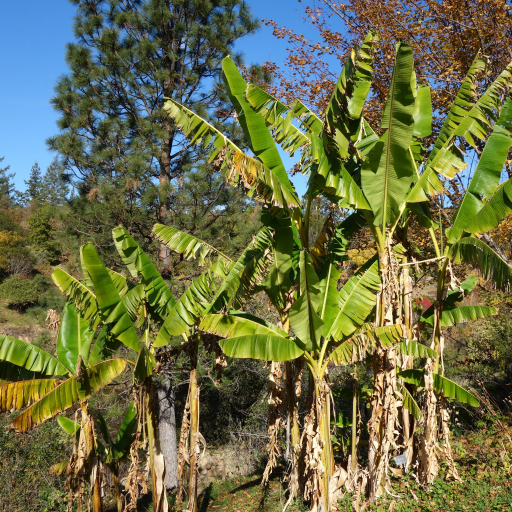
Plant Overview
Commonly known as the Darjeeling Banana, this Himalayan giant brings a lush, Jurassic aesthetic to temperate gardens. Unlike its tropical cousins, it hails from the high altitudes of Northeast India and Bhutan, making it one of the toughest "hardy" bananas in the world. Its dramatic foliage often features striking maroon accents, telling a story of survival in the misty, high-elevation forests of the clouds.
🔍 How to Identify
- 🍃 Stately Foliage: It produces massive, paddle-shaped leaves that can reach over 6 feet in length, boasting a thick, waxy texture that helps it shed heavy mountain rain.
- 🎨 Maroon Highlights: Younger plants frequently display beautiful reddish-purple variegation or "tiger stripes" on the upper leaf surface, paired with a distinct, deep red midrib.
- 🐘 Robust Pseudostem: The "trunk" is thick, sturdy, and typically a dark reddish-brown color, allowing the plant to reach heights of 12 to 15 feet in a single growing season.
🏡 In Your Garden
- 🏔️ Mountain Resilience: Because it originates from high elevations, this banana is surprisingly cold-tolerant. While the leaves will perish in a hard frost, the underground rhizome can survive freezing temperatures if protected with a thick layer of mulch or "straw jacketing."
- 💧 Thirsty Giant: To sustain its rapid growth, it requires deep, consistent watering and rich, organic soil. Think of it as a "heavy feeder"—it loves compost and liquid fertilizers to maintain its vibrant green and red hues.
⚠️ Safety & Toxicity
- 🐾 Non-Toxic: Musa sikkimensis is generally considered safe and non-toxic for cats, dogs, and curious children.
- 👕 Sap Warning: Use caution when pruning or removing old leaves; the clear, watery sap from the pseudostem contains tannins that can cause permanent brown stains on clothing and garden gloves.
✨ Fun Fact
While most tropical bananas struggle at sea level in cooler climates, Musa sikkimensis has been found growing at altitudes of up to 7,000 feet, where it occasionally experiences snow in its natural habitat!

Detailed Care Instructions
| Color | Deep Red Or Purple |
| Soil Ph | Slightly Acidic To Neutral |
| Humidity | Normal |
| Lighting | Part Sun |
| Soil Type | Rich And Well-Draining |
| Bloom Time | Summer |
| Difficulty | Medium |
| Plant Type | Perennial Or Houseplant |
| Mature Size | 12 To 15 Feet High |
| Native Area | Asia |
| Temperature | 24°C - 30°C |
| Sun Exposure | Full Sun To Partial Shade |
| Hardiness Zones | 5-9 |
To grow Musa Sikkimensis, also known as the Darjeeling Banana or Red Tiger Banana, you can follow these steps:
- Select a suitable location: Musa Sikkimensis prefers full sun to partial shade. Choose a location in your garden with well-draining soil that receives at least 6-8 hours of sunlight per day.
- Prepare the soil: Ensure the soil is nutrient-rich and well-draining. You can add organic matter like compost or well-rotted manure to improve soil fertility and drainage.
- Planting: Dig a hole that is slightly larger and deeper than the plant's root ball. Place the Musa Sikkimensis plant in the hole, ensuring that the top of the root ball is level with or slightly above the soil surface. Gently backfill the hole with soil and water thoroughly to settle the soil around the roots.
- Watering: Keep the soil consistently moist but not overly saturated. During the growing season, water deeply once or twice a week, increasing the frequency during hot and dry periods. Reduce watering during winter dormancy.
- Mulching: Apply a layer of organic mulch around the base of the plant to help retain moisture, suppress weed growth, and regulate soil temperature. Avoid piling mulch directly against the trunk to prevent rotting.
- Fertilization: Musa Sikkimensis is a heavy feeder. Apply a balanced, slow-release fertilizer every 4-6 weeks during the growing season to ensure the plant receives sufficient nutrients. Follow the package instructions for the appropriate dosage.
- Pruning: Remove any dead or yellowing leaves regularly to maintain the plant's appearance and health. Musa Sikkimensis produces new leaves from the center of its pseudostem, so old leaves can eventually be cut down to the base.
- Protecting from cold: If you live in a region with cold winters, it's essential to protect the Musa Sikkimensis plant. Before the first frost, cut the plant back to around 1-2 feet above the ground. Mulch heavily around the base and cover the remaining stem with burlap or a frost blanket.
- Pest and disease control: Monitor your Musa Sikkimensis plant for common banana pests like aphids, spider mites, and banana weevils. Treat any infestations promptly using organic pest control methods. Disease prevention can be achieved by providing adequate air circulation and avoiding overhead watering.
- Propagation: Musa Sikkimensis can be propagated through division or by growing from seeds. Mature plants can be divided, ensuring each division has healthy roots attached. Seeds can be collected from mature fruit and planted in a suitable growing medium, keeping them warm and moist until germination occurs.
Remember to research the specific care requirements of Musa Sikkimensis, as environmental conditions may vary depending on your location.

Place in a bright room that is sun drenched almost all day. Or directly in a south-facing window.

To water Musa Sikkimensis, also known as the Himalayan banana plant, it is important to consider a few factors:
1. Watering frequency: The plant should be watered regularly to keep the soil consistently moist but not waterlogged. Monitor the top inch of soil and ensure it doesn't dry out completely between waterings.
2. Adequate drainage: The plant prefers well-draining soil to prevent waterlogging, which can lead to root rot. Choose a pot or planting location with drainage holes to allow excess water to escape.
3. Watering method: Avoid overhead watering, as it can lead to the accumulation of moisture in the plant's crown, which may cause rot. Instead, water at the base of the plant, close to the soil level. Pour water slowly to allow absorption into the root area.
4. Watering quantity: The amount of water required by the Musa Sikkimensis depends on various factors, including the size of the plant, pot size, and environmental conditions. Water thoroughly until you see water coming out of the drainage holes, ensuring the entire root system is adequately moistened.
5. Environmental conditions: Assess the temperature, humidity, and light conditions in which the plant is located as it can impact its water requirements. Higher temperatures, increased light exposure, and lower humidity levels may necessitate more frequent watering.
6. Seasonal adjustments: Adjust watering frequency according to the season. During the growing season, which is typically spring and summer, the plant may require more water due to increased growth and evaporation. In contrast, reduce watering during the dormant period in winter to prevent over-saturation of the soil.
Remember to observe the plant closely and adjust watering practices accordingly. By providing consistent moisture without overwatering, you can help ensure the optimal health and growth of your Musa Sikkimensis plant.
To fertilize a Musa Sikkimensis plant, follow these instructions:
- Choose a balanced, water-soluble fertilizer with an N-P-K ratio of about 10-10-10 or 14-14-14.
- Dilute the fertilizer according to the package instructions, usually 1 teaspoon per gallon of water.
- Water the plant thoroughly before applying fertilizer to prevent burning the roots.
- Pour the diluted fertilizer mixture evenly around the base of the plant, avoiding direct contact with the stem.
- Ideally, fertilize the plant every two to four weeks during the growing season, generally from spring to fall.
- Be cautious not to over-fertilize as it can harm the plant. Follow the fertilizer's instructions for any specific guidelines.
- Monitor the plant's response to the fertilizer. If the leaves show signs of burning or the plant seems stressed, reduce the fertilizer concentration or frequency.
- Remember to always water the plant after fertilizing to help distribute the nutrients and prevent any salt buildup.
- During the dormant winter season, when the growth slows down, reduce or halt fertilization to allow the plant to rest.
- Regularly observe the plant's overall health and adjust fertilization practices as needed to maintain optimal growth and vitality.
The ideal soil for a Musa Sikkimensis plant is one that is well-draining yet retains some moisture. A mixture of organic-rich soil, such as compost or peat moss, blended with regular potting soil is recommended. This combination ensures good drainage while providing essential nutrients for the plant's growth.
The soil pH should range between slightly acidic to neutral, around 6.0 to 7.0, for optimal growth. This range allows the plant to efficiently absorb nutrients from the soil.
Another crucial aspect of the soil composition for a Musa Sikkimensis plant is its texture. Ideally, the soil should be loose and friable, allowing for proper root development and aeration. This helps prevent waterlogging, which can lead to root rot.
Adding perlite or sand to the soil mix can also enhance drainage, especially if the natural soil is heavy or tends to retain excessive moisture. This addition creates a well-structured soil that promotes a healthy root system.
Overall, the key factors for choosing soil for a Musa Sikkimensis plant are good drainage, moisture retention, nutrient availability, and proper pH levels. By providing these conditions, you can create an optimal soil environment for the healthy growth and development of the plant.
Propagation of Musa Sikkimensis plant can be done through various methods. Here are some techniques you can use to propagate this plant successfully:
- Division: One way to propagate Musa Sikkimensis is by dividing its rhizomes. Start by carefully removing the plant from its pot or digging up the parent plant. Look for natural divisions or separate sections of the rhizome with healthy roots and shoots. Use a sharp, sterile knife or pruning shears to cut these sections apart. Ensure each division has a portion of healthy roots attached to it. Plant the divisions in separate pots with well-draining soil, placing them at the same depth they were in the parent plant.
- Suckers: Musa Sikkimensis produces suckers or shoots around its base. These can be detached and propagated into new plants. Gently remove the sucker from the parent plant, ensuring it has its own set of roots. You may need to use a spade or sharp knife to separate it from the parent plant. Plant the sucker in a pot filled with well-draining soil, and make sure to keep it moist until it establishes itself.
- Tissue Culture: This is a more advanced propagation technique that involves taking small tissue samples from the plant and growing them in a sterile laboratory environment. The tissue samples are placed in a culture medium containing nutrients and growth hormones, allowing them to develop into new plants. Tissue culture propagation is commonly used for mass production of plants with desirable traits.
- Seeds: Although less commonly done, Musa Sikkimensis can also be propagated from seeds. Obtain ripe seeds from a mature plant and soak them in warm water for a day or two to soften the seed coat. Sow the seeds in a well-draining seed-starting mix, covering them lightly with soil. Maintain a warm and moist environment, either by using a propagation tray with a plastic cover or a greenhouse. Germination can take a few weeks to several months.
Regardless of the propagation method chosen, it is essential to provide the young plants with a warm, humid environment to foster their growth. Place them in a bright location, protected from direct sunlight until they establish themselves. Keep the soil consistently moist but avoid overwatering to prevent rotting. With proper care, your propagated Musa Sikkimensis plants will grow into healthy specimens.
Common pests of the darjeeling banana include Mealybugs, spider mites, thrips. Make a habit of checking your darjeeling banana frequently for pests so that any infestations can be caught and managed early.








