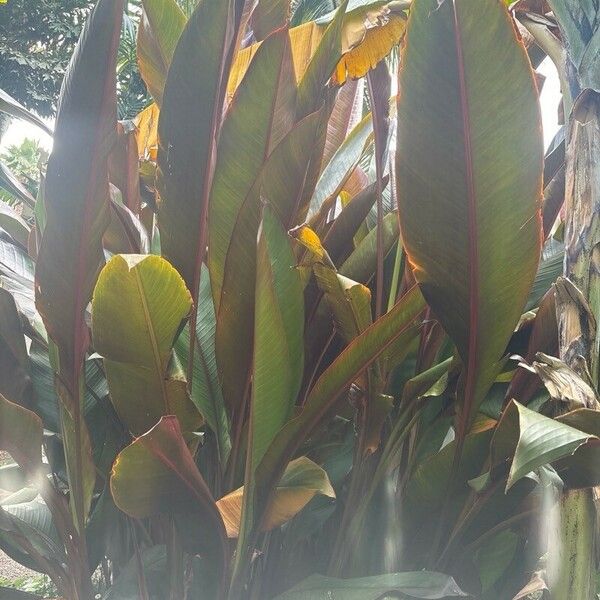
Plant Overview
Often called the Thomson’s Wild Banana, this elegant species hails from the misty, high-altitude forests of the Eastern Himalayas. Unlike the sterile bananas we find in grocery stores, Musa thomsonii is a wild ancestor that tells a story of survival in the cool mountain air. It is prized by collectors not for its fruit, but for its architectural grandeur and the tropical drama it brings to temperate gardens.
🔍 How to Identify
- 🍃 Lush Foliage: The leaves are massive, paddle-shaped, and a deep, glossy green. When young, the undersides and midribs often sport a delicate reddish or purplish tint that glows when backlit by the sun.
- 🎋 The Pseudostem: Its "trunk" is actually a collection of tightly wrapped leaf bases. It has a distinctive waxy, glaucous coating that feels smooth to the touch and can reach impressive heights of 10 to 15 feet.
- 🌺 Exotic Blooms: The flower spikes are heavy and dramatic, featuring dark maroon or deep purple bracts that peel back to reveal rows of small, creamy yellow flowers.
🏡 In Your Garden
- 🌬️ Wind Protection: Because the leaves are so large, they act like sails. To prevent the "shredded" look common in bananas, plant it in a sheltered spot where buildings or sturdier trees can break the wind.
- 💧 The Drainage Balance: While it loves the humidity of its Himalayan home, it is prone to root rot if left in standing water. It prefers "rich but gritty" soil that allows water to pass through quickly while retaining consistent moisture.
- ❄️ Cooler Roots: Interestingly, this species is slightly more cold-tolerant than its tropical cousins. It can handle a light nip of frost better than a Cavendish, though its leaves will still brown and die back in winter.
⚠️ Safety & Toxicity
- ✅ Safe Status: Musa thomsonii is generally considered non-toxic to humans, cats, and dogs.
- 🍌 The Fruit Caveat: While the plant is safe, the fruit itself is a surprise—it is packed with hard, black seeds and very little pulp. It isn’t "poisonous," but it is certainly not a pleasant snack for children or pets due to the choking hazard of the seeds.
✨ Fun Fact
Unlike the bananas we eat, which are "triploid" (sterile and seedless), Musa thomsonii is a fertile wild species. In its native habitat, it relies on bats and birds for pollination, leading to those giant, stony seeds that make it nearly impossible to eat but fascinating to study!

Detailed Care Instructions







