Plant Overview
Known as the "Banana of Paradise," Musa x paradisiaca isn't just one plant but a legendary hybrid that has fed the world for millennia. Often referred to as "Plantains" or "Cooking Bananas," these giants bring an instant tropical jungle vibe to any landscape. Unlike their sweet dessert cousins, these are the starchy powerhouses of the kitchen, steeped in history and folklore from Southeast Asia to the Caribbean.
🔍 How to Identify
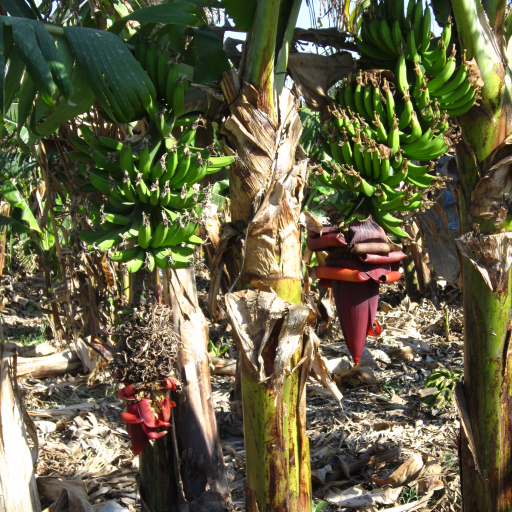
- 🍃 The Foliage: Enormous, paddle-shaped leaves that can reach up to 9 feet long. They feature a prominent central midrib and a natural tendency to "shred" into a fringe-like appearance—a clever evolutionary trick to prevent the giant leaves from acting like sails and toppling the plant in high winds.
- 🎋 The Pseudostem: What looks like a sturdy wooden trunk is actually a "pseudostem." It is a tight, fleshy bundle of overlapping leaf sheaths that are surprisingly strong but contain no actual wood.
- 💜 The Heart: A massive, drooping, maroon or deep purple heart-shaped bud emerges from the center. As the bracts peel back, they reveal rows of tiny flowers that eventually transform into the hanging clusters of fruit known as "hands."
🏡 In Your Garden
- 🍴 The Heavy Feeders: These plants are incredibly "hungry" and "thirsty." They require rich, organic-heavy soil and consistent moisture to support their rapid growth. Because they are 90% water, they will stop growing the moment the soil dries out completely.
- 🛡️ Wind Protection: While they crave full sun to produce fruit, their giant leaves are fragile. Planting them near a south-facing wall or in a sheltered nook prevents them from looking "tattered" and helps the plant conserve the energy it would otherwise spend trying to heal ripped foliage.
⚠️ Safety & Toxicity
- ✅ Safe Status: Musa x paradisiaca is non-toxic to humans, dogs, cats, and horses. It is one of the safest "tropical" looking plants you can keep around curious pets.
- 🧥 The Sap Warning: While not poisonous, the clear sap from the stem and leaves is legendary for its staining power. If it gets on your clothes, it turns into a permanent dark brown or black mark that no detergent can remove. It can also be slightly sticky or irritating to those with very sensitive skin.
✨ Fun Fact
Botanically speaking, a banana is actually a berry, and the "tree" it grows on is technically the world's largest perennial herb because it never develops a woody trunk like a true tree!

Detailed Care Instructions
To grow Musa X Paradisiaca, also known as the banana plant, you can follow these steps:
- Climate: Ensure you live in a suitable climate. Banana plants thrive in tropical and subtropical environments with warm temperatures ranging between 78-86°F (25-30°C) and high humidity. They require a frost-free climate and cannot tolerate temperatures below 50°F (10°C).
- Soil: Select a fertile, well-draining soil. Bananas prefer sandy loam soil rich in organic matter. The soil pH should be between 6.0 and 7.5.
- Planting: Purchase a healthy banana plant or obtain a sucker from an existing banana plant. A sucker is a small plantlet that grows off the base of the main plant. Dig a hole that is two times wider and deeper than the root ball. Gently place the plant or sucker into the hole and backfill with soil, ensuring that the top of the root ball is level with the ground.
- Sunlight: Banana plants require full sun exposure to grow properly. Find a location in your garden that receives at least 6-8 hours of direct sunlight daily.
- Watering: Water the plant regularly, keeping the soil consistently moist but not waterlogged. Ensure proper drainage to prevent the roots from becoming saturated, as this can lead to root rot. During the growing season, provide deep waterings every 7-10 days.
- Mulching: Apply a layer of organic mulch around the base of the banana plant to retain soil moisture, regulate soil temperature, and suppress weed growth. Avoid piling the mulch against the plant stem to prevent rot.
- Fertilizing: Feed the banana plant with a balanced fertilizer every 6-8 weeks during the growing season. Use a fertilizer with a ratio close to 8-10-8, which means it contains equal amounts of nitrogen, phosphorus, and potassium respectively. Follow the product instructions for application rates.
- Pruning: Remove any dead or damaged leaves to maintain plant health and aesthetics. Additionally, bananas produce fruit on a main stem, known as the pseudostem. After fruiting, the pseudostem will die back. Cut it to the ground, as new shoots will emerge to replace it.
- Pest and disease control: Monitor your banana plant for any signs of pests or diseases, such as aphids, spider mites, or fungal infections. Promptly treat any issues using appropriate methods, such as organic insecticides or fungicides. Proper sunlight exposure and good airflow can help prevent many problems.
- Harvesting: Depending on the specific type of banana plant you are growing, it can take anywhere from 9-18 months from planting to harvest. Bananas are typically harvested when they are fully mature but still green in color. Cut the bunch near the top of the stem and allow it to ripen off the plant.
Remember that growing banana plants require patience, as they can take several months to fruit. However, with proper care and attention, you can enjoy the beauty and taste of homegrown bananas.

Place in a bright room that is sun drenched almost all day. Or directly in a south-facing window.

To properly water the plant, first, you need to make sure that the soil is well-draining. The plant requires moist but not waterlogged soil. Allow the soil to dry out slightly before the next watering.
When watering, pour water slowly and carefully onto the soil, avoiding the leaves. Water deeply until the water flows out of the drainage holes.
Monitor the soil moisture regularly by checking the soil with your finger. If the top inch of the soil is dry, then it's time to water the plant.
During the growing season, which is usually from spring to autumn, you can water the plant once or twice a week. In winter, when the plant is in dormancy, you can water less frequently, about once every two weeks.
Overall, ensure that the plant receives sufficient but not excessive water to prevent root rot.
To fertilize this plant, use a nitrogen-rich fertilizer with a balanced NPK ratio. Apply the fertilizer once a month during the growing season, which is typically from spring to fall. Be sure to dilute the fertilizer according to the package instructions to avoid burning the roots. Additionally, supplementing with organic matter such as compost or aged manure can greatly benefit the soil structure and overall health of the plant. Avoid fertilizing during the winter months when the plant is dormant.
Musa X Paradisiaca plant prefers a well-draining soil that is rich in nutrients. The soil should have a pH range of 5.5 to 7.0. The ideal soil type for this plant is sandy loam, but it can also grow well in clay soils if the drainage is good. It is important to add organic matter to the soil to improve its nutrient content and water-holding capacity. The plant also requires a lot of water, so the soil should be moist but not waterlogged. It is recommended to water the plant deeply once or twice per week. Fertilizer should be applied regularly to ensure healthy growth and fruiting. A balanced fertilizer that contains nitrogen, phosphorus, and potassium is the best choice for this plant.
One way to propagate this plant is by using its suckers. Suckers are new shoots that grow from the base of the plant. To propagate, select a healthy sucker that has several leaves. Using a sharp knife, cut the sucker off at its base, leaving enough of the root attached to the sucker. Plant the sucker in a container filled with well-draining soil. Water it regularly and keep it in a warm, humid location with filtered sunlight. The sucker should establish roots and begin to grow within a few weeks. Another way to propagate this plant is by using its seeds, but this method takes longer and requires more patience. To use seeds, harvest ripe fruit from the plant and extract the seeds. Clean and dry the seeds before sowing them in a container filled with well-draining soil. Keep the soil moist and warm, and place the container in a suitable location with filtered sunlight. The seeds should germinate within several weeks, and the resulting seedlings can be transplanted into larger containers or planted in the ground once they are large enough.
Common pests of the banana include Mealybugs, spider mites, thrips. Make a habit of checking your banana frequently for pests so that any infestations can be caught and managed early.








