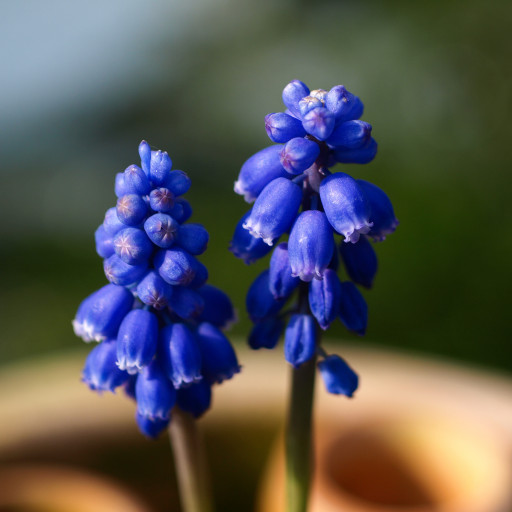
Plant Overview
Often called the "Grape Hyacinth," this charming spring bulb looks like miniature clusters of grapes growing upside down in the garden. Native to the woodlands of Central and South-Eastern Europe, these tiny blue beacons are the heralds of spring, often popping up through the melting snow. In folklore, they are sometimes called "Cuckoo's Flowers," as their appearance coincides with the bird’s return from migration.
🔍 How to Identify
- 🍇 The Bloom: Densely packed, tiny, urn-shaped flowers that cluster together on a sturdy, leafless stem. They are most famous for their striking sky-blue color.
- 🍃 The Foliage: Narrow, fleshy, grass-like leaves that grow in a basal clump. They often appear floppy and can look a bit untidy after the blooming period.
- ⚪ The Edge: If you look closely at each individual "grape" bell, you’ll see a tiny, delicate white rim or "teeth" at the opening, creating a beautiful contrast.
🏡 In Your Garden
- 🌱 Master Naturalizer: These plants are famous for their ability to "naturalize," meaning they will self-seed and spread via underground bulbs to create a rolling sea of blue over several years.
- ☀️ Dormancy Logic: Don’t be alarmed when the leaves turn yellow and die back in early summer. The plant isn't dying; the bulb is simply entering a dormant state to store energy for next year. They prefer well-draining soil to prevent the bulbs from rotting during this "sleep."
⚠️ Safety & Toxicity
- 🐾 Pet Safety: While not as toxic as true Lilies, Grape Hyacinths contain compounds that can cause mouth irritation and digestive upset. Keep curious cats and dogs from chewing on the leaves or bulbs.
- 🚫 Not for Snacks: Despite their "Grape" nickname, these are absolutely not edible. Ingesting any part of the plant can lead to nausea and stomach pain in humans, especially children.
✨ Fun Fact
- 👃 The genus name Muscari comes from the Greek word moschos, meaning musk. This refers to the sweet, subtle fragrance that many species in this family emit, which is designed to attract early-season bees and pollinators.

Detailed Care Instructions
To grow Muscari Botryoides plant, also known as Grape Hyacinth, you can follow these steps:
- Choose the right location: Muscari Botryoides prefers full sun to partial shade. Make sure the location you choose receives at least 6 hours of direct sunlight per day.
- Prepare the soil: Grape Hyacinth plants prefer well-draining soil. Amend the soil by adding organic matter or compost to improve its drainage and fertility.
- Plant the bulbs: Plant the bulbs in the fall, preferably 4-6 weeks before the first frost. Dig a hole that is twice as deep as the bulb's height and place the bulb with the pointy end facing up. Space the bulbs about 2-3 inches apart.
- Water regularly: After planting, water the bulbs thoroughly to help settle the soil and initiate root growth. Keep the soil slightly moist (not overly wet) during the growing season.
- Fertilize sparingly: Grape Hyacinth plants generally do not require much fertilizer. However, if your soil is deficient, you can apply a slow-release, balanced fertilizer in early spring.
- Mulch the area: Apply a layer of mulch around the plants to help conserve moisture and suppress weed growth. Avoid placing mulch directly over the bulbs, as it may hinder emergence in spring.
- Prune after blooming: Once the flowers have faded and the foliage dies back naturally, you can cut the foliage back to ground level. This helps the plant regenerate energy for the next growing season.
- Divide the bulbs: After a few years, Muscari Botryoides bulbs may become overcrowded. To prevent this, dig up the clumps in late summer or early fall, separate the bulbs, and replant them at the desired spacing.
Remember to check your specific plant variety for any additional care instructions, as some Muscari species may have slightly different requirements.

Place in a window with dappled sun or a spot in the middle of a room. Or directly in a window facing west or east.

To water the plant, it is important to first consider the soil type and moisture levels. The plant prefers well-draining soil, so avoid overwatering or letting the soil become waterlogged. Check the soil moisture by sticking your finger an inch deep into the soil – if it feels dry, it is time to water. When watering, aim to moisten the soil evenly throughout the root zone and avoid getting water on the foliage or flowers. Water slowly and deeply to ensure the water reaches the roots, but do not let water pool around the base of the plant. The frequency of watering will depend on factors such as the temperature, humidity, and amount of sunlight the plant receives. In general, the plant should be watered whenever the top inch of soil feels dry to the touch.
- Choose a balanced fertilizer with equal amounts of nitrogen, phosphorus, and potassium.
- Apply the fertilizer in early spring, just as the plant begins to emerge from dormancy.
- Follow the instructions on the fertilizer package for application rates and frequency.
- Water the plant thoroughly after fertilizing to ensure the nutrients are absorbed.
- Avoid over-fertilizing, as this can lead to excessive foliage growth and fewer flowers.
- Consider adding an organic fertilizer, such as compost or aged manure, to the soil in the fall to improve overall soil health and fertility.
Muscari Botryoides is a plant that requires a well-draining soil mix that consists of a balance of organic matter and inorganic components. The soil should be slightly acidic with a pH range of 6.0 to 7.5. It is recommended to mix peat moss, perlite and sand in equal parts to create an ideal soil mix. The plant prefers to grow in a soil that is rich in nutrients, so it is important to use a slow-release fertilizer during transplanting and to fertilize the plant regularly throughout the growing season to promote healthy growth. Finally, it is best to avoid using heavy or clay soils, as this will inhibit the plant's root development and cause harm to the overall health of the plant.
To propagate this plant, you can begin by checking for offsets or small bulblets that are growing off the main plant. Carefully remove these offsets with a sharp, sterilized knife, making sure to take some of the attached root system with them.
Prepare a well-draining and nutrient-rich soil mixture and plant the offsets in the soil, burying them about an inch deep. Water thoroughly and provide bright, indirect sunlight.
If no offsets are available, you can also propagate this plant by collecting its seeds, which are usually formed after the plant has finished flowering. Harvest the seeds once they turn brown and dry, and gently plant them in a prepared soil mixture.
Keep the newly planted offsets or seeds moist but not waterlogged, and wait patiently for them to establish themselves in their new environment. With proper care and attention, your propagated Muscari Botryoides plant will grow into a beautiful and thriving specimen.
Common pests of the grape-hyacinth include Spider mites, aphids, snails. Make a habit of checking your grape-hyacinth frequently for pests so that any infestations can be caught and managed early.








