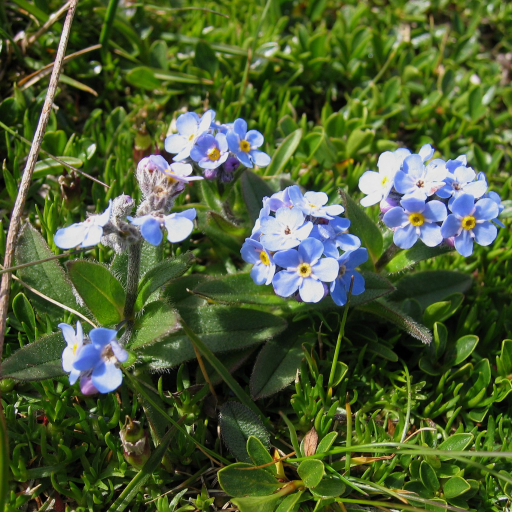
Plant Overview
Known as the "Alpine Forget-me-not," this charming perennial is the stuff of legends and mountain lore. Often found clinging to rocky slopes or tucked into cool garden corners, it symbolizes true love and enduring memory. Whether you call it a mountain gem or recognize it as the state flower of Alaska, its tiny azure blossoms are a signature of springtime beauty.
🔍 How to Identify
- 💙 Petal Power: Tiny, five-petaled flowers in a brilliant sky-blue hue, featuring a distinct, bright yellow "eye" at the center.
- ☁️ Fuzzy Foliage: The leaves are lance-shaped and covered in fine, soft hairs, giving the plant a slightly velvety or grayish-green appearance.
- 🌀 The Scorpion Tail: The flower clusters grow on stems that curve at the tip, uncurling slowly as the blossoms open—a shape botanists call a "scorpioid cyme."
🏡 In Your Garden
- 🏔️ Mountain Roots: As an alpine species, it craves excellent drainage. It feels most at home in rock gardens or gravelly soils that mimic its native high-altitude slopes.
- 🌬️ Cool & Collected: This plant dislikes sweltering summer heat. In warmer regions, it needs a spot with afternoon shade and plenty of airflow to prevent powdery mildew from settling on its fuzzy leaves.
- 🌱 The Great Wanderer: While individual plants are short-lived, they are prolific self-seeders. Once established, they will "walk" around your garden, popping up in new nooks and crannies every spring.
⚠️ Safety & Toxicity
- 🟢 Status: Generally non-toxic to humans and pets, but not intended for the dinner table.
- 🐶 Details: While it lacks the deadly toxins found in some garden neighbors, some species in the Myosotis family contain trace amounts of pyrrolizidine alkaloids. These can be harmful if ingested in large quantities, so it is best to keep curious pets and toddlers from snacking on them.
✨ Fun Fact
The name "Forget-me-not" originates from a medieval German legend. A knight, while picking these flowers for his lady beside a fast-moving river, tripped and fell in due to his heavy armor. As he was swept away, he tossed the bouquet to his love and shouted, "Vergiss mein nicht!" (Forget me not!).

Detailed Care Instructions
| Color | Blue |
| Soil Ph | Mildly Acidic To Mildly Alkaline |
| Lighting | Full Sun |
| Toxicity | Non-Toxic |
| Soil Type | Fertile, Evenly Moist, And Well-Drained |
| Bloom Time | April To May |
| Plant Type | Herbaceous Perennial |
| Mature Size | 6-8" |
| Native Area | North-Western States And Provinces Of The United States And Canada |
| Sun Exposure | Full Sun To Partial Shade |
| Hardiness Zones | 3-9 |
To grow Myosotis alpestris plant, also known as Alpine Forget-me-not, follow these steps:
- Choose a suitable location: Myosotis alpestris prefers full sun to partial shade. It can thrive in a variety of soil types but does best in well-draining soil.
- Prepare the soil: Ensure the soil is loose and free from weeds. Add organic matter like compost to improve the soil's fertility and drainage.
- Plant the seeds: Sow the seeds directly in the garden bed or in pots. If starting indoors, use seed trays or pots and transplant them later. Surface sow the seeds as they require light to germinate. Do not bury them in the soil.
- Watering: Keep the soil consistently moist but not waterlogged. Water the plants regularly, especially during dry periods. Avoid overhead watering to prevent fungal diseases.
- Mulching: Apply a layer of organic mulch around the plants to help retain moisture and suppress weeds.
- Fertilization: Myosotis alpestris generally doesn't require heavy fertilization. However, you can apply a balanced, slow-release organic fertilizer during the growing season to promote healthy growth.
- Pruning: Deadhead the faded flowers regularly to encourage continuous blooming and prevent self-seeding. Cut back the plant after flowering to encourage new growth and prevent it from becoming leggy.
- Pests and diseases: Myosotis alpestris is generally resistant to most pests and diseases. However, keep an eye out for snails, slugs, and aphids. Use appropriate organic pest control methods if needed.
- Division: Every few years, Myosotis alpestris can become overcrowded. To rejuvenate the plant, you can divide the clumps in early spring or fall and replant them in well-prepared soil.
Remember to check the specific requirements and recommendations for your specific variety of Myosotis alpestris, as they may vary slightly.

Place in a bright room that is sun drenched almost all day. Or directly in a south-facing window.

To water this plant, ensure that the soil is thoroughly moist but not waterlogged. It is best to water it once a week, but monitor the soil moisture levels between watering to ensure that the plant is not drying out. During hot weather, the plant may need to be watered more frequently. When watering, water the soil around the base rather than watering the leaves and stems. Use water at room temperature and avoid using cold water, as this can shock the plant and damage its roots. Finally, reduce watering during the winter months when the plant may go dormant.
For proper fertilizing of this plant, it is recommended to use a balanced fertilizer with equal parts nitrogen, phosphorus, and potassium. Apply the fertilizer every two weeks in the growing season, but avoid fertilizing during the plant's dormant period. Make sure to dilute the fertilizer before applying it, and water the plant thoroughly after fertilizing.
For optimal growth and health, it is recommended to use a well-draining and nutrient-rich soil mix for this particular plant species. The pH level of the soil should be slightly acidic to neutral, and it should be loose enough to promote root development and allow for adequate water and nutrient uptake. Adding organic matter such as compost or peat moss can improve soil structure and fertility. It is also important to avoid soil that is too compact or clay-like as this can hinder proper growth and development of the plant.
To propagate this species of plant, it is recommended to take stem cuttings in spring or summer. Cut a stem that is green and healthy, with leaves attached, from the parent plant. Remove the bottom set of leaves from the stem and dip the cut end in rooting hormone powder. Place the cutting in moist soil or a rooting medium such as vermiculite or perlite, and keep it in a warm and bright location. Water the cutting regularly to keep the soil or medium moist. After a few weeks, new roots should begin to form and the cutting can be transplanted into a pot or garden bed.








