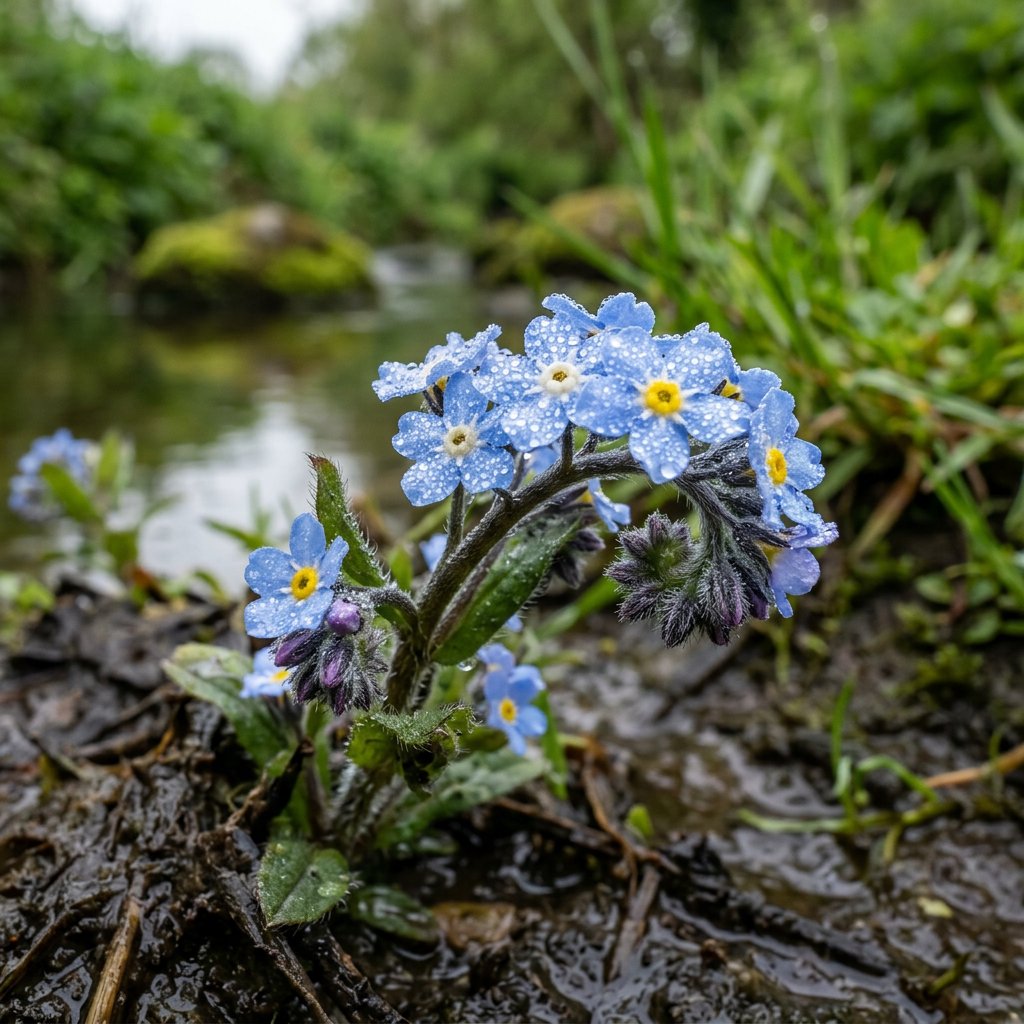
Plant Overview
Known affectionately as the Water Forget-Me-Not or Scorpion Grass, this charming perennial is the "true" forget-me-not of ancient legends. According to German folklore, a knight fell into a river while picking these flowers for his lady; as he was swept away, he tossed the bouquet to her, shouting "Forget me not!" Its botanical name, scorpioides, refers to the way its flowering stems curve gracefully like a scorpion’s tail before they fully bloom.
🔍 How to Identify
- 💧 The "Eye" of the Flower: Look for tiny, five-petaled sky-blue blossoms, each featuring a bright yellow "eye" at the center that acts as a landing pad for pollinators.
- 🌿 Hairy Foliage: The leaves are lance-shaped, bright green, and covered in fine, soft hairs that give them a slightly fuzzy texture.
- 🦂 The Coiled Stem: The most distinct feature is the "scorpioid cyme"—the flower cluster curls tightly at the tip and gradually unfurls as the buds open.
🏡 In Your Garden
- 🌊 Wet Feet Welcome: Unlike its woodland cousins, the Water Forget-Me-Not thrives in soggy environments. It is the perfect choice for the edge of a garden pond, a boggy patch, or a "rain garden" where other plants might rot.
- 🌱 A Natural Spreader: This plant spreads via creeping runners (stolons). It is excellent for "softening" the rocky edges of water features, though you should keep an eye on it to ensure it doesn’t wander too far into neighboring beds.
⚠️ Safety & Toxicity
- 🐾 Mildly Toxic: While beautiful, this plant contains pyrrolizidine alkaloids, which can be harmful if ingested in significant quantities.
- 🐱 Pets and Kids: Keep an eye on curious cats, dogs, or toddlers. While a tiny nibble usually causes nothing more than an upset stomach, consistent ingestion can lead to liver irritation over time.
✨ Fun Fact
The name Myosotis actually translates from Greek to "mouse-ear," a reference to the small, rounded, and fuzzy shape of the plant's leaves!

Detailed Care Instructions
| Humidity | Normal |
| Lighting | Part Sun |
| Difficulty | Medium |
| Temperature | 10°C - 24°C |
| Hardiness Zones | Min 6A |
Here are some steps to help you grow Myosotis scorpioides, also known as Water Forget-me-not:
- Obtain seeds or plants: You can buy Myosotis scorpioides seeds or plants from a garden center or online. Ensure the source is reputable.
- Choose the planting location: Myosotis scorpioides prefers to grow near bodies of water such as ponds, streams, or even containers of water in your garden. It requires moist soil.
- Prepare the soil: Myosotis scorpioides thrives in rich, loamy soil. Clear the area of any weeds or grass and amend the soil with organic matter, such as compost, to improve its fertility and drainage.
- Sow the seeds or plant the seedlings: If growing from seeds, scatter them on the soil surface around the planting area in early spring or late summer. Gently press them into the soil but avoid covering them completely as these seeds require light for germination. If using seedlings, dig small holes and transplant them carefully, spacing them around 6 to 8 inches apart.
- Watering: Adequate moisture is crucial for Myosotis scorpioides. Ensure the soil is consistently moist, especially during dry spells. If growing near a water source, you may not need to water them often.
- Provide partial shade: Myosotis scorpioides prefers partial shade but can tolerate full sun as long as the soil remains moist. It is beneficial to protect them from the intense midday sun, especially in warmer climates.
- Mulching: Apply a layer of organic mulch, such as bark chips or straw, around the plants to help retain moisture, suppress weeds, and keep the soil cool.
- Deadhead regularly: Remove spent flowers (deadhead) to encourage new blooms and prevent self-seeding. This will also help control the spread of the plant.
- Fertilization: Myosotis scorpioides generally doesn't require heavy fertilization. However, you can apply a balanced, slow-release fertilizer in the spring to encourage healthy growth.
- Overwintering: In colder climates, the plant may not survive winter outdoors. You can try to protect it by adding a layer of mulch or moving potted plants to a sheltered area. If necessary, you can collect seeds in the fall and store them in a cool, dry place until spring to replant.
Remember to regularly monitor the health and moisture levels of your Myosotis scorpioides plants to ensure successful growth and blooming.

Place in a window with dappled sun or a spot in the middle of a room. Or directly in a window facing west or east.

To properly hydrate this particular species of plant, it is recommended to thoroughly saturate the soil with water, allowing it to penetrate deeply before draining any excess water. It is important to be mindful of the plant's water needs, as under-watering can lead to wilting and over-watering can cause root rot or other damage. Additionally, it is beneficial to water early in the morning or in the evening, when the temperature is cooler and less water will evaporate.
To promote healthy growth of this plant, it is important to fertilize it every 4-6 weeks with a balanced, water-soluble fertilizer. Be sure to dilute the fertilizer according to the manufacturer's instructions and apply it evenly to the soil around the plant. Avoid getting fertilizer on the foliage as this may cause burning. Water the plant well after fertilizing to ensure the nutrients are absorbed by the roots.
Myosotis Scorpioides prefers soil that is fertile, rich in organic matter, and well-draining. A neutral soil pH level of around 6.0 to 7.5 is optimal. It can grow in both clay and loamy soils but should be planted in a soil mix that is well balanced and has good aeration. The ideal soil for Myosotis Scorpioides is a mix of peat moss, perlite, and vermiculite. Avoid planting it in soil that is too heavy and compact or too sandy. Adding compost or aged manure to the soil can help to improve its fertility and texture. It is important to ensure that the soil is not too wet or too dry, as this can cause problems with the growth of the plant.
To propagate this plant, take stem cuttings in the spring or early summer. Cut a stem that is several inches long and has at least one node. Remove the bottom leaves, leaving only a few at the top. Dip the cut end in rooting hormone and plant in moist soil. Keep the soil consistently moist and place in a bright, indirect light. Roots should begin to form in a few weeks, at which point you can transplant the new plant to a larger pot or outdoors in a garden bed.








