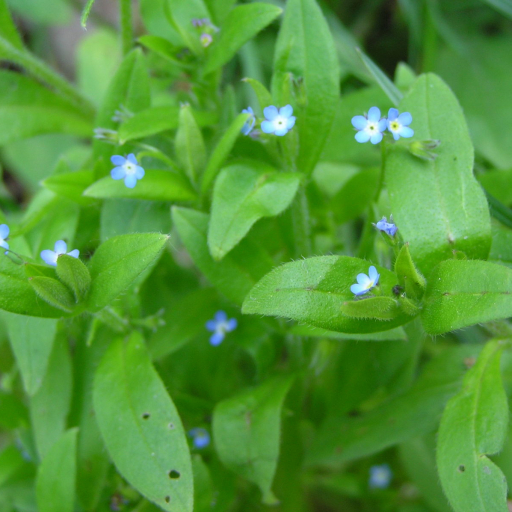
Plant Overview
Often referred to as the Loose-flowered Forget-me-not, this delicate wildflower is the shy, woodland cousin of the common garden Forget-me-not. Unlike its bushy relatives that dominate flowerbeds, Myosotis sparsiflora prefers the quiet dappled shade of riverbanks and damp forests across Europe and Western Asia. Its name perfectly describes its personality: "sparsiflora" means scattered flowers, reflecting its airy and unhurried growth habit.
🔍 How to Identify
- 🔹 The Bloom: Tiny, five-petaled flowers in a classic "Forget-me-not blue," often featuring a bright yellow center (the "eye") that acts as a target for pollinators.
- 🌿 Spaced-out Growth: Unlike other species that form dense clusters, these flowers are spaced widely apart on long, slender stalks, giving the plant a "loose" and delicate appearance.
- 🐭 Mouse-Ear Leaves: The foliage is soft, green, and slightly hairy. The genus name Myosotis actually translates to "mouse-ear" in Greek, describing the small, rounded shape of the leaves.
🏡 In Your Garden
- 💧 Moisture Seekers: This plant is a specialist in damp environments. In a garden setting, it excels in boggy areas or near ponds where the soil never fully dries out. If the soil becomes parched, the plant will quickly wilt.
- 🌥️ Cool Shade: It is not a fan of the midday sun. To keep those sky-blue colors vibrant, plant it in a spot that mimics a forest floor—cool, humid, and protected by the canopy of taller perennials.
⚠️ Safety & Toxicity
- 🐾 Non-Toxic but Not Edible: While not considered high-risk, Myosotis sparsiflora belongs to a family (Boraginaceae) known to contain small amounts of pyrrolizidine alkaloids.
- 👶 Keep it Ornamental: It is generally safe for pets and children to be around, but it should never be consumed. Skin irritation is rare, but sensitive gardeners may want to wear gloves when handling the hairy stems.
✨ Fun Fact
The "eye" at the center of the flower actually changes color! Once a flower has been successfully pollinated, the yellow center often fades to a duller white or pink, signaling to bees that the "restaurant is closed" so they can focus on unpollinated blooms instead.

Detailed Care Instructions

Place in a window with dappled sun or a spot in the middle of a room. Or directly in a window facing west or east.

Some plants require more regular watering than others, which should be done every few days. It's critical to maintain the soil moist all of the time. The water requirements of the same plant placed in pots with varying sizes will differ. Because the water in the smaller pot evaporates faster than the water in the larger pot, it will require more watering. Regardless of pot size, the surface should constantly be maintained moist.








