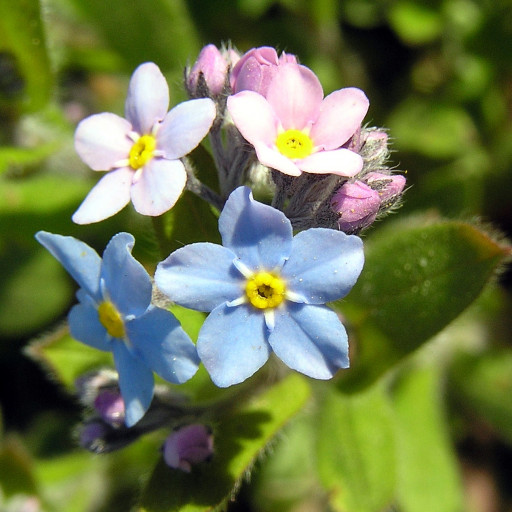
Plant Overview
Often called the "Forget-me-not," these tiny sky-blue blossoms are the ultimate symbols of enduring love and remembrance. According to German legend, a knight fell into a river while gathering these flowers for his lady; as he was swept away, he tossed the bouquet to her, shouting "Forget me not!" They are beloved by gardeners for creating a dreamy, "blue mist" effect across the garden floor every spring.
🔍 How to Identify
- 🌸 The "Eye": The tiny flowers (usually less than 1cm wide) feature five flat petals with a bright yellow or white center, often referred to by botanists as the "eye."
- 🍃 Hairy Foliage: The leaves and stems are covered in fine, soft hairs, giving the plant a slightly fuzzy, matte appearance and a soft texture.
- 🦂 Scorpioid Cymes: Look at the flower stalk; it often curls at the tip like a scorpion's tail, slowly unrolling as the individual buds begin to bloom from the bottom up.
🏡 In Your Garden
- 💧 Thirst for Dampness: These plants are naturally found near streams and damp woodlands. They will struggle in dry, parched soil, so keeping the ground consistently moist—but not swampy—is the secret to a lush carpet of blue.
- 🌱 The Great Travelers: Forget-me-nots are prolific self-seeders. While individual plants are short-lived (biennial), they "walk" around the garden by dropping seeds, often popping up in delightful, unexpected spots the following year.
- 🌤️ Beat the Heat: They adore the cool, crisp temperatures of spring. Once the summer heat intensifies, the foliage may look tired or develop a white "dusting" (powdery mildew), which is your signal to cut them back and wait for the next generation.
⚠️ Safety & Toxicity
- 🐾 Pet Safety: Most common garden varieties are considered non-toxic to cats and dogs. They are a safe choice for a "pet-friendly" landscape.
- 🧪 Internal Caution: While not considered "poisonous" in small doses, some wild species contain pyrrolizidine alkaloids, which can be harmful if eaten in large quantities over time. It’s best to keep them off the dinner plate and away from curious toddlers.
✨ Fun Fact
The genus name Myosotis literally translates from Ancient Greek as "mouse's ear." If you look closely at the small, rounded, and slightly fuzzy leaves, you’ll see they look exactly like the ears of a tiny field mouse!

Detailed Care Instructions
| Lighting | Part Sun |
| Hardiness Zones | Max 8B |
To grow Myosotis plants (commonly known as Forget-Me-Nots), you can follow these steps:
- Selection of Plant: Choose seeds or young plants from a nursery or online store. There are different variety options available, such as blue, white, pink, or yellow flowers.
- Location: Myosotis plants prefer a partially shaded spot with well-draining soil. They can tolerate full sun in cooler climates but may require some shade in hot summer regions.
- Soil Preparation: Prepare the soil by loosening it with a garden fork or tiller. Add organic matter such as compost to improve the soil texture and fertility.
- Planting: If using seeds, sow them directly into the prepared soil in early spring or fall. Alternatively, you can start seeds indoors 6-8 weeks before the last expected frost and then transplant them outdoors. If using young plants, space them about 8-10 inches apart.
- Watering: Keep the soil evenly moist but not waterlogged. Water the plants regularly, especially during dry spells. Avoid getting the foliage wet, as this can increase the risk of leaf diseases.
- Mulching: Apply a layer of organic mulch around the plants to help conserve moisture, suppress weed growth, and regulate soil temperature.
- Pruning: After the flowering season, you can gently trim back the plants to encourage regrowth and prevent self-seeding if desired. However, it's also fine to leave them to self-seed and naturalize.
- Maintenance: Remove any faded flowers to prolong blooming. In hotter regions, these plants might go dormant during the summer. In such cases, reduce watering and wait for them to start growing again in cooler weather.
- Fertilization: As these plants usually grow in nutrient-rich soils, they generally don't require extra fertilization. However, if your soil is poor, you can apply a balanced fertilizer during the growing season.
Remember, Myosotis are self-seeding plants, meaning they tend to spread and reseed themselves. With proper care, you can enjoy their delightful blooms for years to come.

Place in a dark room with little light, like a dark bedroom or a spot far away from a window or directly in a north-facing window.

To properly water this plant, observe the soil to ensure that it is dry before watering. When it is time to water, gradually pour water on the soil until it is moist, but not soaked. Avoid getting water on the leaves or stems directly as this can cause rot and disease. It is best to water in the morning or early afternoon to allow the plant time to dry before nighttime. During the winter, reduce watering as the plant goes into dormancy.
For the flowering plant that has small, soft, delicate and blue or white flowers with five petals and can grow up to 25 cm tall, it is recommended to fertilize in the spring or summer with a balanced fertilizer, with equal amounts of nitrogen, phosphorus, and potassium. Fertilizer can be applied every two to four weeks, following the manufacturer's instructions. Be sure to water the plant thoroughly after fertilizing. Avoid using high-nitrogen fertilizers, as they can cause excessive foliage growth at the expense of flowers.
The ideal soil for this plant should be loose, well-draining, slightly acidic, and rich in organic matter. The soil should have a pH ranging from 5.5 to 6.5. It should also be able to retain moisture while allowing excess water to drain away to prevent waterlogging. The addition of peat moss, compost, or well-decomposed manure can help maintain the soil's moisture content and provide essential nutrients to support the plant's growth. Watering should be done regularly, allowing the top layer of soil to dry out between waterings. Over-fertilization should be avoided to prevent root burns and other nutrient-related problems.
To propagate this plant, you can divide its roots during the spring or fall. First, gently dig up the plant and try to keep the roots intact. Then, separate the roots into smaller sections using a clean, sharp knife or scissors. Each section should have at least two to three healthy, leafy stems. Plant the divided sections in moist soil in a shady area, and water them regularly until they start growing. Alternatively, you can also take stem cuttings during the summer and root them in a well-draining soil mix. Select a healthy stem, make a sharp angle cut below a node, remove the lower leaves, dip the cut end in rooting hormone, and insert it in moist potting mix. Keep the soil moist and provide indirect light until new growth appears.







