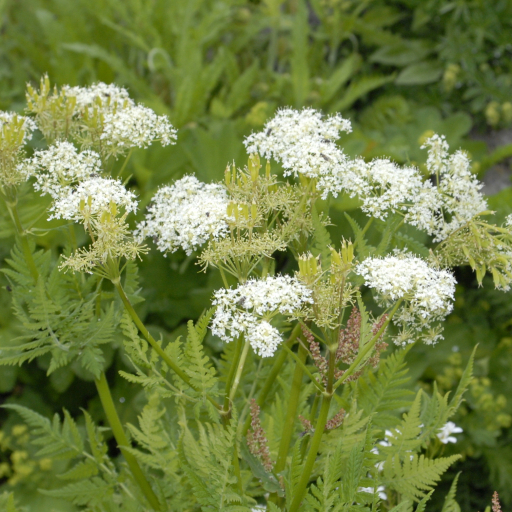
Plant Overview
Known affectionately as Sweet Cicely, this charming European native is as much a culinary herb as it is an ornamental beauty. With its delicate, fern-like foliage and white starry blooms, it often looks like a refined woodland inhabitant. Historically, it was a staple in cottage gardens, prized for its ability to naturally sweeten tart fruits like rhubarb, reducing the need for added sugar.
🔍 How to Identify
- 🌿 The Foliage: Delicate, feathery leaves that are soft to the touch and often feature distinctive white or pale splotches, looking as though they were lightly dusted with flour.
- 🌼 The Flowers: Tiny, pure white flowers clustered in flat-topped "umbels" that float above the greenery like delicate lace during late spring and early summer.
- 👃 The Scent: One of the most reliable markers; crushing any part of the plant releases a potent, sweet aroma of anise or licorice.
- 📏 The Seeds: Large, dark brown, and needle-shaped seeds (up to an inch long) appear after flowering, possessing a strong licorice flavor.
🏡 In Your Garden
- 💧 Moisture Lover: This plant thrives in the cool, damp corners of a garden. It prefers rich, loamy soil and will struggle or wilt if left to dry out completely during the peak of summer.
- 🌱 Deep Roots: Sweet Cicely develops a long, sturdy taproot. Because of this, it "hates" being moved once established. It is best to plant it in its "forever home"—ideally in partial shade—and leave it to flourish.
- 🐝 Pollinator Magnet: The nectar-rich flowers are a favorite for hoverflies and bees, making it an excellent choice for an eco-friendly or wildlife-focused garden.
⚠️ Safety & Toxicity
- 🚫 Lookalike Warning: While Sweet Cicely is edible and sweet, it bears a striking resemblance to several members of the Apiaceae family, including the deadly Poison Hemlock. Never consume it unless you are 100% certain of the ID; the distinctive anise scent and hairy stems are key differences from its toxic cousins.
- 🐾 Pet Safety: It is generally considered non-toxic to cats and dogs. However, as with any garden plant, ingesting large quantities of the fiber or essential oils may cause mild digestive upset in sensitive pets.
✨ Fun Fact
In the past, the large, oily seeds were not just eaten as "candy" by children; they were crushed and used as a fragrant, natural wax to polish fine oak furniture and wooden floors!

Detailed Care Instructions
| Humidity | Normal |
| Lighting | Part Sun |
| Difficulty | Easy |
| Temperature | 18°C - 30°C |
| Hardiness Zones | 3A - 9 |
To grow Myrrhis Odorata, also known as Sweet Cicely, you can follow these steps:
- Choose the right location: Select a spot that receives partial shade to full sun. Sweet Cicely prefers well-draining soil with a pH range of 6.0 to 7.5.
- Prepare the soil: Amend the soil with organic matter, such as compost or aged manure, to improve its fertility and drainage. Remove any weeds or grass from the planting area.
- Sow the seeds: Either start the seeds indoors in biodegradable pots or directly sow them in the garden. For indoor sowing, plant the seeds in pots 6-8 weeks before the last frost. When planting outdoors, sow the seeds directly in early spring or autumn. Sow the seeds about 1/4 inch deep and spacing them around 12 inches apart.
- Watering: Provide regular watering, keeping the soil consistently moist but not waterlogged. During dry spells, make sure to keep the soil adequately irrigated.
- Thin the seedlings: If you have sown seeds directly, thin out the seedlings once they reach a couple of inches tall, ensuring that there is enough space for each plant to grow.
- Mulch: Apply a layer of organic mulch, such as straw or wood chips, around the plants to conserve moisture and suppress weed growth.
- Pruning: Sweet Cicely benefits from regular pruning to encourage bushier growth and prevent it from becoming leggy. You can trim the plants back to about 6-8 inches tall in late spring or early summer.
- Harvesting: The foliage of Sweet Cicely is edible and has a pleasant anise-like flavor. You can start harvesting the leaves once the plant becomes established. Simply snip off the outer leaves, leaving the inner ones intact to continue growing.
By following these steps, you should be able to successfully grow Myrrhis Odorata in your garden.

Place in a window with dappled sun or a spot in the middle of a room. Or directly in a window facing west or east.

To properly water this plant, you should ensure that the soil is consistently moist, but not waterlogged. It is recommended to water the plant deeply and then allow the top layer of soil to dry out before watering again. Be sure to water at the base of the plant to avoid wetting the leaves, which can cause disease. During hot and dry weather, the plant may require more frequent watering to prevent wilting. However, be cautious not to overwater, as this can lead to root rot.
To fertilize this plant, use a balanced fertilizer with an N-P-K ratio of 10-10-10. Apply the fertilizer in early spring before new growth emerges, and again in early summer. Water the plant thoroughly after fertilizing to ensure the nutrients reach the roots. Avoid over-fertilizing, as it can cause excessive leaf growth at the expense of flower and seed production.
The ideal soil for the plant that cannot be named is one that is well-draining and rich in organic matter. A sandy loam soil mixed with compost or aged manure is recommended to provide the plant with the necessary nutrients and moisture it needs to grow. Additionally, the soil pH should be slightly alkaline, with a range of 6.5 to 7.5, to encourage healthy growth. It is important to note that the plant prefers a moist soil but does not like to be overly wet, so proper drainage is crucial.
Myrrhis Odorata can be propagated through root division or by sowing seeds. Root division is the easiest and quickest method for propagating this plant. In the early spring or late fall, carefully dig up the plant and untangle the roots. Divide the plant from the roots by cutting through the base of the crown and replanting each division in a new location.
Alternatively, Myrrhis Odorata can be propagated by sowing seeds indoors or outdoors. Collect seeds from mature plants in the fall. Sow the seeds in a seed tray or directly in the soil in the fall or early spring. Germination can take several weeks to months, and seedlings should be transplanted when they are large enough to handle.
Both propagation methods require moist, well-draining soil and regular watering. Myrrhis Odorata plants grow best in partial shade to full sun and prefer cool, moist environments. Once established, these plants are low maintenance and can be a beautiful addition to any garden.








