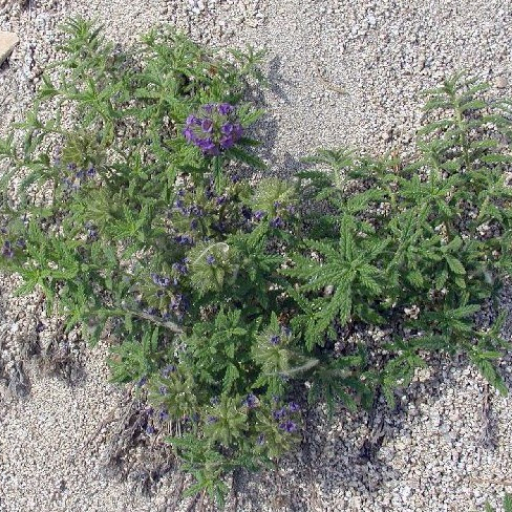
Plant Overview
Often called Rothrock's Fiddleleaf or simply Rothrock's Nama, this rugged beauty is a true mountaineer of the plant world. Found clinging to the rocky, high-altitude slopes of the Sierra Nevada and Great Basin, it looks like a delicate wildflower but possesses the grit of a survivor. It is named after Joseph Rothrock, a pioneering botanist and the "Father of Forestry" in Pennsylvania, who discovered it during his 19th-century explorations.
🔍 How to Identify
- 🌿 Crinkled Foliage: The leaves are dark green, deeply veined, and have a distinctively "crinkled" or "fiddle-leaf" appearance. They are covered in glandular hairs, making them feel quite sticky to the touch.
- 🌸 Funnel Blooms: Small but striking funnel-shaped flowers emerge in dense, rounded clusters at the tips of the stems. They range from a soft lavender to a vibrant, royal purple.
- 🪵 Woody Foundation: While the top looks herbaceous, the base of the plant is often woody (suffrutescent), allowing it to anchor firmly into shifting gravelly or volcanic soils.
🏡 In Your Garden
- ⛰️ Alpine Aspirations: This plant is not for the typical lush garden bed. It craves "lean" soil—think gravel, grit, and perfect drainage. If its roots sit in stagnant water, it will decline rapidly.
- ☀️ Sun Seeker: In its native habitat, it thrives under the intense ultraviolet light of high altitudes. It requires full sun to maintain its compact, mounding shape and to trigger its brilliant flowering cycle.
⚠️ Safety & Toxicity
- 🐾 Non-Toxic Status: There are no documented toxicities for Nama rothrockii regarding cats, dogs, or horses. It is generally considered safe for a nature-friendly landscape.
- 🖐️ Sticky Residue: The glandular hairs produce a resin that can act like "botanical Velcro," picking up dust or small seeds. While not poisonous, this sticky coating can be a minor skin irritant for humans with very sensitive skin.
✨ Fun Fact
- 🔥 The Pioneer: Nama rothrockii is often a "pioneer species." It is one of the first plants to colonize harsh, disturbed landscapes, such as areas recently cleared by wildfires or volcanic slides, helping to stabilize the soil for future life.

Detailed Care Instructions

Place in a bright room that is sun drenched almost all day. Or directly in a south-facing window.

Some plants require more regular watering than others, which should be done every few days. It's critical to maintain the soil moist all of the time. The water requirements of the same plant placed in pots with varying sizes will differ. Because the water in the smaller pot evaporates faster than the water in the larger pot, it will require more watering. Regardless of pot size, the surface should constantly be maintained moist.








