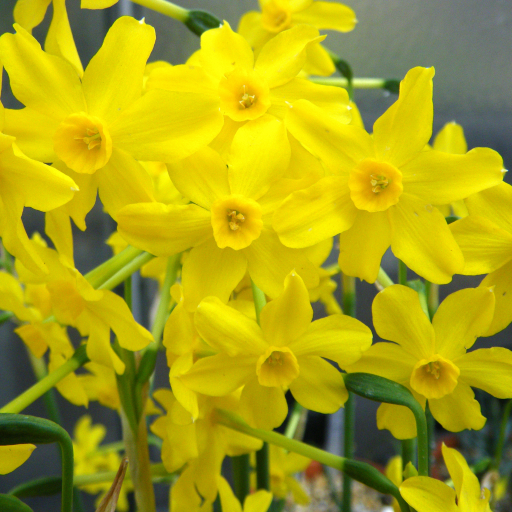
Plant Overview
Known as the "Rush Daffodil" or simply the "Jonquil," this Mediterranean beauty is the sweet-smelling cousin of the common daffodil. It has been a staple in European gardens for centuries, prized for an intense, honey-like fragrance that can perfume an entire yard on a spring breeze. While many people use the word "Jonquil" to describe any yellow daffodil, the true Narcissus jonquilla is a distinct, elegant species with a character all its own.
🔍 How to Identify
- 🌿 Rush-Like Leaves: Unlike the flat, strap-like leaves of other daffodils, Jonquils have slender, dark green, cylindrical leaves that look more like rushes or thick blades of grass.
- 🌼 Clustered Blooms: A single sturdy stem usually bears a cluster of 2 to 6 small, bright yellow flowers, rather than one large solitary bloom.
- 👃 Short Cup & Scents: The central "cup" (corona) is notably short and disc-shaped, surrounded by overlapping petals that emit a heavy, intoxicating perfume.
🏡 In Your Garden
- ☀️ The Summer Bake: To ensure they return year after year, Jonquils need a "summer bake." This means leaving the bulbs in a spot that gets plenty of sun even after the foliage dies back; this heat is essential for the bulb to set next year’s flower buds.
- 💧 Drainage is Vital: These bulbs are prone to rot if they sit in soggy soil during their dormant summer phase. They thrive best in rock gardens or sloped beds where water moves quickly away from the bulb.
- 🍃 Patience with Foliage: Resist the urge to cut back the "messy" green leaves after the flowers fade. The plant uses this period to store energy in the bulb; cutting them too early is the most common reason they fail to bloom the following spring.
⚠️ Safety & Toxicity
- 🚫 Toxic Status: All parts of the Narcissus jonquilla, particularly the bulb, contain the toxic alkaloid lycorine.
- 🐾 Pets & Kids: Ingestion can cause severe stomach upset, vomiting, and lethargy in dogs, cats, and humans. The sap can also cause "Daffodil Itch," a mild skin irritation, so it is best to wear gloves when handling cut stems or planting bulbs.
✨ Fun Fact
👃 Perfumer’s Gold: The scent of the Jonquil is so complex and potent that it is one of the few flowers still commercially harvested in Grasse, France, for the production of high-end essential oils used in luxury perfumes.

Detailed Care Instructions
To grow a Narcissus Jonquilla plant, you can follow these steps:
- Buy healthy bulbs: Purchase high-quality Narcissus Jonquilla bulbs from a reputable nursery or garden center. Look for bulbs that are firm and free from mold or damage.
- Choose the planting location: Narcissus Jonquilla prefer well-draining soil and full sun to partial shade. Select a spot in your garden that receives at least 6 hours of direct sunlight each day.
- Prepare the soil: Loosen the soil in the planting area with a garden fork or tiller. Remove any rocks or weeds and incorporate organic matter like compost or well-rotted manure to improve soil fertility and drainage.
- Plant the bulbs: Dig holes in the soil, placing the bulbs pointed end up. The depth for planting the bulbs should be about 3-4 inches (7-10 cm) deep, and they should be spaced about 4-6 inches (10-15 cm) apart.
- Water thoroughly: After planting, water the bulbs thoroughly to settle the soil and remove any air pockets. The bulbs should be kept slightly moist but not overly saturated throughout the growing season.
- Mulch: Apply a layer of organic mulch, such as straw or wood chips, around the planted bulbs. This will help to retain moisture in the soil, keep the temperature steady, and suppress weed growth.
- Fertilize: Fertilize the Narcissus Jonquilla bulbs once they begin to sprout. Use a slow-release bulb fertilizer or a balanced, water-soluble fertilizer according to the package instructions.
- Maintain regular care: Continue to water the plants regularly, especially during dry spells. Remove any weeds or debris that may hinder the growth of the bulbs. Also, deadhead the spent flowers to promote healthier growth.
- Overwintering: Narcissus Jonquilla plants are generally hardy and can tolerate cold temperatures. However, in regions with severe winters, you may need to protect the bulbs by covering the planting area with mulch or straw.
- Harvesting and division: Allow the foliage of the Narcissus Jonquilla plants to die back naturally after blooming. This will help the bulbs store energy for the next season. Once the foliage turns yellow and begins to dry, you can dig up the bulbs and divide them if desired.
With proper care and maintenance, your Narcissus Jonquilla plant should grow and produce beautiful, fragrant flowers each year.

Place in a bright room that is sun drenched almost all day. Or directly in a south-facing window.

The plant should be watered regularly but avoid over-watering as it can damage the roots of the plant. The soil should be moist but not waterlogged. It is recommended to water deeply once or twice a week during growing season. During the dormant period, the plant requires less water but should not be left completely dry. It is best to water the plant in the morning to avoid fungal infections and reduce evaporation. Ensure proper drainage as any water that remains in the soil can cause root rot and damage the plant.
To fertilize this flowering plant, it is recommended to first ensure that the soil is moist but not waterlogged. Then, apply a balanced, general-purpose fertilizer at a rate of about 1/2 to 1 pound per 100 square feet of planting area. This should be done in the early spring before the flowers begin to bloom. It is important to avoid over-fertilizing as this can cause the plant to become too leggy and weak. Additionally, it is recommended to mulch around the base of the plant with organic material to help retain moisture and nutrients in the soil.
For Narcissus Jonquilla plants, it is recommended to use soil that is well-drained and fertile. It should have a pH level between 6.0 and 7.5. The soil should also be rich in organic matter, such as compost or peat moss. It is important to avoid heavy clay soils or soils that are too sandy. Narcissus Jonquilla plants prefer a slightly acidic soil, so adding sulfur or aluminum sulfate may be necessary depending on the pH level of the soil. When planting, make sure to mix in a slow-release fertilizer to encourage healthy growth.
The first step in propagating this plant is to select healthy and mature bulbs from an existing plant. The bulbs should be firm and free from any damage or disease.
Next, the bulbs should be stored in a cool, dry place until planting time. In the fall, when the soil has cooled down, the bulbs can be planted in a well-draining soil that has been enriched with organic matter.
Once planted, the bulbs should be kept moist but not overly wet. Overly wet soil can lead to bulb rot.
As the bulbs grow, they will produce offsets or "bulblets" that can be carefully separated from the main bulb. These offsets should be allowed to dry in a shaded area for a few days before planting.
Once the offsets have dried, they can be planted in a separate location or directly into the soil near the existing plant. They should be planted at a depth that is equal to their diameter and spaced 2-3 inches apart.
With proper care and maintenance, the new plants should grow into mature plants that produce their own offsets and continue to expand the population.
Common pests of the daffodil include Spider mites, aphids, thrips. Make a habit of checking your daffodil frequently for pests so that any infestations can be caught and managed early.








