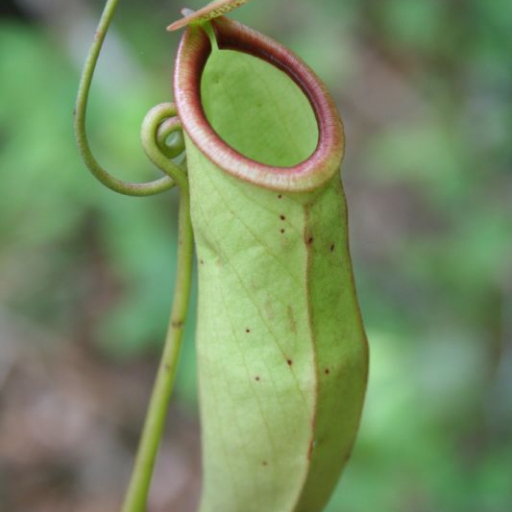
Plant Overview
Often called the Common Swamp Pitcher Plant, Nepenthes mirabilis is the globetrotter of the carnivorous plant world. While most pitcher plants are picky about where they live, this resilient climber has conquered territories from Southern China all the way to Australia. It is a master of the "wet feet" lifestyle, often found dangling its elegant, trap-laden vines over swampy waters and tropical marshes.
🔍 How to Identify
- 🏺 The Pitchers: Look for elegant, cylindrical traps that transition from green to reddish tones. The "mouth" is topped with a distinct lid (operculum) that acts as a little umbrella to keep rainwater from diluting its digestive enzymes.
- 🍃 The Leaves: Long, sword-shaped green leaves that don't just end—they extend into a thin, wire-like tendril. This tendril eventually swells and "inflates" to become the famous pitcher.
- 🧗 The Growth: This isn't a stationary rosette; it is a scrambling vine. In the wild, it uses its tendrils to hitchhike onto nearby bushes, climbing toward the sunlight to hang its traps at eye level.
🏡 In Your Garden
- 💧 The Humidity King: Unlike some of its high-altitude "highland" cousins, this "lowland" plant thrives in sweltering heat and high humidity. It is much more tolerant of wet roots than other species, making it a great choice for a tropical terrarium or a humid greenhouse.
- 🦟 Natural Pest Control: Instead of chemical fertilizers, this plant prefers "protein." It lures gnats, flies, and ants with sweet-smelling nectar on the rim. Once the insect slips, it falls into a pool of enzymes at the bottom, providing the plant with the nitrogen it can't find in poor soil.
⚠️ Safety & Toxicity
- ✅ Non-Toxic: Nepenthes mirabilis is generally considered non-toxic to humans, cats, and dogs. It doesn't have "venom" or poisonous sap.
- 🧪 The "Soup": While the plant isn't poisonous, the liquid inside the pitchers is a cocktail of acidic digestive enzymes and drowned bug remains. It’s definitely not something you want kids or pets to drink, as it could cause an upset stomach or a very unpleasant taste.
✨ Fun Fact
Nepenthes mirabilis holds the record for being the most widely distributed species in the entire genus! Because it is so adaptable, it has evolved hundreds of local "variations," including some rare forms with beautiful "fringed" wings along the front of the pitcher.

Detailed Care Instructions
To grow a Nepenthes Mirabilis plant successfully, you can follow these steps:
- Choose the right conditions: Nepenthes Mirabilis plants thrive in warm and humid environments similar to their native tropical regions. The temperature should ideally be between 70-85°F (21-29°C) during the day and not drop below 60°F (15°C) at night. They also need high humidity levels, around 50-70%.
- Provide proper lighting: Nepenthes Mirabilis plants require bright, indirect light. Place them near a window where they can receive filtered sunlight. Avoid direct sunlight, as it can burn the leaves. Artificial grow lights can also be used if natural light is insufficient.
- Planting medium: Nepenthes Mirabilis plants prefer a mixture of sphagnum moss and perlite or orchid bark. This mixture provides good drainage while retaining enough moisture for the plant. You can also use a specialized Nepenthes mix available in nurseries.
- Watering: Nepenthes Mirabilis plants must be kept consistently moist. Water them regularly with distilled or rainwater to avoid mineral buildup from tap water. Ensure that the planting medium is always damp, but not waterlogged. You can also place the pot in a tray with water to maintain humidity levels.
- Feeding: Nepenthes Mirabilis plants are carnivorous and require additional nutrients from insects. They can catch their prey using their pitcher traps. However, if you're growing them indoors or in an environment with limited insect activity, you can supplement their nutrition by offering them small insects or fish food pellets. Be careful not to overfeed, as excessive prey may cause the pitchers to decompose.
- Pruning: Remove any brown or dying pitchers to prevent the spread of diseases or pests. Trimming excess foliage can also help maintain the plant's shape and encourage new growth.
- Pest control: Monitor your plant for common pests such as aphids, mealybugs, or fungus gnats. Use appropriate organic insecticides or natural remedies to control these pests.
- Dormancy period: Some Nepenthes species, including Nepenthes Mirabilis, may go through a dormancy period during cooler months where the growth slows down. Reduce watering and provide slightly cooler temperatures during this time to mimic their natural environment.
With proper care and attention, your Nepenthes Mirabilis plant should grow well and develop beautiful pitcher traps for capturing prey.

Place in a bright room that is sun drenched almost all day. Or directly in a south-facing window.

To water this particular plant, you should ensure that the soil is consistently moist but not waterlogged. This can be achieved by watering the plant regularly, allowing water to fully saturate the soil but not allowing it to sit in standing water. It is also important to make sure the plant receives adequate humidity, either through misting or placing a tray of water near the plant. Additionally, it is recommended to use distilled or rainwater instead of tap water as the high mineral content in tap water can damage the plant's sensitive roots.
To fertilize this plant, use a weak dilution of a liquid fertilizer every other week during the growing season, which is typically from spring to fall. Be careful not to over-fertilize, as this can harm the plant. Also, avoid using fertilizers with high levels of phosphorus, which can be harmful to this type of plant. It's best to use a balanced fertilizer designed for carnivorous plants.
For Nepenthes Mirabilis, the ideal soil mixture would be one that is well-draining and nutrient-poor. A mixture of peat moss, sphagnum moss, perlite, and sand would be suitable. It is important to ensure that the soil mixture is airy and not too compact, as this can lead to root rot. Adding some orchid bark or charcoal can also help with drainage and prevent soil compaction. Additionally, it is important to use a pot with drainage holes to allow excess water to drain out and prevent waterlogging.
To propagate this particular plant, we need to take a cutting of a healthy stem or a leaf with a node. The cutting should be around 4-6 inches long with at least two leaves attached. The bottom of the cutting should be sliced diagonally to expose the inner tissue and dipped in rooting hormone powder. Then it should be planted in a well-draining soil mix and kept in bright, indirect light. The soil should be kept consistently moist but not waterlogged. The cutting should root within a few weeks and begin to produce new growth. Once the plant has established roots and grown several new leaves, it can be transplanted into a larger pot or planted in its permanent location.
Common pests of the tropical pitcherplant include Mealybugs, spider mites, fungus gnats, thrips. Make a habit of checking your tropical pitcherplant frequently for pests so that any infestations can be caught and managed early.








