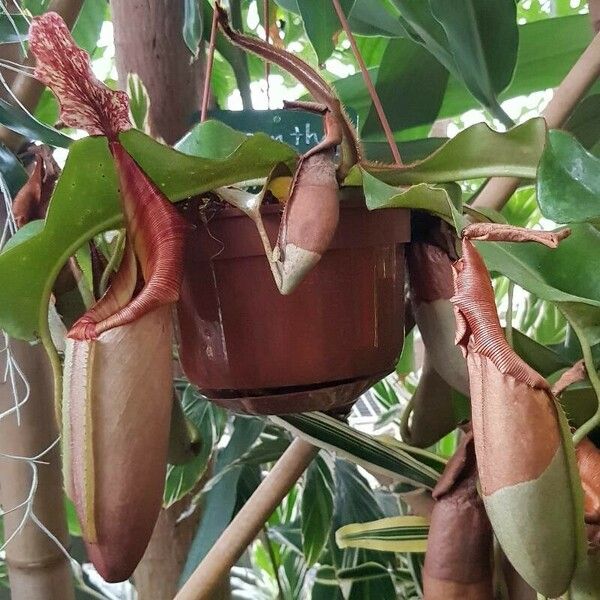
Plant Overview
Often hailed as the "King of Pitchers," Nepenthes veitchii is a crown jewel among carnivorous plant enthusiasts. Native to the mist-shrouded rainforests of Borneo, this spectacular climber is world-renowned for its massive, flared "peristome" (the rim of the pitcher) that often displays stunning candy-cane stripes. In its natural habitat, it lives a life of high-altitude drama, literally hugging tree trunks as it ascends toward the canopy.
🔍 How to Identify
- 👑 The Peristome: Its most famous feature is an exceptionally wide, ribbed, and flattened rim that can range from golden yellow to deep crimson, often with vertical stripes.
- 🌿 Hairy Texture: The leaves and pitchers are often covered in a coarse, brownish fuzz (known as indumentum), which helps the plant manage moisture and grip surfaces.
- 🧗 Leaf-Clasping Habit: Unlike many other pitcher plants that use tendrils to climb, Nepenthes veitchii has leaves that seem to "wrap" around tree trunks or rocks, giving it a unique, hugging appearance.
🏡 In Your Garden
- ☁️ Humidity is Key: Coming from the mossy forests of Borneo, this plant craves high humidity (70% or higher). Without enough moisture in the air, it may stubbornly refuse to produce its iconic pitchers.
- 🪵 The "Hugger" Setup: Because this species is naturally epiphytic (growing on trees), it thrives in very airy, well-draining media like long-fiber sphagnum moss mixed with perlite or orchid bark. It doesn't like "wet feet" and prefers its roots to breathe.
- 🌡️ Temperature Nuance: Depending on whether your variety is a "lowland" or "highland" type, it will have different temperature needs. Generally, it appreciates a significant drop in temperature at night to mimic the cooling mountain air of its homeland.
⚠️ Safety & Toxicity
- ✅ Non-Toxic: Nepenthes veitchii is generally considered non-toxic to humans, cats, and dogs. It poses no chemical threat if touched.
- 💧 Digestive Juices: While the plant isn't poisonous, the fluid inside the pitchers is acidic and contains digestive enzymes. It’s best to keep curious pets or children from "sampling" the liquid, as it could cause mild stomach upset or a messy cleanup.
✨ Fun Fact
Nepenthes veitchii is one of the few pitcher plants that has evolved to be a true "tree hugger." Instead of just dangling its pitchers in the air, it presses its pitchers firmly against the bark of a tree. This creates a stable "staircase" for ants and other crawling insects to walk right into the plant's mouth!

Detailed Care Instructions

Place in a bright room that is sun drenched almost all day. Or directly in a south-facing window.

Water-loving plants flourish in wet or sloppy soil and near ponds. The extensive root system enables these plants to absorb plenty of water. The surface of the soil should be kept moist at all times. Place your pot in a container filled with water to guarantee that plants get enough water. If the ground becomes dry, it is recommended that you water it well. Plants in smaller pots will need to be watered more frequently. Water the soil in which the plant is standing thoroughly using a watering can.







