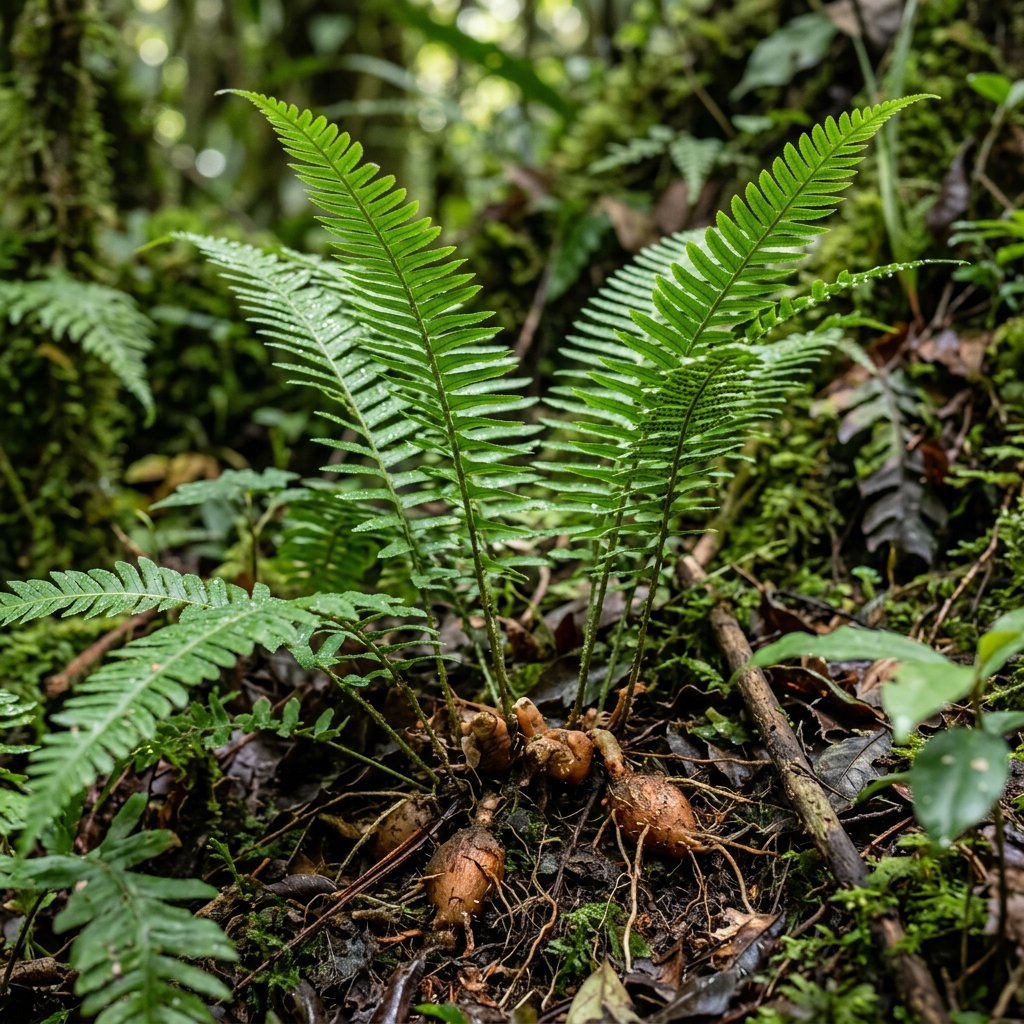
Plant Overview
Often called the Tuberous Sword Fern or Fishbone Fern, this resilient greenery is a staple for both tropical landscapes and indoor shelf displays. Native to many parts of the world, including Asia and Australia, it is prized for its neat, architectural fronds that grow with a disciplined, upright habit. While it looks delicate, it is actually one of the "tough guys" of the fern world, capable of handling a bit more neglect than its finicky cousins.
🔍 How to Identify
- 🌿 The Fronds: Long, narrow blades that can grow up to 2 feet long. They feature many small, closely spaced leaflets (pinnae) arranged in a ladder-like or "fishbone" pattern.
- 🤎 The Tubers: The most distinct feature is found underground. Unlike many other ferns, this species produces small, hairy, potato-like tubers on its roots which it uses to store water and nutrients.
- 🍃 Leaf Shape: Each individual leaflet has a slightly rounded, heart-shaped base where it meets the stem—this is actually where its name cordifolia (Latin for "heart-leaf") comes from.
🏡 In Your Garden
- 💧 Drought Insurance: Because of its underground tubers, this fern is surprisingly drought-tolerant for its genus. If you forget to water it for a few days, it uses its "emergency water tanks" to stay green.
- 🏃 The Great Escape: It spreads vigorously via horizontal runners (stolons). In a pot, this makes for a lush, full plant; however, in warm, humid climates, it can be invasive in the garden and may quickly crowd out native species.
- ⛅ Lighting Logic: While it loves bright, indirect light, it is particularly good at adapting to lower light corners of a home, making it a favorite for bathrooms or offices.
⚠️ Safety & Toxicity
- 🐾 Pet Friendly: Great news for pet owners! The Nephrolepis cordifolia is generally considered non-toxic to cats and dogs, making it a safe choice for households with curious nibblers.
- 👶 Human Safety: It is non-toxic to humans. While the tubers are technically edible (though starchy and somewhat tasteless), the plant is primarily grown for its ornamental beauty.
✨ Fun Fact
In some cultures, the small underground tubers are harvested and eaten as a survival food or used as a source of clean water in the wild, as they are mostly composed of moisture!

Detailed Care Instructions
| Color | Faint To Moderate Green |
| Soil Ph | 4.0-7.0 |
| Humidity | Normal |
| Invasive | Weed |
| Lighting | Part Sun |
| Soil Type | Moisture-Retaining, Organic Soil |
| Bloom Time | Spring And Summer |
| Difficulty | Medium |
| Plant Type | Perennial, Vascular |
| Mature Size | 0.3-0.7 Meters In Height And 5.0- 7.6 Centimeters In Width |
| Native Area | Subtopic And Tropic Asian Region |
| Temperature | 15°C - 25°C |
| Sun Exposure | Partial Sun Or Shade |
| Hardiness Zones | 9-11 |
To grow a Nephrolepis Cordifolia plant, also known as the Fishbone Fern, you can follow these steps:
- Choose a suitable location: Select a spot that receives indirect or filtered sunlight. The plant can also tolerate some shade.
- Provide the right temperature and humidity: Nephrolepis Cordifolia prefers temperatures between 60 to 75°F (15 to 24°C). It thrives in high humidity, so try to maintain a humidity level above 50%.
- Select the right soil: Use a well-draining potting mix that contains equal parts of peat moss, perlite, and coarse sand. This will provide enough moisture retention while preventing water saturation.
- Planting: Place the Nephrolepis Cordifolia plant in a container with drainage holes to avoid waterlogged roots. Ensure the container is big enough to accommodate the growing fern.
- Watering: Keep the soil consistently moist but not soggy. Water the plant when the top inch of soil feels dry. Ensure excess water drains out of the container to prevent root rot.
- Fertilization: Feed the plant with a balanced houseplant fertilizer once every 1-2 months during the growing season (spring and summer). Follow the manufacturer's instructions for dosage and application.
- Pruning and maintenance: Remove any yellow or dead fronds regularly to encourage new growth. You can also trim back overgrown fronds to maintain a compact appearance.
- Propagation: Nephrolepis Cordifolia plants can be propagated through division. Carefully separate the plant into smaller sections, each with its own root system, during spring. Re-plant the divisions in their own containers.
- Monitoring: Watch out for common pests like aphids, mealybugs, and scale insects. Treat infestations with insecticidal soap or neem oil.
With proper care and maintenance, your Nephrolepis Cordifolia plant should grow well and fill its space with lush, vibrant foliage.

Place in a window with dappled sun or a spot in the middle of a room. Or directly in a window facing west or east.

To water this plant, thoroughly wet the soil until water begins to drain out of the bottom of the pot. Allow the excess water to drain away. Do not allow the plant to sit in standing water, as this can cause root rot. Water the plant when the top inch of soil feels dry to the touch. It is important to avoid wetting the leaves of the plant, as this can promote the growth of harmful fungi and diseases. Use room temperature water to avoid shocking the plant's roots.
To fertilize this plant, use a balanced fertilizer with equal amounts of nitrogen, phosphorus, and potassium. Apply the fertilizer every two to four weeks during the growing season, from spring to fall. Be sure to dilute the fertilizer to half strength to avoid burning the plant's roots. Water the plant thoroughly before and after fertilizing to prevent fertilizer buildup in the soil. If the plant shows signs of nutrient deficiency, such as yellowing leaves or slow growth, increase the frequency of fertilizing or switch to a fertilizer with higher nitrogen content.
The ideal soil for the plant should be well-draining, lightweight, and rich in organic matter. It should have a pH level between 5.5 and 6.5, with a balanced mix of sand, loam, and peat moss. The soil should retain moisture but not be overly wet or soggy, as this can lead to root rot. A good mix for the plant can include perlite or vermiculite to improve drainage and aeration. The soil should be kept fertile by regular fertilization with a high-quality fertilizer that is formulated for acid-loving plants. It is recommended to repot the plant every two to three years to maintain the quality of the soil.
To propagate this plant, first obtain a healthy parent plant and prepare it for division. Carefully remove the parent plant from its container, and gently tease apart the roots and stems. Divide the plant into several smaller portions using a clean, sharp tool.
Each new section should have its own cluster of leaves and roots. Repot these smaller plants into individual containers filled with well-draining potting soil and water thoroughly. Keep the new plants in a shaded area with high humidity until they establish themselves. Over time, each new plant will grow into a mature version of its parent plant.
Common pests of the ladder fern include Scale insect, mealybugs, spider mites, fungus gnats. Make a habit of checking your ladder fern frequently for pests so that any infestations can be caught and managed early.








