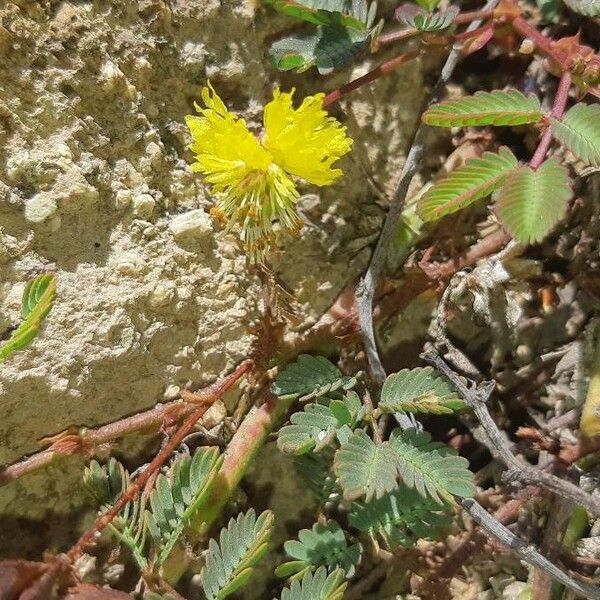
Plant Overview
Often called the Tropical Puff or Downy Sensitive Briar, Neptunia pubescens is a charming, low-growing groundcover that acts like a living interactive toy. Native to the Americas, it belongs to the legume family and is famous for its "shy" nature—its delicate, fern-like leaves will quickly fold inward when touched or brushed by the wind.
🔍 How to Identify
- 🌿 The Sensitive Foliage: The leaves are bipinnate (looking like tiny green feathers) and exhibit rapid movement, snapping shut at the slightest vibration or touch to protect themselves from predators.
- 🟡 Puffball Blooms: It produces striking, spherical flower heads that look like bright yellow pom-poms or "puffs," which contrast beautifully against the deep green foliage.
- 🌱 Creeping Habit: This plant stays low to the ground, spreading via prostrate stems that are covered in fine, soft hairs (which is what "pubescens" refers to in its Latin name).
🏡 In Your Garden
- 💧 The "Wet Feet" Lover: Unlike many garden plants that fear root rot, Neptunia pubescens thrives in moist to wet soils. It is often found near the edges of ponds or in marshy areas, making it perfect for those "problem" soggy spots in your yard.
- 🧪 Soil Improver: As a member of the pea family, it works behind the scenes to "fix" nitrogen in the soil. It pulls nitrogen from the air and stores it in its roots, naturally fertilizing the ground for its neighbors.
- 🦋 Pollinator Magnet: The fuzzy yellow blooms are a high-value target for small native bees and butterflies, providing a reliable nectar source throughout the warmer months.
⚠️ Safety & Toxicity
- ✅ Generally Safe: Neptunia pubescens is considered non-toxic to humans and common household pets like cats and dogs.
- 🤏 Handle with Care: While it isn't poisonous, the plant is delicate. Frequent "tripping" of the leaf-folding mechanism costs the plant energy, so try to enjoy its movement sparingly to keep the plant vigorous.
✨ Fun Fact
The rapid movement of its leaves is called seismonasty. It happens because of a change in water pressure within specialized cells at the base of the leaflets. Scientists believe this evolved to make the plant look "wilted" and unappetizing to hungry herbivores!

Detailed Care Instructions
To grow Neptunia pubescens (also known as sensitive neptunia or water mimosa), you can follow these steps:
- Obtain seeds or young plants: Seeds are often available for purchase online or at specialty nurseries. Alternatively, you can start with a young plant obtained from a nursery.
- Choose a suitable planting location: Neptunia pubescens grows well in well-drained soil and requires full sun to thrive. Select an area with plenty of sunlight, such as a garden bed or a large container.
- Prepare the planting area: If planting in a garden bed, loosen the soil and remove any weeds, rocks, or debris. If using a container, ensure it has drainage holes and fill it with a well-draining potting mix.
- Sow the seeds or transplant the young plant: If using seeds, follow the instructions on the seed packet for the proper depth and spacing. If transplanting a young plant, make a hole in the soil/container large enough to accommodate the roots of the plant and gently place it in the hole.
- Water thoroughly: Give the plant a good watering after sowing or transplanting to help settle the soil and ensure proper hydration.
- Watering and maintenance: Neptunia pubescens prefers consistently moist soil. Water the plant regularly, especially during dry spells or hot weather. Avoid overwatering, as it may cause root rot. Mulching around the base of the plant can help retain moisture and prevent weed growth.
- Pruning and trimming (optional): Neptunia pubescens can become bushy over time. To maintain its shape and encourage healthy growth, you can trim back any excessively long or leggy branches. Pruning can be done during the active growing season.
- Fertilization (optional): If desired, you can apply a balanced fertilizer once every two to three months during the growing season to promote healthy growth. Follow the instructions on the fertilizer package for the proper dosage.
- Pest and disease management: Neptunia pubescens is generally resistant to pests and diseases, but occasionally, it may encounter issues such as aphids or fungal diseases. Inspect the plant regularly for any signs of pests or diseases, and take appropriate measures if necessary.
- Enjoy your plant: With proper care, Neptunia pubescens should grow well and provide you with lovely foliage and delicate yellow flowers. Enjoy the beauty and uniqueness of this plant in your garden or container!

Place in a bright room that is sun drenched almost all day. Or directly in a south-facing window.

To effectively water this particular plant, it is important to understand its specific needs. The Neptunia Pubescens plant prefers to be maintained in a damp to wet soil environment, with its roots constantly submerged in water.
To achieve this, it is recommended to water the plant frequently, allowing the soil to stay consistently moist. However, be sure to avoid overwatering as this can lead to root rot and other issues.
When watering, it is best to use a watering can with a long, narrow spout in order to direct the water directly to the soil and avoid getting water on the leaves. Aim to water the plant once or twice a week, keeping an eye on the soil moisture level and adjusting as needed.
In addition, it is important to ensure that the Neptunia Pubescens plant is situated in a location that provides adequate drainage to prevent water from pooling in the pot or container. This will help maintain proper soil moisture levels and prevent waterlogging.
For optimal growth of this plant, fertilizer should be applied during the growing season from early spring to late summer. A balanced fertilizer with equal parts nitrogen, phosphorus, and potassium is recommended, with a ratio of around 10-10-10 or 20-20-20.
Fertilizers should be applied at a rate of about 1 tablespoon per square foot of soil, and should be worked into the top layer of soil. Fertilizers can also be applied as a liquid solution, following the manufacturer's instructions for dilution and application.
Be careful not to over-fertilize, as this can lead to excessive growth, poor flowering, and damage to the plant's root system. In general, fertilizing once every 3-4 weeks should be sufficient for this plant.
Remember to water the plant well after fertilizing to ensure that the nutrients are absorbed effectively. With proper fertilization and care, this plant should thrive and produce beautiful foliage and flowers.
When planting Neptunia Pubescens, it is recommended to use a well-draining soil mix that is rich in organic matter. The soil should have a pH level between 6.0-7.5 and should be able to retain moisture without becoming waterlogged. It is also important to ensure that the soil is not too compacted, as this can prevent proper root growth and development. Adding perlite or sand to the soil mix can help improve drainage and prevent waterlogging. Additionally, providing regular fertilization with a balanced, slow-release fertilizer can also help promote healthy growth and development.
To propagate this plant, take a cutting from a healthy and established parent plant. Choose a stem with at least one leaf node and remove any lower leaves. Dip the cut end of the stem into rooting hormone powder, if desired. Plant the stem in a well-draining, moist soil mix and keep it in a warm and humid location with bright, indirect light. Water the cutting regularly to keep the soil moist but not waterlogged. After a few weeks, the cutting should develop roots and can be transplanted into a larger container.








