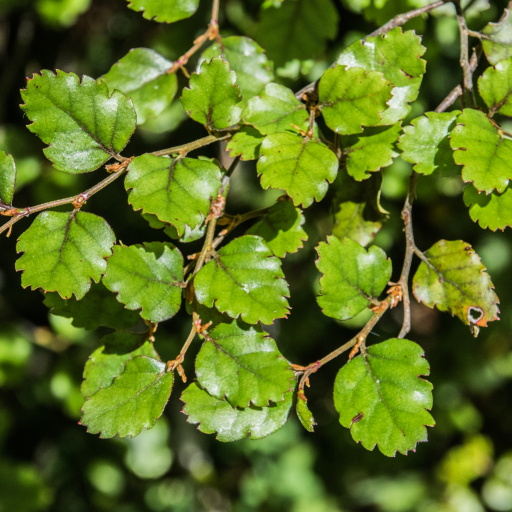
Plant Overview
Known as the Red Beech or Tawhai raunui in Māori, this majestic evergreen is a cornerstone of New Zealand’s ancient southern forests. It earns its name from the rich, reddish hue of its heartwood and the bronze tints that flush its foliage during the colder months. In its natural habitat, these trees are the "grandfathers" of the forest, often living for over 500 years and creating a high, airy canopy that filters sunlight into a golden glow.
🔍 How to Identify
- 🍃 The Leaves: Look for small, leathery, oval leaves with distinctively "toothed" or serrated edges. They are typically a bright green but turn a beautiful deep bronze or red in winter or during dry spells.
- 🌳 The Bark: On young trees, the bark is smooth and silvery-grey. As the tree matures, it transforms into a thick, dark, and deeply furrowed protective layer, often hosting vibrant communities of moss and lichen.
- 🌸 The Flowers: The flowers are tiny and easily missed; they appear as small red clusters in late spring, followed by little woody husks that contain the tree's seeds (beech mast).
🏡 In Your Garden
- 🏞️ Space and Setting: Because the Red Beech can grow quite tall (up to 30 meters in the wild), it is best suited as a specimen tree for larger landscapes or lifestyle blocks. It creates a stunning "woodland" feel but needs plenty of room for its root system to spread.
- 💧 Drainage is Key: This tree is "allergic" to soggy soil. It thrives in well-drained, slightly acidic earth. If the roots sit in water for too long, the tree may suffer from root rot, reflecting its preference for sloping forest hillsides.
- 🌬️ Climate Nuances: It is incredibly hardy against the cold and wind once established, but it appreciates a layer of mulch around its base to keep its shallow feeder roots cool and moist during hot summers.
⚠️ Safety & Toxicity
- ✅ Pet and Child Friendly: The Red Beech is considered non-toxic. It is safe to plant in areas where dogs, cats, or curious children might come into contact with the leaves or fallen bark.
- 🐝 Honeydew Alert: While the tree itself isn't toxic, it is a host for scale insects that produce "honeydew." This sweet secretion can attract wasps in certain seasons, so be mindful when walking under the canopy during peak summer.
✨ Fun Fact
Every few years, Red Beech trees undergo a phenomenon called "masting." Instead of dropping a few seeds, every tree in the forest simultaneously drops millions of seeds at once. This "overwhelms" the local seed-eating animals, ensuring that at least some seeds survive to become the next generation of giants!

Detailed Care Instructions
To grow Nothofagus Fusca, also known as red beech or southern beech, you can follow these steps:
- Determine the appropriate climate: Nothofagus Fusca plants thrive in temperate and mountainous regions with cool, moist environments. Check if your climate matches these conditions before planting.
- Select an appropriate location: Choose a spot with well-drained soil and partial shade. This plant prefers slightly acidic soil, so it's a good idea to test the pH level and make any necessary adjustments.
- Obtain seeds or seedlings: Nothofagus Fusca can be propagated from seeds or purchased as young seedlings from a nursery. If starting from seeds, cold stratification may be required. This involves placing the seeds in a moist paper towel and refrigerating them for several weeks before sowing.
- Prepare the planting site: Clear the area of any weeds or grass and dig a hole slightly larger than the root ball of the seedling if using one. If sowing seeds directly, prepare the soil by loosening it and removing any debris.
- Plant the seedling or sow the seeds: If using seedlings, gently place the root ball into the hole and backfill with soil, ensuring the plant is at the same depth as it was in the container. If sowing seeds, follow the packet instructions for spacing and depth.
- Water regularly: Keep the soil consistently moist but not waterlogged. It's important to maintain adequate moisture levels, especially during dry spells or while the plant is establishing.
- Mulch the area: Apply a layer of organic mulch around the base of the plant to help retain moisture, suppress weeds, and provide nutrients over time. Mulching also helps maintain a more consistent soil temperature.
- Prune and care for the plant: Nothofagus Fusca generally requires minimal pruning, mostly to remove any dead or damaged branches. Make sure to keep an eye out for pests, such as aphids or scale insects, and take appropriate measures if necessary.
- Provide winter protection: In areas with harsh winters, protect the plant from freezing temperatures by wrapping the base in burlap or using a protective tree wrap.
- Patience and monitoring: Nothofagus Fusca is a slow-growing tree, so be patient as it establishes and grows. Regularly monitor the plant for any signs of stress or disease, and address any issues promptly.
Remember, Nothofagus Fusca is a long-lived tree that can grow quite tall, so make sure to consider its growth potential and choose an appropriate location where it will have enough space to flourish.
To fertilize this plant, apply an all-purpose fertilizer in early spring, just before new growth begins. Use a balanced fertilizer with equal parts nitrogen, phosphorus, and potassium. Apply the fertilizer evenly and sparingly, making sure to avoid direct contact with the plant's stem and foliage. Water thoroughly after fertilizing to allow the nutrients to penetrate the soil. Repeat the application every four to six weeks during the growing season. Avoid fertilizing in late autumn and winter, as this can encourage new growth that will be vulnerable to frost damage.
The ideal soil for the plant is a well-draining loam or sandy loam with a slightly acidic pH level between 5.5-6.0. The soil should be rich in organic matter, such as leaf litter or compost, to provide nutrients for the plant. It is important to avoid heavy clay soils or soils with poor drainage as this can lead to root rot. The plant prefers moist soil conditions but can tolerate periods of drought once established. Adding a layer of mulch around the base of the plant can help to retain moisture and regulate soil temperature.
To propagate this plant, you can take softwood cuttings in the early spring when new growth is just starting. Cut a stem about 4-6 inches long, remove the leaves from the lower half of the stem, and dip the cut end in rooting hormone. Plant the cutting in a well-drained potting mix and keep the soil moist but not waterlogged. Place the pot in a warm, bright spot but out of direct sunlight. The cutting should root in four to six weeks. Once it has rooted, you can transplant it to a larger pot or into the garden.








