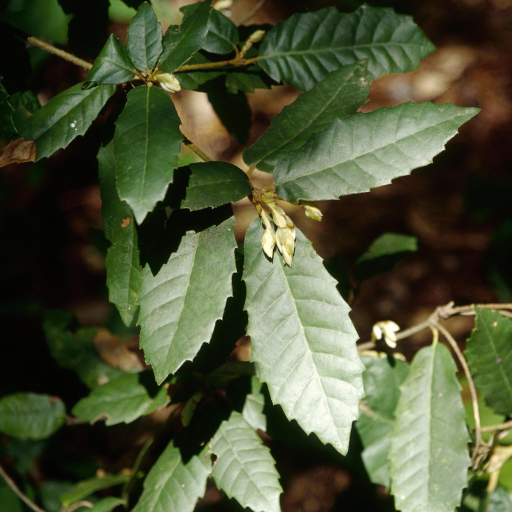
Plant Overview
Often called the Tanoak or Tanbark-oak, this tree is a botanical rebel that refuses to fit neatly into a category. While it produces acorns like an oak, its flowers resemble those of a chestnut, placing it in a unique genus all its own. Native to the mist-shrouded coastal forests of California and Oregon, it acts as a majestic, evergreen pillar of the West Coast’s rugged landscape.
🔍 How to Identify
- 🍃 Leathery Leaves: The foliage is thick and evergreen, featuring distinct, parallel veins and edges that often roll slightly downward. The undersides are covered in a fine, lead-colored fuzz.
- 🌰 Fringed Acorns: The most iconic feature is the acorn cup, which is covered in long, spreading, needle-like scales, making the nut look like it’s wearing a tiny, bristly hat.
- 🌼 Erect Catkins: Unlike true oaks that have drooping flowers, the Tanoak produces stiff, upright spikes of creamy-white flowers that emit a heavy, musky fragrance in late spring.
🏡 In Your Garden
- 🌲 Fog and Humidity: These trees are "fog drinkers." They thrive in the cool, moist air of the Pacific coast and struggle in dry, inland heat. If planting one, ensure it has protection from the scorching afternoon sun.
- 🍄 The SOD Challenge: Tanoaks are unfortunately the most susceptible species to Sudden Oak Death (Phytophthora ramorum). They require excellent drainage and should not be over-watered during the summer to prevent root rot and fungal infections.
- ⛰️ Acidic Soul: They prefer deep, acidic soils rich in organic matter. They have a deep taproot, which makes them very difficult to transplant once established—pick their "forever home" carefully!
⚠️ Safety & Toxicity
- 🐾 Pet & Child Safe: The Tanoak is generally considered non-toxic to humans, dogs, and cats. It does not have the stinging hairs or irritants found in some other forest species.
- 👅 Tannin Warning: While the acorns are technically edible and were a historical staple for Indigenous tribes, they are packed with bitter tannins. They require extensive leaching (soaking) to be palatable; eating them raw will cause a very dry mouth and potential stomach upset.
✨ Fun Fact
The Tanoak is an "evolutionary missing link." It is the only species in its entire genus, Notholithocarpus, serving as the biological bridge between the true Oaks of North America and the Stone Oaks found across Asia.

Detailed Care Instructions
To grow Notholithocarpus densiflorus, commonly known as tanoak, you can follow these steps:
- Obtain seeds or seedlings: You can buy tanoak seeds from nurseries or collect them yourself from mature trees. Alternatively, you can purchase seedlings from a nursery to ensure higher chances of successful growth.
- Choose a suitable location: Tanoak prefers growing in full sun or partial shade. Select a location with well-draining soil that is slightly acidic to neutral pH. Ensure the area has enough space for the tree to grow to its full size, as tanoak can reach up to 100 feet in height.
- Prepare the soil: Tanoak thrives in well-drained soil, so amend heavy clay or compacted soil by adding organic matter like compost or peat moss to improve drainage.
- Plant the seedlings or seeds:
- Seedlings: Dig a hole that is twice as wide and deep as the root ball of the seedling. Place the seedling in the hole, ensuring that the top of the root ball is level with the ground surface. Backfill the hole with soil, gently firming it around the roots. Water thoroughly.
- Seeds: Start the seeds indoors in pots or trays, providing them with a well-draining seed-starting mix. Plant each seed about 0.5-1 inch deep and keep the soil moist. Transplant the seedlings outdoors after they have grown to a sufficient size, usually 6-12 inches tall.
- Seedlings: Dig a hole that is twice as wide and deep as the root ball of the seedling. Place the seedling in the hole, ensuring that the top of the root ball is level with the ground surface. Backfill the hole with soil, gently firming it around the roots. Water thoroughly.
- Water and mulch: Tanoak requires regular watering, especially during dry periods. Water deeply, making sure the soil is evenly moist but not waterlogged. Apply a layer of organic mulch, such as wood chips or bark, around the base of the tree to retain moisture and suppress weed growth.
- Pruning and maintenance: As the tree grows, prune any damaged, dead, or crossing branches to improve its structure and health. Regularly monitor for pests and diseases and take necessary measures promptly.
- Be patient: Notholithocarpus densiflorus is a slow-growing tree, so it may take several years to reach maturity. Be patient and provide it with the appropriate care and maintenance.
Remember to check with your local gardening authorities or experts for specific guidelines or considerations relevant to your region.

Place in a bright room that is sun drenched almost all day. Or directly in a south-facing window.

To water this plant, check the moisture level of the soil by inserting your finger into the soil about an inch deep. If it feels dry, it's time to water. Water the plant thoroughly, making sure the water reaches the roots. Allow the excess water to drain out of the container. Avoid letting the plant sit in standing water. When watering, aim to keep the soil consistently moist but not waterlogged, as this can lead to root rot. Adjust your watering frequency depending on the season and environmental conditions.
To fertilize the Notholithocarpus Densiflorus plant, choose a balanced fertilizer with equal amounts of nitrogen, phosphorus, and potassium. Apply the fertilizer in late winter or early spring before new growth begins. Spread the fertilizer evenly around the base of the plant, avoiding the trunk. Water thoroughly after fertilizing. Repeat the process every year to maintain healthy growth and foliage.
Notholithocarpus densiflorus thrives in well-drained soils that are moderately acidic. It requires a soil that is rich in organic matter with good drainage. A loamy or sandy loam soil is ideal, but it can also grow in rocky, gravelly, or clay soils as long as they are well-drained. The soil should be kept moist but not waterlogged as excessive water can cause root rot. Additionally, the plant prefers soils that are slightly acidic with a pH ranging from 5.5 to 6.5. Soil fertility is generally not an issue with this plant as it is adapted to grow in nutrient-poor soils. However, it can benefit from occasional applications of a balanced fertilizer to promote healthy growth.
Notholithocarpus Densiflorus plants can be propagated through seed germination or vegetative propagation.
To propagate through seed germination, collect and clean the seeds from mature cones. Soak the seeds in water for 24 hours before planting them in a well-draining soil mixture, keeping the soil moist and warm. The seeds may take up to 2 months to germinate.
To propagate through vegetative propagation, take softwood cuttings in the spring or early summer. Cut a 3-4 inch stem, remove the lower leaves, and dip the cut end in rooting hormone. Plant the cutting in a well-draining soil mixture and keep it moist and warm. The cutting should root and produce new growth within 2-3 months.
Propagation through layering is also possible. In the spring, take a stem and strip a section of the bark. Dust the exposed area with rooting hormone, bend the stem down to the soil, and cover the exposed area with soil. The stem should root within a few months, and can then be cut from the original plant and transplanted.








