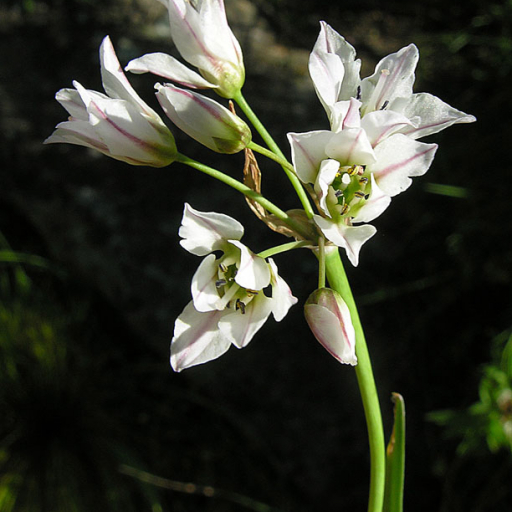
Plant Overview
Often called Slender False Garlic or the "Fragrant False Garlic," this South American native is a master of deception. While it looks and even grows like a wild onion, it lacks the signature pungent scent when its leaves are crushed. In many parts of the world, it is treated as a persistent "garden escapee" or a stubborn weed because of its incredible ability to multiply and colonize flower beds with its delicate, honey-scented blooms.
🔍 How to Identify
- 🌸 The Flowers: Small, bell-shaped white flowers with six petals, often featuring a subtle green or brownish-red stripe running down the center of each petal.
- 🍃 The Foliage: Long, narrow, strap-like leaves that are soft and grayish-green. Unlike true garlic, these leaves do not smell like onions when bruised.
- 🧅 The Root System: A primary white bulb that is surrounded by dozens of tiny, rice-sized "bulbils." These small offsets break off easily, allowing the plant to spread rapidly even if the main bulb is removed.
🏡 In Your Garden
- 🌱 The Great Survivor: This plant is famous for its resilience. It thrives in neglected corners, cracks in pavement, and well-manicured lawns alike. It isn't picky about soil, though it prefers sunny spots where its flowers can open fully during the day.
- 🚫 Management Nuance: If you find it in your garden and wish to remove it, do not simply pull it by the leaves. The "bulbils" around the base will detach and remain in the soil, resulting in ten new plants for every one you pull. It requires deep digging to ensure the entire cluster is removed.
⚠️ Safety & Toxicity
- 🐾 Status: Low toxicity to humans, but potentially harmful to pets.
- 🐶 Details: While not as toxic as true onions or garlic (Allium species), it can still cause gastrointestinal upset, lethargy, or anemia in cats and dogs if consumed in large quantities. It is best kept away from curious chewers.
✨ Fun Fact
The "False" in its name isn't just a coincidence! While true garlic and onions use strong sulfur compounds to ward off grazers, Nothoscordum gracile relies on its sweet, lily-like fragrance to attract pollinators, proving that it is a lover, not a fighter in the plant world.

Detailed Care Instructions
| Humidity | Normal |
| Lighting | Full Sun |
| Difficulty | Easy |
| Hibernation | Cold Period |
| Hardiness Zones | 6 - 9 |
To grow Nothoscordum gracile, also known as slender bladderpod, follow these steps:
- Planting time: You can start planting Nothoscordum gracile seeds in the spring or fall. Choose a well-draining pot or an outdoor location that receives full sun or partial shade.
- Soil preparation: Prepare the soil by loosening it with a garden fork or tiller. Remove any weeds or debris. The soil should be moderately fertile and well-draining. Nothoscordum gracile can tolerate a wide range of soil types, but it thrives in sandy or loamy soil.
- Sowing seeds: Scatter the Nothoscordum gracile seeds directly on the soil surface or sow them in pots, pressing them gently into the soil. Cover the seeds with a thin layer of soil or vermiculite.
- Watering: Keep the soil consistently moist, but avoid overwatering. Water the plants whenever the top inch of soil feels dry. Nothoscordum gracile prefers slightly dry conditions rather than constantly moist soil.
- Germination: Nothoscordum gracile seeds typically germinate within 1-4 weeks. Once the seedlings emerge, thin them to allow proper spacing between plants, as they can spread rapidly.
- Maintenance: Nothoscordum gracile requires minimal maintenance. Remove any weeds that compete for nutrients and water. The plants are generally pest and disease-free, but keep an eye out for any signs of infestation or diseases, and treat accordingly.
- Propagation: Nothoscordum gracile can also be propagated through division. Dig up mature plants in early spring or fall, divide the bulbs, and replant them at the desired location.
- Flowering and care: The flowers of Nothoscordum gracile typically appear in late spring or early summer. After flowering, allow the plants to go to seed if you wish to collect seeds for future propagation. Deadhead spent flowers to divert energy into bulb formation.
- Winter care: In areas with cold winters, Nothoscordum gracile may go dormant. Mulch the plants in late fall to protect the bulbs from freezing temperatures. In warmer climates, the plant remains evergreen.
- Harvesting: Nothoscordum gracile can be grown for its bulbs, which have a mild onion-like flavor. Harvest the bulbs when they have reached the desired size, typically in late summer or early fall. Allow the bulbs to cure and store them in a cool, dry place.
By following these steps, you can successfully grow Nothoscordum gracile and enjoy their delicate flowers and edible bulbs.

Place in a bright room that is sun drenched almost all day. Or directly in a south-facing window.

To water this plant, it is important to understand its natural habitat and needs. This particular plant prefers a relatively dry environment, so it is important not to overwater it. When watering, it is best to allow the soil to dry out completely between waterings. The soil should be moist but not saturated, and it is best to avoid getting water on the leaves of the plant to prevent potential fungal growth. Some gardeners prefer to water this plant from the bottom by placing the pot in a saucer of water, allowing the soil to absorb moisture from the bottom up. Overall, it is important to monitor the soil moisture regularly and adjust watering habits accordingly to ensure the health of the plant.
To fertilize this plant, begin by preparing a well-draining soil mixture that is rich in organic matter. Mix in a slow-release fertilizer that is high in nitrogen, phosphorus, and potassium.
During the growing season, apply a water-soluble fertilizer every two weeks, following the manufacturer's instructions for dilution and application. Be careful not to over-fertilize, as this can lead to nutrient burn and damage the roots.
In the winter months, reduce fertilization to once every four to six weeks. Always water the plant thoroughly after fertilization to help distribute the nutrients evenly throughout the soil.
The optimal soil for the Nothoscordum Gracile plant should be well-draining and rich in nutrients. It should have a pH between 6.0 and 7.5. A mixture of sand and loam is suitable for this plant. The soil should not be too heavy or compacted, as this may cause waterlogging and root rot. A layer of organic matter such as compost or leaf mold can be mixed into the soil to improve its structure and fertility. When planting, make sure that the soil is moist but not waterlogged. Adding a layer of mulch can help to retain moisture and regulate soil temperature. The Nothoscordum Gracile plant should be watered regularly but not overwatered, as this may cause root rot.
To propagate this plant, first, select a healthy and mature specimen with well-developed roots. Then, using a sterile cutting tool, take a cutting of approximately 4-6 inches in length from the stem, making sure to include a few nodes. Remove any leaves from the bottom two-thirds of the cutting.
Next, dip the cut end of the stem into a rooting hormone powder or gel. This will help to encourage the growth of new roots. Plant the cutting into a pot filled with a well-draining soil mix, and water thoroughly.
Place the pot in a bright spot that receives indirect sunlight and keep the soil moist but not waterlogged. In a few weeks, new growth should start to emerge from the stem, indicating successful propagation.
Once the new plant has established roots and is growing vigorously, it can be transplanted into a larger pot or container or planted directly into the ground.








