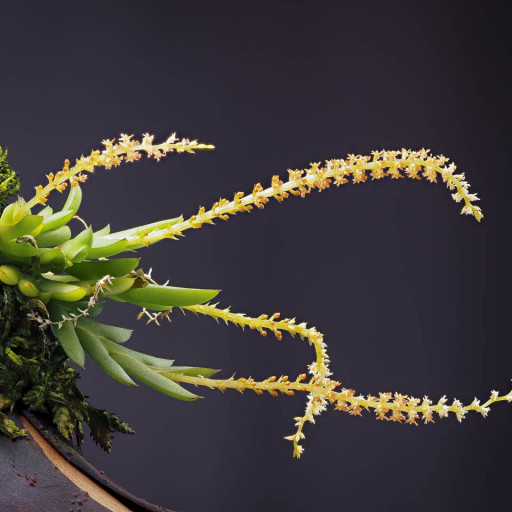
Plant Overview
Known as the "Yōraku-ran" in Japan, this botanical jewel is a favorite among micro-orchid enthusiasts. Its name refers to the yōraku, the ornate hanging jewelry found on Buddhist statues, which perfectly describes the way its tiny, beaded flower spikes drape from tree branches. This is a plant for those who appreciate the "hidden" beauty of nature, as its intricate details are often best viewed through a magnifying glass.
🔍 How to Identify
- 🌿 The Foliage Fan: The plant grows in a distinct fan shape. The leaves are succulent, sword-shaped, and overlap at the base, resembling a tiny, green iris or a miniature folding fan.
- 🌸 Microscopic Blooms: It produces a long, cylindrical flower spike densely packed with hundreds of orange-red or brownish-yellow flowers. Each individual flower is barely 1–2 millimeters wide.
- 📏 Size Matters: This is a true miniature; the entire plant usually stays under 3 or 4 inches in height, making it a perfect candidate for terrariums or "orchid trees."
🏡 In Your Garden
- 🌳 Epiphytic Lifestyle: In the wild, Oberonia japonica clings to mossy tree trunks or rocks. In a home setting, it performs best when "mounted" on a piece of cork bark or tree fern fiber rather than sitting in a traditional pot of soil.
- 💧 The Humidity Balance: Because it has no pseudobulbs to store water, it is sensitive to drying out. It thrives in high humidity with gentle air movement—think of the damp, cool forests of Japan. It prefers "bright shade" rather than direct, scorching sunlight.
⚠️ Safety & Toxicity
- ✅ Safe for All: Like the vast majority of the orchid family, Oberonia japonica is considered non-toxic to humans, cats, and dogs.
- 🧤 Handle with Care: The primary safety concern is for the plant itself! Because it is so small and delicate, it can be easily crushed or damaged by curious pets or heavy-handed watering.
✨ Fun Fact
The genus name Oberonia is a tribute to Oberon, the King of the Fairies in Shakespeare’s A Midsummer Night's Dream. It was named this because the plants are so small and whimsical that they look like they belong in a fairy's garden!

Detailed Care Instructions
To grow Oberonia japonica, follow these steps:
- Light: Provide the plant with bright, indirect light. Avoid direct sunlight, as it can scorch the leaves.
- Temperature: Maintain a consistent temperature between 60°F to 80°F (15°C to 27°C). This orchid prefers slightly cooler temperatures than some other tropical orchids.
- Humidity: Maintain high humidity levels of around 60% to 80%. You can achieve this by placing the plant on a humidity tray filled with water or using a humidifier.
- Watering: Water the plant regularly, allowing the potting medium to dry slightly between each watering. Avoid overwatering, as it can lead to root rot. It is best to use rainwater or distilled water to prevent the buildup of salts in the potting medium.
- Potting medium: Use a well-draining potting medium specifically formulated for orchids, such as a mix of bark, sphagnum moss, and perlite. Repot the plant when it outgrows its current pot, usually every 1 to 2 years.
- Fertilizer: Feed the orchid with a balanced, water-soluble orchid fertilizer once a month during the growing season (spring and summer). Follow the instructions on the fertilizer package for proper dilution and application.
- Air circulation: Provide good air circulation around the plant to prevent the buildup of stagnant air and to promote healthy growth.
- Propagation: Oberonia japonica can be propagated through division. When repotting, carefully separate healthy pseudobulbs from the main plant and plant them individually in their own pots.
- Pests and diseases: Monitor the plant for common orchid pests like aphids, mealybugs, and spider mites. Treat any infestations promptly with appropriate insecticides or by using natural pest control methods.
With proper care and attention to these guidelines, you can successfully grow Oberonia japonica and enjoy its beautiful flowers.

Place in a window with dappled sun or a spot in the middle of a room. Or directly in a window facing west or east.

1. Understand the plant's watering needs: It is important to understand the watering needs of Oberonia Japonica plant before watering it. This plant requires moderate watering and needs to be watered whenever the topsoil is dry.
2. Check the moisture level of the soil: Before watering the plant, check the moisture level of the soil by inserting your finger into the soil up to an inch deep. If the topsoil feels dry, then it's time to water the plant.
3. Use room temperature water: It is important to use room temperature water when watering Oberonia Japonica plant as cold water can shock the roots and cause damage to the plant.
4. Water the plant evenly: When watering, make sure to distribute the water evenly around the plant's soil. Avoid watering the plant too frequently as it can cause waterlogging in the soil, leading to root rot.
5. Avoid wetting the leaves: Try to avoid wetting the leaves of the plant during watering, aswater sitting on the leaves can lead to fungal or bacterial infections.
6. Allow excess water to drain: Make sure to allow excess water to drain out of the pot's bottom, as excess water sitting in the pot can lead to root rot. Empty the saucer under the pot after watering to avoid standing water.
7. Adjust watering in different seasons: During summers, the plant may require more frequent watering, while in winters, it may need less watering. So, adjust the watering according to the plant's changing needs.
To fertilize this particular species of plant, use a balanced fertilizer with equal amounts of nitrogen, phosphorus, and potassium. Avoid over-fertilizing, as it may cause leaf burn or damage to the plant. Apply fertilizer during active growth periods, and increase the frequency of application during the summer months. Consider using a slow-release fertilizer to provide nutrients gradually over time. Always follow the manufacturer's instructions when fertilizing.
The recommended soil for this plant is one that is well-draining, porous, and rich in organic matter. It should be slightly acidic with a pH range of 5.5-6.5. A mix of peat moss, perlite or vermiculite, and orchid bark is suitable. The soil should be kept moist but not soggy as the plant is susceptible to root rot. A balanced orchid fertilizer can be added to the soil during the growing season to provide necessary nutrients.
To propagate this plant, you will need to gather a healthy specimen with several strong stems. Using a sharp and sterile pair of pruning shears, cut each stem so that it is about 4-6 inches long.
After cutting, place the stems in a cup or jar of water so that the bottom inch is submerged. Change the water every couple of days and keep the stems in a bright location out of direct sunlight.
Once roots begin to form, which can take as little as a week or as long as a few months, pot the cuttings in a well-draining soil mix. Keep the soil consistently moist but not waterlogged and provide bright indirect light.
With proper care, the cuttings will continue to grow and establish themselves as new plants.
Common pests of the japan oberonia include Scale insect, mealybugs, spider mites, thrips. Make a habit of checking your japan oberonia frequently for pests so that any infestations can be caught and managed early.







