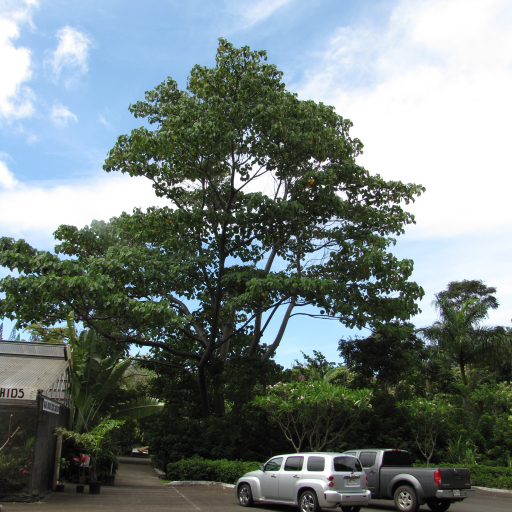
Plant Overview
Known as the "Racecar of the Rainforest," the Balsa tree is famous for its gravity-defying, lightweight wood. While most hardwoods take decades to mature, the Ochroma pyramidale lives life in the fast lane, shooting upward with incredible speed to reach the sunlight. From model airplanes to the legendary Kon-Tiki raft that crossed the Pacific, this tree’s timber has supported human adventure for centuries.
🔍 How to Identify
- 🍃 Giant Foliage: The leaves are massive, heart-shaped, and can grow up to 12–15 inches long, often resembling a larger version of a Hibiscus leaf.
- 🍦 Midnight Blooms: It produces large, upright, funnel-shaped flowers that are creamy white. These blooms open at night to attract nectar-drinking bats.
- 🧸 Woolly Pods: After flowering, it develops long, spongy seed pods. When they ripen and burst, they release a mass of silky, brownish "fluff" that looks like a rabbit's foot.
🏡 In Your Garden
- 🚀 Pioneer Growth: This is a "pioneer species," meaning it is one of the first trees to grow in cleared areas. In a garden setting, it needs immense space; it can easily grow 10 to 15 feet in its very first year!
- 💧 Thirsty Roots: Because it grows so rapidly, it has a high metabolic rate. It requires consistent moisture and high humidity, mimicking its native home in the tropical Americas. If it dries out, the soft wood can become brittle and prone to breaking.
⚠️ Safety & Toxicity
- ✅ Safe Status: The Balsa tree is generally considered non-toxic to humans, cats, and dogs.
- 🌬️ Inhalation Risk: While not poisonous, the "kapok" or silky fluff from the seed pods can be a respiratory irritant for some people or pets if it becomes airborne in large quantities.
✨ Fun Fact
Despite being the softest and lightest commercial wood in the world, Balsa is scientifically classified as a hardwood. This isn't based on the wood's density, but rather on the fact that the tree has broad leaves and produces seeds in a fruit, rather than being a cone-bearing needle tree!

Detailed Care Instructions
Here are some tips for growing Ochroma Pyramidale, also known as the balsa tree:
- Climate: Balsa trees thrive in tropical or subtropical climates with plenty of sunlight and high humidity. They prefer temperatures between 70-90°F (21-32°C).
- Soil: Balsa trees prefer well-draining soil with a slightly acidic to neutral pH level (around 6.0-7.0). The soil should be rich in organic matter.
- Watering: Balsa trees require regular watering to keep the soil moist. Avoid overwatering as it can lead to root rot. Allow the soil to dry slightly between watering sessions.
- Sunlight: Balsa trees need direct sunlight for at least 6-8 hours a day. Place the plant in a location with ample sunlight or ensure proper artificial lighting if grown indoors.
- Planting: When planting your balsa tree, dig a hole that is slightly larger and deeper than the root ball. Place the tree in the hole and backfill it with soil, ensuring the tree is firmly supported. Water thoroughly after planting.
- Fertilization: Apply a balanced fertilizer during the growing season to provide additional nutrients. Follow the instructions on the fertilizer packaging for proper dosage and frequency.
- Pruning: Balsa trees may require occasional pruning to maintain a desired shape or remove damaged or crossing branches. Prune during the dormant season when the tree is not actively growing.
- Protection: Protect the balsa tree from strong winds and extreme weather conditions, as it has a relatively delicate nature.
- Pest and disease control: Keep an eye out for common pests like aphids, caterpillars, or scales, and address any infestations promptly using appropriate insecticides. Monitor for any signs of diseases such as root rot or leaf blight and treat accordingly.
- Patience: Balsa trees can take several years to reach maturity and achieve significant growth. Be patient and consistent with care for optimal results.
Remember to check if growing balsa trees is allowed in your region, as it may be subject to restrictions or regulations.

Place in a bright room that is sun drenched almost all day. Or directly in a south-facing window.

The recommended watering process for Ochroma Pyramidale involves a careful assessment of the moisture level of the soil surrounding the plant. This can be done by observing the color and texture of the soil, as well as using a moisture meter to measure the moisture content. If the soil feels dry to the touch, it is time to water.
To water the plant, slowly pour water over the soil surrounding the plant until the soil becomes moist. Be sure not to overwater the plant, as this can lead to root rot and other issues. It is recommended to allow the soil to dry out slightly between watering, which will encourage the roots to grow more deeply and develop a stronger system.
It is important to note that the watering needs of Ochroma Pyramidale will vary depending on a number of factors, including the climate, soil type, and amount of sunlight the plant receives. Therefore, it is important to monitor the plant regularly and adjust the watering schedule as needed.
To fertilize this plant, use a balanced fertilizer with equal amounts of nitrogen, phosphorus, and potassium. Apply the fertilizer every two to three months during the growing season, which is typically from spring to fall. Make sure to follow the manufacturer's instructions for the correct amount to use. Water the plant before fertilizing and avoid fertilizing when the soil is dry. Also, avoid getting the fertilizer on the leaves as it may cause damage.
When planting Ochroma Pyramidale, it is recommended to use a well-draining soil mix that is rich in organic matter. The ideal pH level of the soil should be between 5.5 to 7.0. The soil should be loamy and sandy, to ensure that water does not stay within the soil for too long, which can lead to root rot. Adding perlite to the soil can further improve drainage. Additionally, a slow-release fertilizer can be added to the soil to provide essential nutrients to the plant over time. It is also recommended to plant Ochroma Pyramidale in an area with some shade, as it can be sensitive to direct sunlight.
To propagate this plant, start by obtaining a fresh cutting from a healthy parent plant that is at least six inches in length. Remove any leaves from the bottom inch of the cutting and dip the cut end into rooting hormone powder. Then, using a pot filled with a well-draining soil mix, plant the cutting about an inch deep into the soil. Water the cutting and place it in a bright, indirect location. Ensure the soil is kept moist, but not too wet, as the cutting begins to form roots. After about four weeks, gently tug on the cutting to see if it has taken root. Once roots have formed, transplant the new plant to a larger pot or into the ground.








