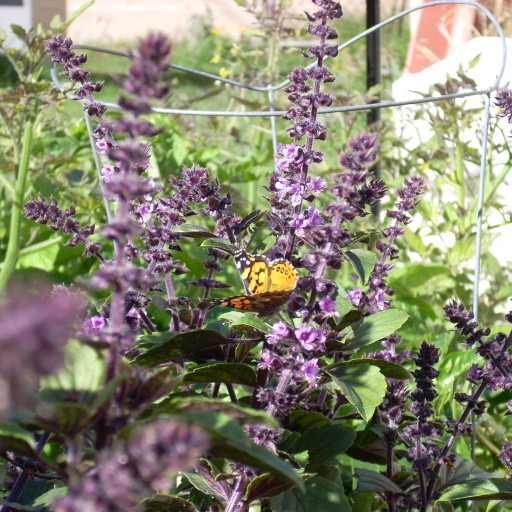
Plant Overview
Meet the "Everlasting Basil," a garden powerhouse that defies the typical life cycle of its cousins. While most basils are fleeting annuals that wither once they bloom, African Blue Basil is a sterile hybrid that never goes to seed, allowing it to grow into a stunning, woody shrub that lasts for years in warm climates. It is legendary among gardeners for being a "bee magnet," often vibrating with the activity of local pollinators from dawn until dusk.
🔍 How to Identify
- 💜 Stunning Foliage: The leaves are a rich green but feature dramatic deep purple veins and undersides, especially on newer growth.
- 🌸 Persistent Blooms: It produces long, elegant spikes of light purple flowers that bloom continuously since the plant doesn't spend energy making seeds.
- 🌿 Upright Stature: Unlike the low-growing Genovese basil, this variety grows tall and bushy, often reaching 3 to 4 feet in height.
- 👃 Spicy Aroma: If you bruise a leaf, you’ll notice a complex scent that mixes traditional basil sweetness with strong notes of camphor and cloves.
🏡 In Your Garden
- ✂️ The Propagation Secret: Because this plant is sterile, you will never find "African Blue" seeds. Every single plant in existence started as a cutting from another one! If you want more, simply snip a stem and pop it in a glass of water.
- ☀️ Sun-Loving & Thirsty: It craves full sun to maintain its deep purple coloring. While it is more heat-tolerant than other basils, it has a large leaf surface area and will wilt dramatically if it gets too thirsty.
- 🍳 Culinary Nuance: It is perfectly edible, though much stronger than standard basil. It’s best used as a garnish or in pestos where its musky, camphor-forward flavor can be balanced by garlic and nuts.
⚠️ Safety & Toxicity
- ✅ Human Safe: This plant is non-toxic and widely used in cooking and herbal teas.
- 🐾 Pet Friendly: Like most members of the mint family (Lamiaceae), it is generally considered safe for dogs and cats, though ingestion of large amounts of any plant material can cause mild stomach upset in pets.
✨ Fun Fact
Because African Blue Basil cannot produce seeds, it stays in a state of "permanent adolescence." It never gets the chemical signal to stop growing and die, which is why it stays lush and productive long after other basil varieties have turned brown and crispy!

Detailed Care Instructions
To grow Ocimum kilimandscharicum x basilicum, also known as African blue basil, you can follow these steps:
- Choose the right location: Select a spot that receives full sun or partial shade during the day. Ensure that the area has well-draining soil.
- Purchase healthy plants: Look for established African blue basil plants at a local nursery or garden center. This is the easiest and fastest way to start growing this plant. However, you can also grow it from seeds if desired.
- Planting: If planting in a garden, dig a hole that is slightly larger than the root ball of the plant. Place the plant into the hole and backfill with soil, gently firming it around the plant. If planting in a container, choose a pot with drainage holes and fill it with quality potting soil before planting the basil plant.
- Watering: African blue basil enjoys moist but not waterlogged soil. Water the plant consistently, aiming for the soil to remain consistently moist. Avoid overwatering to prevent root rot.
- Fertilizing: Apply a balanced, water-soluble fertilizer every two to three weeks during the growing season. Follow the package instructions for application rates.
- Pruning: To encourage bushier growth, pinch off the top sets of leaves when the plant is approximately 6 inches tall. This will encourage lateral branches to develop. You can also prune the plant to remove any dead or yellowing leaves.
- Harvesting: African blue basil is known for its aromatic and flavorful leaves. Harvest the leaves as needed, avoiding stripping the plant completely. Regular harvesting can encourage continued growth.
- Overwintering: African blue basil is not frost-tolerant, so in colder climates, it is recommended to bring the plant indoors during winter or treat it as an annual. Keep it in a sunny location indoors and continue to water and care for it.
By following these steps, you should be able to successfully grow Ocimum kilimandscharicum x basilicum and enjoy its beautiful foliage and fragrant leaves.

Place in a bright room that is sun drenched almost all day. Or directly in a south-facing window.

In order to provide optimal moisture levels for a specific herbaceous plant, it is important to follow several guidelines. First and foremost, ensure that the soil remains moist, but not saturated. Over-watering can lead to root rot and other fungal diseases, while under-watering can cause the plant to wilt and die.
One way to assess the moisture levels in the soil is to insert a finger about an inch deep into the soil. If it feels dry to the touch, it is time to water the plant. Additionally, it is important to use a well-draining soil mix to prevent water from accumulating at the bottom of the pot.
It is recommended to water the plant in the morning or evening when the temperatures are cooler, as this allows the water to be absorbed better and reduces the risk of evaporation. Use a watering can or hose with a gentle spray to water the plant, aiming for the soil rather than the leaves.
Finally, consider the environmental conditions when watering. In hot and dry weather, the plant may require more frequent watering, while cooler and more humid conditions may require less. With proper attention to moisture levels and environmental factors, the plant can thrive and produce an abundance of flavorful leaves for consumption.
To fertilize this plant, first make sure it is planted in well-draining soil and receives plenty of sunlight. Use a balanced fertilizer with equal amounts of nitrogen, phosphorus, and potassium. Apply the fertilizer sparingly once a month during the growing season, avoiding over-fertilization which can lead to salt build-up and damage the plant. Water the plant well before and after fertilization to help distribute the nutrients. Prune any dead or damaged leaves to promote healthy growth.
The best soil to use for this particular plant is a loose, well-draining soil with a neutral pH. It should be rich in organic matter, such as compost or aged manure, to provide the necessary nutrients for healthy growth. The soil should also be able to hold moisture without becoming waterlogged, as this can lead to root rot and other plant diseases. A mixture of peat moss, perlite, and vermiculite can create the ideal growing environment for this plant. It is also important to avoid using soil that contains excessive amounts of salt, as this can be harmful to the plant.
To propagate this plant, take a healthy stem cutting with a length of at least 4 inches. Remove the lower leaves and dip the cut end into rooting hormone powder. Place the cutting into a pot filled with moist soil and cover it with a plastic bag to maintain humidity. Keep the plant in a warm and bright location but away from direct sunlight. After two to three weeks, the cutting should have roots and can be transplanted into a larger pot or into the garden. Water the new plant regularly and provide it with proper fertilization.
Common pests of the ocimum kilimandscharicum x basilicum include Spider mites, fungus gnats, aphids, thrips. Make a habit of checking your ocimum kilimandscharicum x basilicum frequently for pests so that any infestations can be caught and managed early.







